
Numerical reality stalks the perma-bulls

While US equity returns have been undeniably jubilant over the past 12 months, the reality is that the calendar year end is not a definitive or even meaningful finish line in real-life money management. How real life people fare in net dollar terms is defined over the course of full market cycles (which includes the expansion and contraction phases) and not in just in one, two or even four year’s of numbers.

You see a little mentioned truth haunts stock perma-bulls today: they needed an extra-ordinary price recovery over the past 4 years, just to try and recoup the staggering sums their followers and clients lost in the 50% down cycles of 2000-2002 and 2007-2009. Moreover even now–with the above average cyclical rally of 170% from the 2009 bottom–the truth is that the S&P 500 has gained just 3.2% a year (before any investment fees) since this secular bear began in 2000. And that’s only if investors didn’t miss out on any of it! In truth most were inclined to buy near tops and sell in terror near bottoms and therefore have dramatically under-performed even the 3.2% a year gross returns of those few brave souls who were not scared out after capital losses.

This means that on a total return basis over the past 14 years, those who avoided stocks and invested in just bonds, bank deposit certificates and cash equivalents have earned higher returns. After adjusting for the extreme risk and volatility endured by stock holders to try and garner that meager 3.2% a year, equities have far underperformed fixed income since 2000. Not only that, but from here, even after 5 years of double digit annual increases, stock holders cannot afford another bear market or they will lose most if not all of the gains from all of their pains over the past 15 years. Believe it or not. Here are the net dollar effects on $1,000,000 invested 100% in US stocks since December 31, 1999 (generously assuming no investment costs):
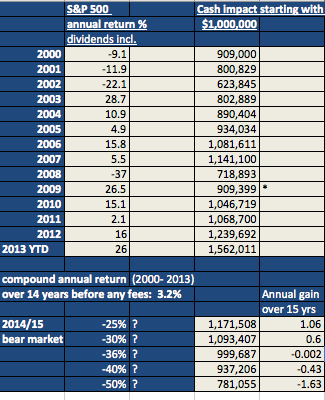
*Even following the dramatic bounce in March 2009 for a 26% recovery by the end of the 2009 calendar year–including dividends received, equity returns were negative over the 10 long years from Dec 31, 1999 to Dec 31, 2009, with 1 million being worth just $909,399.

As further shown in the bottom 5 rows of the chart above, if we now see a relatively mild bear market of just -25% from here, the net return from holding US equities over 15 years will be 1.06% gross a year including dividends, and a bear market of -36% will reveal today’s super confident bulls as having negative nominal returns (never mind after fees, or after inflation, just nominal returns will be negative) as that same 1m invested in Dec 1999, will have shrunk to **$999,687 once more.

As a comparison, the Canadian TSX fared somewhat better on the commodities boom than the S&P from 2000 to 2007, and then fared worse on the commodities bust ever since–the TSX has recovered just 79% of its 2008 losses to date–with gross annual returns now since December 31, 1999 of 3.6% a year including dividends (and before any fees). A bear market from here of -25% would reduce that to a gross gain of 1.43% a year, and a bear market of -40% would reduce that to negative returns over 15 long years.

Now we understand why equity perma-bulls cannot afford to look down or see a bear market ever again.

Posted in Main Page | Comments Off on Numerical reality stalks the perma-bulls

Blast from the past 1999: lest we forget

December 31, 1999, I recall being hunkered down for the holidays with our 2 week old son, and 16 month old daughter and happened to catch this episode of Wall Street Week with Louis Rukeyser, featuring esteemed guests Laszlo Birinyi, Liz Ann Sonders and the usual bullish suspects. The NASDAQ gained 100% in just 1999(!) and other stock markets were trading at never before seen (until today of course) extremes in valuations, and still this panel of long-always prophets were cooing about the “magical”, “positive”, “improved growth” and “higher markets” they expected in 2000. Several of them can still he found today on business television spewing the same rosie forecasts, even though those following their recommendations have been financially pummeled now repeatedly over the past 14 years.Here is a direct video link.

Rukeyser credited himself with inventing the job of economic commentary and the medium of investment broadcasting on television. And it paid off for him very well as he rode up the momentum of the longest secular bull in history from 1982 to 1999. By the early 90’s he was earning a salary of $300,000 from his show and another million a year in speaking fees, with Wall Street front men and women scrambling to appear on his show as a sure fire way to attract new victims customers.

Except unbeknownst to the masses, the show was not advice or helpful insights it was infomercial entertainment. The bent was always bullish of stocks and the higher prices soared in the final throes of the tech bubble, the more emboldened guests and viewers became in extreme bullish confidence. (Every bit like today, where bearish market commentators warning of downside risks has now slumped to less than 15% and the lowest level ever recorded, see my Relentless rally chasing bears to near extinction. Ruckeyser died in 2006 at 73, but his legacy of perma-bull television lives on today:

“An eternal bull on the stock market, the more bullish, and less tolerant of dissenting bears he became, the higher the averages climbed. On the program of Nov. 5, 1999, Mr. Rukeyser announced the firing of the veteran panelist Gail Dudak for her 156 consecutive weeks of bearishly errant forecasting. Ms. Dudak heard the news from her neighbors the next morning. The stock market peaked four months later.”

Posted in Main Page | Comments Off on Blast from the past 1999: lest we forget

Dr copper disagreeing with equity bulls

Investors pondering the economic outlook could consult economists, equities or good old Dr Copper, the metal with a PhD in economics. James Mackintosh, investment editor, considers contradictory indicators. Here is a direct link to the video report.

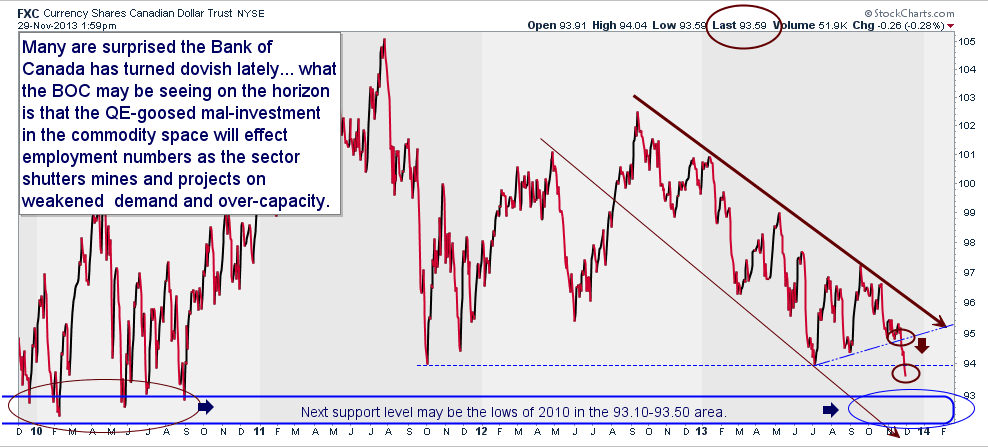
It is not just copper either, see: Worst Raw-Materials slump since ’08 seen deepening: commodities. As the commodities dollar Canadian dollar is now fathoming the lows of its pre-QE support from May 2010. All of which seems to be admitting what equity markets so far chose to ignore: that QE has not created jobs, inflation or economic growth and the contraction part of the business cycle remains on deck. Ready or not…

Posted in Main Page | Comments Off on Dr copper disagreeing with equity bulls




