
This week’s segment: “Deflation winning the arm wrestle with central bank inflation efforts”
Follow






_________________________
This week’s segment: “Deflation winning the arm wrestle with central bank inflation efforts”
U.S. state pension funding declines despite reforms. Here is a direct video link.
As we consider the funding deficits prevalent in pension plans today we should appreciate that large deficits persist even though US stocks have soared in a dream of their own over the past year as shown in the chart below, where the S&P price level is plotted as against macro economic indicators as well as high yield bond prices. (These 3 economic indicators are supposed to be highly correlated.)
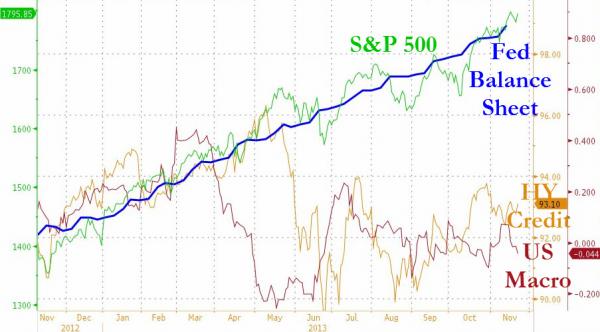
Chart source: zerohedge.com
One does not need to be clairvoyant to predict how much worse savings deficits will measure once stock valuations revert to their historic mean–some 40%+ lower than present levels. As the commentator notes in the video clip, higher fixed income rates when they come will definitely help income flows into pensions as money comes due and can be rolled over at higher yields. But at the same time, the typical pension mix (and retirement portfolio recommended by financial types) is 60% equity and 40% fixed income today. So when the 60% of the money in equities plunges in value anywhere within historic norms (-25% to -50%) a jump up in income earned on the fixed income side will not be able to offset the overall capital declines and funding deficits will once more compound in the wrong direction.
Today HSBC’s Chinese preliminary purchasing managers’ index slipped to 50.4 in November from 50.9 in October. The reading just above 50 implies a weak expansion among manufacturers, and is a sign that growth in the third quarter is fading. The much anticipated rebound in exports remains elusive: new export orders slumped to 49.4 from 51.3. Things the US economy is demanding like energy equipment are largely being made at home, with clothing now coming more from Mexico and cheaper labor parts of Asia beyond China. See: Waking up from the Chinese Dream
Despite intense marketing initiatives and central bank injections to the financial system, consumer spending in the developed world continues to be subdued. See: Target’s profit plunges on weak consumer spending. Here is a direct video link.
Cash-strapped, North American families are focusing their spending more on necessities and automobiles (responding to the 0 down, 0 interest for 8 years financing campaigns, as auto dealers scurry feverishly to bring forward even more demand from the future and capitalize on it today). Cars that are not made in China. Nor is the world grabbing up much of what is made in Canada either for that matter: today the Loonie is plunging again as the Bank of Canada reiterated that “significant slack” remains in the economy and growth is being held back by sluggish business investment and exports.
Spending less and waiting for lower prices is the right thing for consumers to do. But it’s not good for the still bloated retail sector that has yet to downsize significantly from the gargantuan proportions it achieved during the now deflating consumer credit bubble. For more on how significant consumer spending is to the economic cycle see Joseph Ellis’ excellent book “Ahead of the Curve”. Here is a direct video link to a Bloomberg report.


