
The dumb and the reckless

You really can’t go a day without hearing or reading the self-serving, dumb nonsense served up to a vulnerable public by the investment sales crew today. This is especially the case since the last 10 months of monetary experiments and record leverage in financial traders have produced anomalous price gains for the most reckless methods and actors. The cruel irony of such periods is that those exercising valuable risk management discipline, care and accountability have always seen their performance lag in periods dominated by speculative madness. Often this causes people to make early and erroneous declarations of victory and failure where neither is yet deserved. Similar perceptions have emerged at every other valuation peak in history–most recently in 2000 and 2007/08.

What is even more dangerous this time, is that because interest rates are the lowest we have seen in many decades, people are being lured out the risk curve to reach for yield at exactly the most dangerous time–facing huge personal risk to reach for pennies in front of steamrollers. Worse, most financial advisors are pushing them out there.

This article in the Globe last weekend
is a perfect example of the extremely dangerous logic being used on the gullible today by the investment community. Here an advisor explains that his “concern about longer lifespans and his bearish outlook for bonds make him comfortable with even higher levels of stock market exposure for retirees. “I’m prepared to go 60-40 [stocks-bonds] or even 70-30 for someone who is in their early 70s and can tolerate some risk.”

He is “comfortable” he says, passively plopping 60-70% of retired client savings into assets that typically lose 30-50% of their value in the cyclical bear phase of each 5 year market cycle. If they understood this is what they were paying handsome fees for, I doubt there is a sane working 50 year old who would be “comfortable” with such a strategy for their life savings, never mind a 60 or 70 year old retiree that has already stopped working!

Moreover, while the TSX remains 16% below its 2008 peak (5 long years ago) and 10% below its commodity bounce peak in 2011 [but never mind–the financial types will assure everyone that they have been making great money: “put your head in this vice here and I will show you how negative real returns over 5 years and even 13 years for the S&P add up to you making money” they say, “who are you going to trust, my glossy reports or your own arithmetic?”]

The reality is that the only sectors that have been holding up the TSX even at its current levels are the now extremely overbought and over loved interest sensitives: REITS (XRE), financials (XFN) and utilities(XDV) shown below. And every cycle these defensive names lag but then recouple with the other leading sectors like energy, materials and mining (see green box where they all bottomed in 2009 and blue box they have been moving back towards since 2011 below). Over the past 5 months, the REITS (XRE) have begun to hear the sirens song and have made some progress, moving down 20% so far. The Canadian financials now have the distinction of being some of the most over-valued assets in the world today (along with QE-juiced US stocks).

Unfortunately as always, crazy price gains have served to make the dumb and the reckless the most “comfortable” and risk-exposed they have been since 2008.
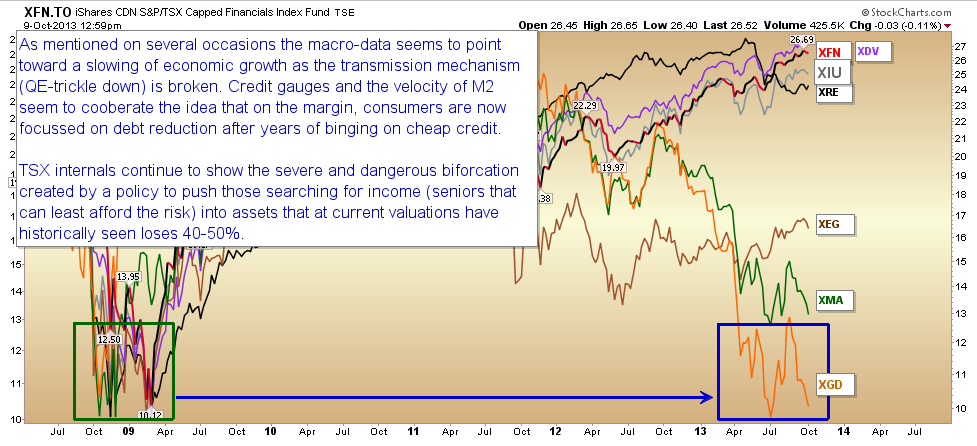
Chart source: Cory Venable, CMT, Venable Park Investment Counsel Inc.


Posted in Main Page | Comments Off on The dumb and the reckless

Danielle on the Financial Survival Network

Danielle was a guest on the Financial Survival Network today with Kerry Lutz talking about recent developments in the world economy and markets. You can listen to an audio clip of the segment here.

Posted in Main Page | Comments Off on Danielle on the Financial Survival Network

Overly optimistic prices are the investment risk–not US politics

This week has seen a sudden concern in media outlets over what might happen to regular people’s investment accounts if the US government does not come to an agreement to raise the debt ceiling and the US ends up temporarily unable to pay interest to its bondholders. A host of international authorities are issuing formal statements urging Congress to come to a consensus and raise the debt limit without further delay or else. Unfortunately in a world full of debt abusers, no country has much credibility in demanding or recommending fiscal responsibility to another. The fact is that a co-dependent world economy needs US spending in whatever form that ends up going forward. And for the foreseeable future, that spending will necessarily be diminished by the weight of record public and household debt.

This is the well-worn historical cycle from reckless spending to forced austerity as balance sheets heal and financial strength is slowly built back up in reserve to fuel future boom times. In the meantime though, less spending in the US will mean less capital flowing into other countries and even less growth for a world economy that is today already growing at less than 3% in 2013. This should be compared with more than 5% global growth at the peak of the consumer credit bubble in 2007.

But for those with savings to lose, the investment risk today is not that politicians will make bad, short-term focused choices–they have been doing that for decades hence the mess we are presently in–or that the world will end if the US delays or even defaults on some bond payments. The investment risk for savings today remains that 13 years into the secular deleveraging process since the tech bubble peak in 2000, risk assets are again priced on the expectation of future demand growth that is simply not possible to sustain.

Stocks are some 40% over-valued today thanks to over-optimistic buyers paying more and more for corporate earnings that have been inflated 70% above historic means over the past couple of years via low labour costs, share buybacks and other accounting maneuvers. All of these tricks will be increasingly difficult to maintain in the face of falling corporate revenues. The fact is that abnormally high profit margins since 2009 have been an historical anomaly only possible thanks to excessive consumer and government spending on debt that was only available on a temporary basis through the “miracle” plague of debt securitization and then excess liquidity available from “emergency” Central Bank “rescues”.

The risk to savings in risk markets today is clear and present danger to those who cannot or do not wish to endure another damaging bear market. This is not a reason to panic or stick one’s head in the sand of disbelief. But it is a perfectly rational reason to take proactive steps to lower risk exposure before the downdrafts hit.

Sadly as in 2000 and 2007 most financial advisors and desperate souls who are still clinging to the reckless roller coaster of stock markets today, have no risk management plan at all, and so are destined to lose heavily and then bail to cash near the next cycle bottom ahead just as they did in 2002-03 and 2008-09. I was explaining all of this on CKNW Morning News with Phil Till this morning. You can listen to the segment in the audio archive here on the CKNW web site by selecting Oct 8, 7am and advancing to 10:00. Needless to say my comments were pretty much the antithesis of what the long always, risk seller guests had to say.

Posted in Main Page | Comments Off on Overly optimistic prices are the investment risk–not US politics



