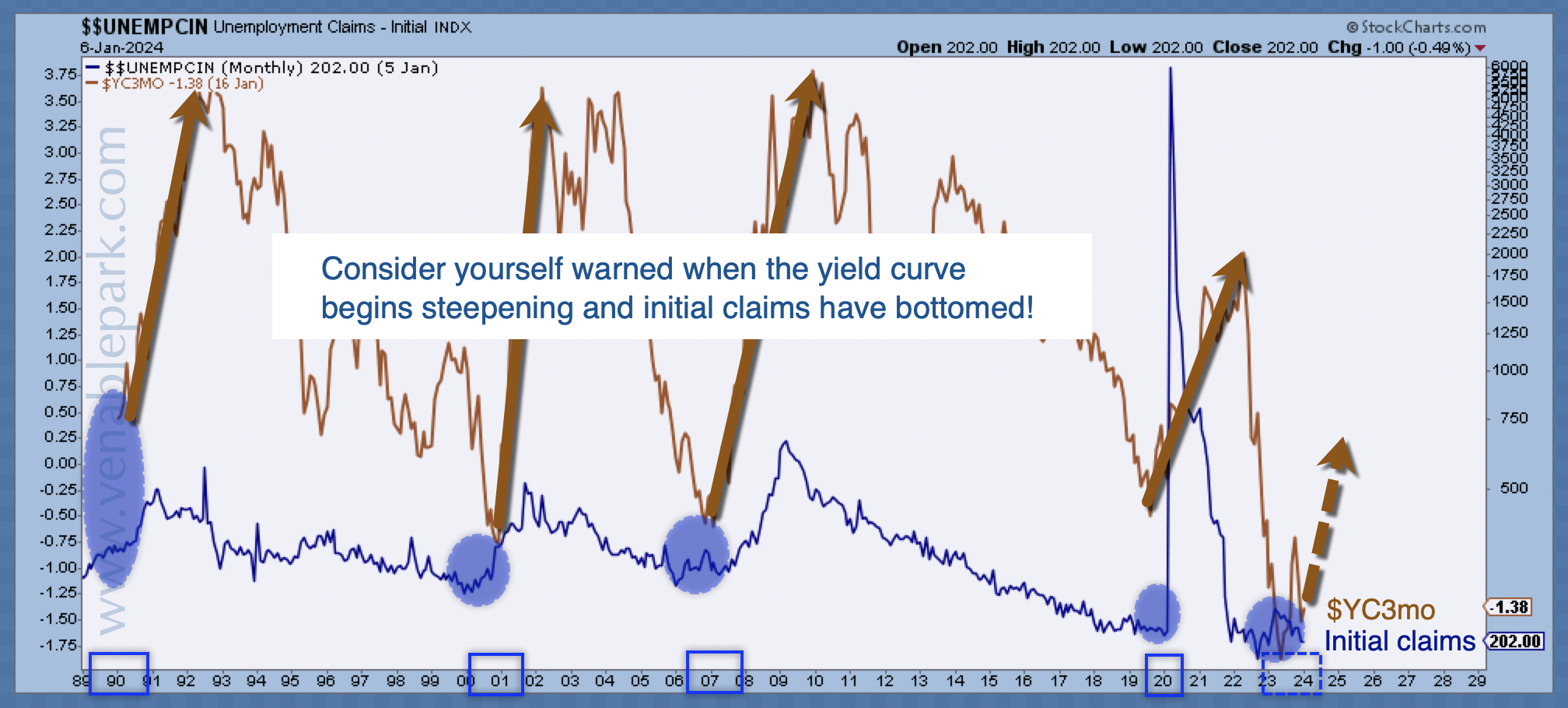
Unemployment spikes as recessions begin, but before that, early warning signs are fewer job openings and a shorter work week. The latest December jobs report showed spreading cyclical weakness.
Year over year, Indeed job postings fell 15% in 2023. See Finding a New Job is Getting Harder. Under the hood, postings for lower-paying positions increased while higher-paying openings in leading sectors like finance and software development decreased. Economist Liz Ann Sonders offers a good overview in her latest update.
Liz Ann Sonders shares her perspective on the U.S. stock market and economy in this monthly Market Snapshot video.
Posted inMain Page|Comments Off on Employment cycling down
January US Empire Manufacturing reading this morning was -43.7, much worse than the -5 estimated and much weaker than during the 2008 financial crisis/great recession.
January Empire Manufacturing Index plunged to -43.7 vs. -5 est. & -14.5 prior; interestingly, index was never this negative/weak during GFC … new orders sank to -49.4, shipments fell to -31.3, employment eased a touch to -6.9, and prices paid moved higher pic.twitter.com/uHDkVGiz5u
Meanwhile, the analyst consensus is for S&P earnings per share growth of more than 10 percent over the next 12 months (red line below since 2000, courtesy of Mikael Sarwe) even as nominal new orders are contracting (in blue). Typically, earnings follow new order trends. At the same time, US Gross Domestic Income was -.2% year over year in the third quarter compared with a 4.9% estimate for GDP. This disconnect is extreme and commonly, GDP is revised lower in retrospect to meet GDI.
Dr. Hunt illuminates many of these readings in the segment below.
The Bank of Canada’s (BOC’s) Business Outlook Survey for the fourth quarter of 2023 found that 40% of Canadian companies were experiencing a slowdown in sales. Indicators of future sales – including order books, advance bookings, and sales inquiries – remain subdued. See: Bank of Canada surveys show weak business environment, lower inflation expectations. The dour outlook for demand is feeding into weaker investment intentions and hiring plans, and most firms no longer feel the need to add staff.
Canadian consumer spending contracted 4% year over year in 2023, even with unemployment still sub-6% and the bulk of mortgages yet to renew at higher interest rates in 2024-2026. A separate BOC survey of consumers found that households are growing more pessimistic about the economy and pulling back on spending. See 2024 in charts.
Spending from 2020 to 2023 was enabled by unsustainable government support for households and businesses and record debt addition in the public and private sector.
The Bank of Canada will soon have to acknowledge that the economy has weakened far more rapidly than it expected. The third-quarter 2023 GDP growth was negative, and the first half of 2024 is looking to follow suit. Already, the unemployment rate has increased by a percentage point since June 2022, and home prices are falling again. According to the Canadian Federation of Independent Business, the proportion of businesses suffering from insufficient demand has rocketed to its highest level since early in the pandemic.
After a period of unprecedented rate hikes, this year will be a story of wage growth slowing as unemployment goes up. That’s according to David Rosenberg, Founder and President of Rosenberg Research. Here is a direct video link.
Posted inMain Page|Comments Off on Rate cuts come as demand-driven economy slows
“An explosive critique about the investment industry: provocative and well worth reading.”
Financial Post
“Juggling Dynamite, #1 pick for best new books about money and markets.”
Money Sense
“Park manages to not only explain finances well for the average person, she also manages to entertain and educate while cutting through the clutter of information she knows every investor faces.”
Toronto Sun