It has been 5 years since the debt-fueled financial crisis of 2008 first burst onto the public consciousness. Back then I recall a feeling of relief and hope that recognition was the first step to recovery. The world had been in denial about its poor finances for several years leading up to 2008, when the truth jumped out it seemed like progress. Admit, repent, reform, recover, are the steps necessary for meaningful learning.
“Admit” hit like a lightening bolt in 2008, as the world built on reckless credit finally blew up. But repenting was patchy and reforms have been painfully slow to come, as the financial machine and the status quo have been allowed to duck their due and resume old habits. It has been rather horrifying to watch.
The incoming young US President in 2008, who had promised so much change, in the end demanded none. In that one decision, Obama failed his duty in history and effectively closed what was a rare opportunity to reboot the system. The American people had handed him the financial reform mandate on a platter. Apparently he decided it was not important. He was looking for some other legacy. In doing so, he missed what the nation and the world needed most on his watch. Like the garment factory in Bangladesh that collapsed on more than a thousand occupants this year, the economy collapsed in 2008 under the weight of excessive greed and debt manufactured in the financial sector. As it lay there in the crumbled dust of aftermath, this truth was revealed in a way that is rarely so incontrovertible. But sadly, rather than admit that the foundations were fraudulent and negligently designed, the government and regulators decided to stop investigating the architects, engineers and builders involved, and settle for just some fresh coats of paint.
To the extent that we humans are forced to admit and accept individual responsibility for our mistakes, there is always great hope for improvement and evolution. Where we are saved from our pain—bailed out from our errors—we rarely learn. The financial crisis of 2008 was an epic revelation lost. 5 years later and counting, most of the world is continuing to pay for the mistake, while a handful of insiders have made off like bandits.
This weekend, the BIS (Bank for International Settlements), the only major global body that foresaw and warned on the banking crisis before 2008, issued a quarterly report warning, that the share of leveraged loans used by the weakest borrowers in the syndicated loan market has jumped to an all-time high of 45% (black line below), ten percentage points higher than the pre-crisis peak in 2007-2008 as shown in this chart.
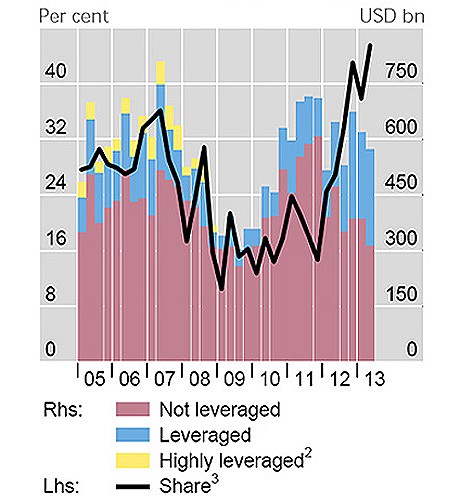
They further point out that interbank credit to emerging markets has reached the highest level on record while the value of bonds issued in off-shore centres by private companies from China, Brazil and other developing nations exceeds total issuance by firms from rich economies for the first time. This underscores the sheer size of the debt build-up in Asia, Latin Africa, and the Mid-East.
Former BIS chief economist, William White, now chair of the OECD’s Economic Development and Review Committee had this to add:
“This looks like to me like 2007 all over again, but even worse…all the previous imbalances are still there. Total public and private debt levels are 30pc higher as a share of GDP in the advanced economies than they were then, and we have added a whole new problem with bubbles in emerging markets that are ending in a boom-bust cycle.”
Mr White said the five years since Lehman have largely been wasted, leaving a global system that is even more unbalanced, and may be running out of lifelines: “The ultimate driver for the whole world is the US interest rate and as this goes up there will be fall-out for everybody. The trigger could be Fed tapering but there are a lot of things that can go wrong. I very am worried that Abenomics could go awry in Japan, and Europe remains exceedingly vulnerable to outside shocks.”
White said the world has become addicted to easy money, with rates falling ever lower with each cycle and each crisis. There is little ammunition left if the system buckles again. “I don’t know what they will do: Abenomics for the world I suppose, but this is the last refuge of the scoundrel,” he said. See: BIS veteran says global credit excess worse than pre-Lehman.
Current BIS research chief, Claudio Borio, said the ructions in emerging markets since the Fed turned hawkish in May is a warning to investors that they must tread with care, nobody knows how far global borrowing costs will rise as the Fed tightens or “how disorderly the process might be”.
“The challenge is to be prepared. This means being prudent, limiting leverage, and avoiding the temptation of believing that the market will remain liquid under stress, the illusion of liquidity.” he said.
It can be frustrating to patiently wait and prepare for the next implosion and inevitable opportunity to hit. And yet the alternative prospects– not waiting and not preparing–remain far, far worse.