No shame in seeking debt help

A generation of people has been devastated by monetary and fiscal policies aimed at ‘helping’ them to borrow financially suicidal sums for housing. Grave mistakes have been made, encouraged by many well-meaning family members, policy-makers and commissioned realtors and lenders.

In many cases, costs will be impossible to sustain even as interest rates retreat because the prices paid were too high. It has long been established that 3 to 4 times the household income is the maximum affordable home price, and in recent years, many commonly paid double and triple that ratio. A growing number are now short on cash for basics like food, fuel and daycare, even as they take on secondary employment (chart below since 2005).

The harm to family unity, health, and community can be long-lasting. See, Two jobs. No money: How mortgage rates have pushed one Toronto father to the brink.

As of the third quarter of 2023, Canadian households must dedicate 55.2% of their income to shelter costs, up from the long-term average of 35% of income. From 2020 to 2022, the shelter cost-to-income ratio increased by 12.5 points as low rates fueled a surge in speculation and home prices. Housing affordability was only briefly worse in the early 1980s when interest rates were much higher. The problem today is not that interest rates are so high, but rather, prices are well beyond mathematical reason.

Participants, politicians and the Bank of Canada like to cite a “long-standing” housing stock deficit for our problems. This week, a report from Bank of Montreal economists places blame where blame is due, and notes recessions are the payback period; see Canadian Housing Affordability 2nd Worst In History, Recession To Follow: BMO. Here’s a taste:

“Even a cursory look at either the Bank’s own measure of housing affordability or rent inflation readily shows that there was no major issue prior to 2020. The fire was lit by a combination of ultra-low interest rates and then the fastest population growth in 50 years. The Bank’s own measures of home vacancies and new building versus household formation show that the true problem only emerged very recently, and this is not a ‘long-standing’ issue.

…Looking ahead, note that the three prior spikes in unaffordability (early 1980s, early 1990s, and 2007/08) were followed in short order by Canadian recessions.”

A similar tragedy is playing out in other countries at the same time. Australia’s crisis is highlighted in the 60 Minutes segment below. Crazy sums were borrowed when interest rates were unsustainably low.

Australians with a mortgage copped another crippling cost of living hit on Tuesday when the Reserve Bank raised the official cash rate to 4.35%. It’s the 13th interest rate rise in the last 18 months and means many people will now have to become magicians and conjure up money they don’t have if they’re to avoid defaulting on their home loans. Here is a direct video link.

All of these problems were evident in the making. The question is how quickly we can admit, repent, reform, and recover. Fortunately, in North America (unlike China), there are consumer bankruptcy laws to help individuals move out from under impossible situations. Insolvency trustees note that many clients stay in denial too long and seek help much later than they should.

If you know someone struggling, they should be encouraged to seek a review of their situation with an insolvency trustee as soon as possible. Lessons learned can help us make wiser choices for a lifetime. There is no shame in seeking professional help.

Posted in Main Page | Comments Off on No shame in seeking debt help

Consumer spending and employment downturn in 2024

Consumer spending drives some 58% of Canada’s economic growth and 68% in America, so when households are blindsided by higher carrying costs and deteriorating employment, financial weakness compounds through the economy to lower revenues for companies and governments. See more on the current US job cycle in ECRI, Unveiling the Cyclical Reality of Jobs Growth:

Our research questions the complacency surrounding employment growth, suggesting an impending downturn as cyclical job losses loom. This counters the popular belief in a soft-landing, underpinned by the expectation of job market stability. To resolve the contradictions, we delve deeper into the U.S. employment outlook.

Canadian consumer debt reached $2.9 trillion in the third quarter ($2.2 trillion is mortgages), and households needed 15.4% of their disposable income to cover debt payments compared with 13.6% in 2020 and 13.2% at the US consumer debt peak prior to the 2008 financial crisis. As fixed loan terms come up for renewal at higher interest rates, payments will take an even larger portion of disposable income (see Canada’s mortgage crunch is already hitting the economy–and it’s going to get worse).

Even economists at sell-side bank-broker conglomerates are warning about a consumer-led downturn in 2024 (see a recent segment below of James Orlando, Senior TD Economist, discussing TD’s latest forecast). Here is a direct video link.

Of course, wealth management manglement arms are still recommending customers buy and hold corporate securities with the bulk of their wealth even though equities have routinely lost 40%+ during past recessions. Product-pumpers, got to pump, after all.

Central bank rate cuts will start next year, but there will be no quick fix for what ails here.

Bond yields set fixed-term loan rates, and it’s typical for the 10-year Treasury yield to roll over near the end of Fed tightening cycles (see red arrows below since 1989, courtesy of my partner Cory Venable) as government bond prices rise–that’s been happening since early October.

Job losses and credit defaults eventually bring central banks back to cutting short-term policy rates, and that’s when stock markets really tumble (S&P 500 in blue below)–more than 80% of bear market losses have historically happened while central banks are easing, not before. Eyes open!

Posted in Main Page | Comments Off on Consumer spending and employment downturn in 2024

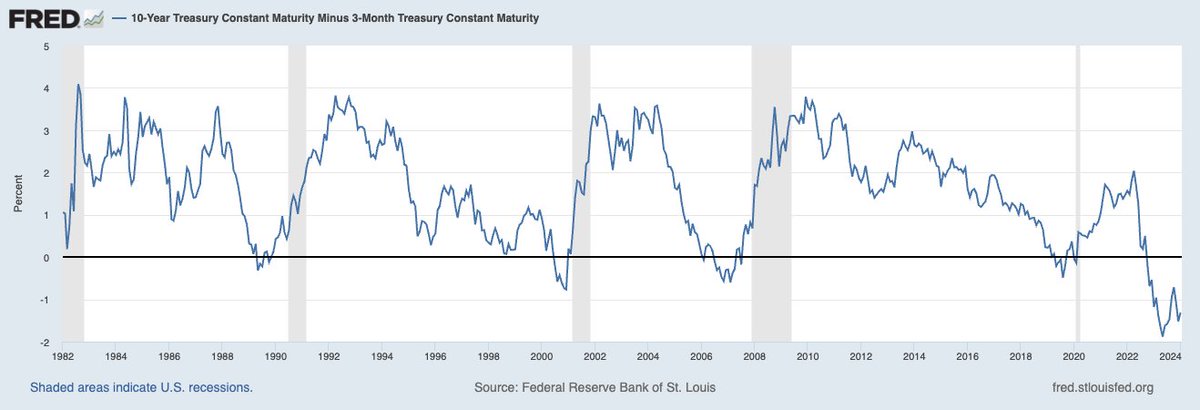
Yield curve screaming bear market in process

The US yield curve’s last 17 months of inversion has been the second longest in history (2-10 curve inversion lengths shown below since 1941 courtesy of The Daily Shot).

Ditto for Canada, where the 2s-10s curve has also been inverted since July 2022.

Only four other times in history have seen this degree of inversion, and except for the summer of 1962, every one preceded a recession. Moreover, these incidents were followed by worse-than-average equity and corporate debt bear markets as government bond prices rose.

See, Canada is in economic decay. Prepare for BoC rate cuts and big returns in this asset class. Here’s a taste:

But when the negative gap between longer-term bond yields and rates at the front end of the GoC curve was as steep as it is now, the Canadian economy entered a recession 100% of the time.

Why are the Canadian banks tightening their credit guidelines and boosting their loan loss provisioning of late? Because they are being forward-looking and see things unfolding just as I do.

Economic decay is already underway. Real GDP growth in Canada has slowed markedly on a four-quarter trailing trend basis from a hot +4% pace a year ago to a chilly +0.5% as of the third quarter, as fiscal stimulus lags fade away and the bite from the radical tightening in monetary policy lingers on. This is a stall-speed economy and is either in recession or rapidly approaching one. When you adjust for the immigration-fueled +2.7% population boom, what this means is that the economy, in real per-capita terms, has contracted -2.2% over the past four quarters. You can only camouflage the dismal economic reality via unprecedented inbound migration flows for so long.

Posted in Main Page | Comments Off on Yield curve screaming bear market in process