
Whose cash is trash?

As asset markets have soared into bubbledom again the past couple of years, the usual risk-selling crowd has been hard at mocking anyone for holding onto some cash. “Cash is trash; with interest rates low, you have no choice but to buy [over-priced] stocks and high-yield debt” is their typical sales pitch. Ironic really: the public is told they are fools to hold on to any cash, when financial firms and large corporations are today holding on to the highest cash levels ever seen.

The buildup of cash and marketable securities accelerated in Q1 2013 on a year-over-year basis to a record $1.73 trillion after slowing in early 2012. At the same time, capital spending in the most recent quarter rose by the least since March 2010. The trends suggest company executives lack the confidence to invest in the face of federal spending cuts and the economic slowdowns in the US, Europe and China.

“If you are a CEO or a CFO, you aren’t going to get fired or criticized by your board for keeping a little bit more cash,” McCormick said in a telephone interview. “They are not going to take a lot of risk in this environment.” See: Cash piles up as US CEO’s play safe with slow-growth economy

Now we see the dominant double standard in action..the investing public are dubbed fools for not funneling their cash into over-priced assets amid a global slowdown that has been spreading since 2010, but companies are wise for not doing so. So my cash is trash because I am not supposed to question valuations, or worry about my downside, but corporations hoarding cash now are deemed shrewd investors. Got it.

On a similar point also see: Why millionaires are holding on to cash
Posted in Main Page | Comments Off on Whose cash is trash?

Electric cars equal savings for cash-strapped consumers

Few people care enough about fossil fuel harm to actually buy an electric car. But once the masses see that electric cars are affordable and can bring them large monthly savings over gas, demand is certain to spread. Steep discounts and public subsidies have more and more consumers considering electric cars. Eyes on the Road columnist Joe White takes a look at how going electric could end up putting money in drivers’ pockets. Here is a direct link.

Those who rail against the idea of government incentives helping to make electric cars affordable for the masses, overlook the fact that conventional energy and auto companies have been long standing benefactors of incredible amounts of government support. It makes perfect sense to share the wealth with cars that will also help cash-strapped consumers waste less of their precious income on transportation costs. Some of the status quo energy and car companies have been foolishly lobbying hard against this transition. To their own loss of course, as many pig-headily refuse to build smart products that will actually help their consumers rebuild financial strength and self-sufficiency (never mind help the environment). But the wise ones are beginning to embrace the win-win-win of this technology who’s time has come. See: To spark buyers for electric cars, drop the price to nearly $0

Electric cars are still a long way from achieving mass appeal. Plug-in cars accounted for less than 1% of total vehicle sales in the U.S. during the first four months of this year, according to data compiled by the website hybridcars.com. But the flurry of discounts and public subsidies has more consumers refiguring the math. Plug-in sales more than doubled in the first four months of 2013 compared with a year earlier.

Bronson Beisel, 46, says he was looking last fall for an alternative to driving his gas-guzzling Ford Expedition sport utility around suburban Atlanta, when he saw a discounted lease offer for an all-electric Nissan Leaf. With $1,000 down, Mr. Beisel says he got a two-year lease for total out-of-pocket payments of $7,009, a deal that reflects a $7,500 federal tax credit.

As a resident of Georgia, Mr. Beisel is also eligible for a $5,000 subsidy from the state government. Now, he says, his out-of-pocket costs for 24 months in the Leaf are just over $2,000. Factor in the $200 a month he reckons he isn’t paying for gasoline to fill up his hulking SUV, and Mr. Beisel says “suddenly the car puts $2,000 in my pocket.”

Yes, he pays for electricity to charge the Leaf’s 24-kilowatt-hour battery—but not much. “In March, I spent $14.94 to charge the car” and a bit less than that in April, he says. He also got an electric car-charging station installed at his house for no upfront cost.

“It’s like a two-year test drive, free,” he says.

Posted in Main Page | Comments Off on Electric cars equal savings for cash-strapped consumers

Oh Canada

Certainly not the end of the world, but Canada is moving into a natural period of correction for some of the commodity-fueled over-exuberance cast its way over the past 5 years. With GDP year-to-date cooling so far to a 1.6% annualized rate, the second half of the year is looking weaker still.

This morning we learned that March retail sales were flat as Canadian consumers feel the weight of record debt levels (now 167% of disposable income) and weakening home prices (in hot spots like Vancouver prices are so far down about 12% and counting). Nationally, Canadian real estate is approximately 30% over-valued on conventional metrics. Considering that most people buy homes with mortgages and relatively modest down-payments, a price correction anywhere in the 5-30% range can effectively erode all of the owner’s net equity and then some. The average Canadian home price is $380,000 in 2013, and the average buyer has anywhere from 5 to 20% as a down-payment. Even if mortgage rates stay near current record lows for the next couple of years, stagnate and falling home prices remove the ability of consumers to refinance in order to consolidate other debts or support extra spending. Last July, the government wisely mandated a reduction in the maximum that Canadians could refinance on their home equity lines of credit from 80% to 65%. This will help to guide Canadians back to more healthy spending and borrowing habits, but in the meantime, it has placed a natural curb on consumer spending for the masses.

With commodity prices moving lower with the global economy, and the domestic economy paying penance for past over-spending, Canada is firmly in pay-back mode. The Bank Credit Analyst released a report this week entitled, Canada: on the road to recession (subscribers only).

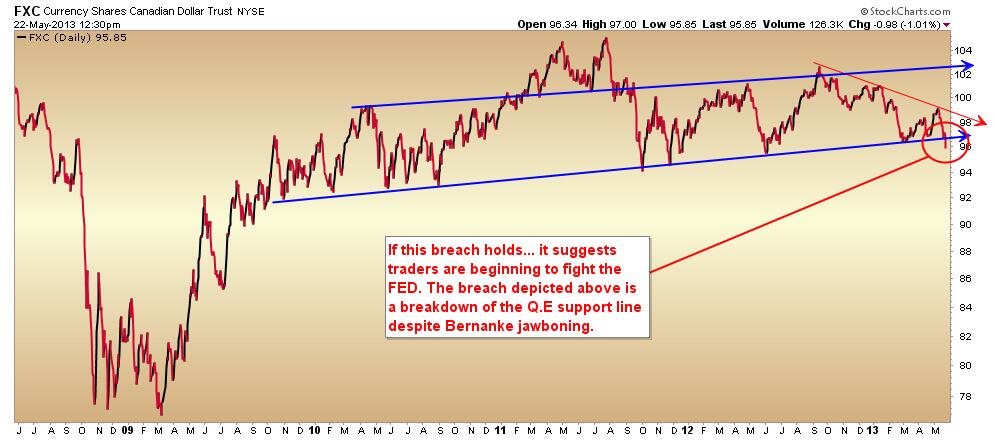
The Canadian dollar seems to agree, selling off about 1% today and now down over 8% since 2011.  In the longer run of course, a weaker dollar is exactly the kind of support Canada’s export sector needs.  In the broader picture shown below, the Loonie is today breaking company with the “QE-will-boost-demand” hopes of the past couple of years.  As they say in rehab, it is healthy to let go of false beliefs that do not serve us.  So this trend breach back to reality is actually progress.

Chart source: Cory Venable, CMT, Venable Park Investment Counsel Inc.

Posted in Main Page | Comments Off on Oh Canada





