Oh Canada

Certainly not the end of the world, but Canada is moving into a natural period of correction for some of the commodity-fueled over-exuberance cast its way over the past 5 years. With GDP year-to-date cooling so far to a 1.6% annualized rate, the second half of the year is looking weaker still.

This morning we learned that March retail sales were flat as Canadian consumers feel the weight of record debt levels (now 167% of disposable income) and weakening home prices (in hot spots like Vancouver prices are so far down about 12% and counting). Nationally, Canadian real estate is approximately 30% over-valued on conventional metrics. Considering that most people buy homes with mortgages and relatively modest down-payments, a price correction anywhere in the 5-30% range can effectively erode all of the owner’s net equity and then some. The average Canadian home price is $380,000 in 2013, and the average buyer has anywhere from 5 to 20% as a down-payment. Even if mortgage rates stay near current record lows for the next couple of years, stagnate and falling home prices remove the ability of consumers to refinance in order to consolidate other debts or support extra spending. Last July, the government wisely mandated a reduction in the maximum that Canadians could refinance on their home equity lines of credit from 80% to 65%. This will help to guide Canadians back to more healthy spending and borrowing habits, but in the meantime, it has placed a natural curb on consumer spending for the masses.

With commodity prices moving lower with the global economy, and the domestic economy paying penance for past over-spending, Canada is firmly in pay-back mode. The Bank Credit Analyst released a report this week entitled, Canada: on the road to recession (subscribers only).

The Canadian dollar seems to agree, selling off about 1% today and now down over 8% since 2011.  In the longer run of course, a weaker dollar is exactly the kind of support Canada’s export sector needs.  In the broader picture shown below, the Loonie is today breaking company with the “QE-will-boost-demand” hopes of the past couple of years.  As they say in rehab, it is healthy to let go of false beliefs that do not serve us.  So this trend breach back to reality is actually progress.
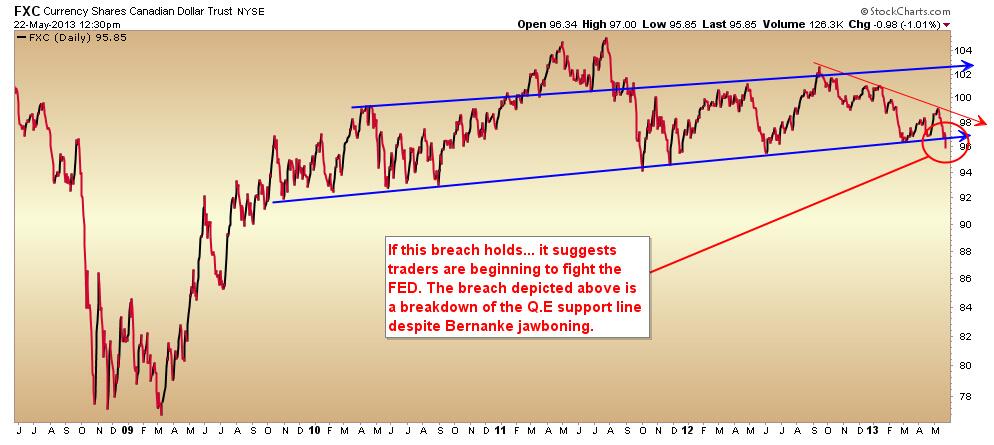
Chart source: Cory Venable, CMT, Venable Park Investment Counsel Inc.


Posted in Main Page | Comments Off on Oh Canada

Glass-Steagall reintroduced in US senate

Sometimes meaningful reform to reign in rampant self-dealing and corruption in the government and financial system can seem hopeless. And then something encouraging happens: last week on May 16, Sen. Tom Harkin (D-IO) introduced in the US Senate, S. 985 a companion Glass-Steagall bill. See: Bankster Alert

“Sen. Tom Harkin on Thursday introduced S. 985, which would rebuild the wall that had once separated commercial banking from brokerage and investment speculation. The Iowa Democrat’s bill came on the 80th anniversary of the original 1933 Glass Steagall Act.

The text of S.985 was not posted on the Senate website as of Friday afternoon, but it is believed to resemble HR 129, introduced by Reps. Marcy Kaptur, D-Ohio, and Walter Jones, R-N.C. Their measure has 62 bipartisan sponsors in the House.

Meantime, 20 state legislatures are considering resolutions urging Congress to reinstate Glass-Steagall. Lawmakers in four states — South Dakota, Maine, Indiana and Alabama – have passed such measures.

Harkin was one of eight senators to vote against financial deregulation that formally abolished Glass-Steagall in 1999.

The repeal, signed by President Bill Clinton in the waning days of his administration, cleared the way for Wall Street bankers to expand trading in bundled subprime mortgages, derivatives, collateralized debt obligations, credit default swaps and the like.

Inventing evermore exotic investment vehicles, the money movers pumped up a global financial bubble that burst in 2008.”

Posted in Main Page | Comments Off on Glass-Steagall reintroduced in US senate

TSX glimpse under the hood: sector update

With interest and rates in the basement–the zeal for yield has driven desperate capital into heinously over-bought interest sensitive equities (financials, REITs) even as the more industrial sectors (materials, miners, energy) have appropriately sold off with the slowing global economy. A similar divergence in these sectors took place to start off the 2007-09 bear market. Dividend paying equities typically lag to the downside but they have not managed to decouple indefinitely from past down cycles.


Chart source: Cory Venable, CMT, Venable Park Investment Counsel Inc.

Posted in Main Page | Comments Off on TSX glimpse under the hood: sector update