Buffett’s Berkshire: return-free-risk round trip

The business press loves to hammer viewers with bullish quips from the “Oracle of Ohama”. Usually the story is along the lines of “Buffett is bullish” or “Buffett is buying” with the assertion being that the regular public should be following suit. I have read several Buffett books over the years and have noted some valuable ideas from him along the lines of sticking to one’s investment discipline, not parting with cash until there is a strong investment case to do so and the need for managers to sometimes fire clients who try to interfere with one’s rule set. That said, as Buffett’s fund grew mammoth over the years, he became less and less able to make tactical asset allocations. Owning huge chunks of publicly traded companies, he became unable to easily sell or downsize holdings without moving price against himself leaving Berkshire essentially a typical “long-always” fund. While long-always works reasonably well in secular bull markets like 1982 to 2000, it works very poorly during secular bear markets like 2000 to present.

While Buffett likes to quote his returns in terms of the fund’s internal book value, the reality is that investors participate in his fund via ownership of shares that are valued by the publicly traded market each day. Monthly statements and our related net worth fluctuate with market value every day. If one wishes or needs to cash out, they have to sell their shares at market value. In addition, so far Berkshire has resisted paying out any dividends, opting to reinvest all cash flow back into the fund. As a result, investor returns are all based on how the share price moves over time, and in this regard, the below chart of the share price over the past 5 years shows a highly volatile, return-free round trip for Berkshire share holders. At $150,000 Berkshire A shares are just now back to the highs reached in December 2007 (more than 5 years ago) and before they fell more than 50% to $70,000 in March of 2009. They also lost with overall markets in 2011 falling 18%, before rallying again with the QE’infinity trade in 2012.
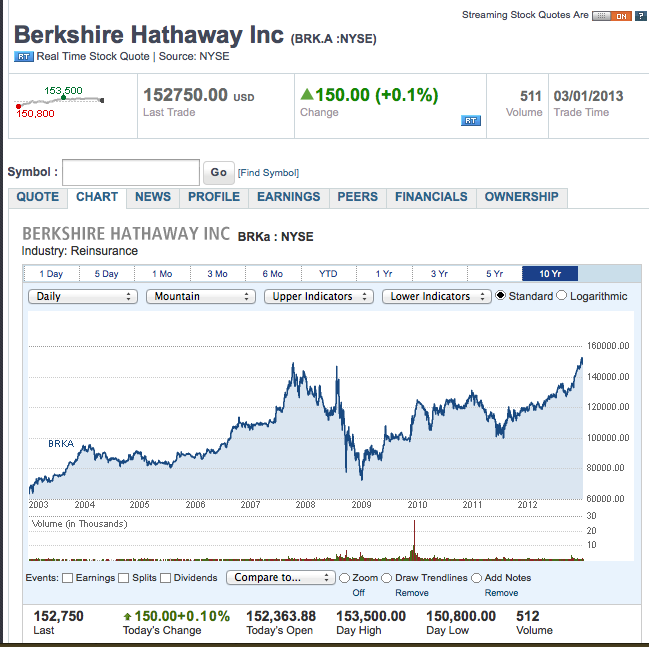
So by all means call Berkshire a stock you would like to buy in the next bear market when it is likely to drop in perfect step with the S&P once more (-50% a third time?). But for the end-user investor, no matter how hard the head-in-vice financial community tries to convince us that “everyone is making money here”, buy and hold of Buffett’s “genius” in this secular bear environment has been just as unrewarding as buy and hold of other equity products. Timing one’s entry and exit points well is crucial.


Posted in Main Page | Leave a comment

Excellent chart series on present market cycle

This series of charts courtesy of Business Insider offers some useful big picture on current market cycle risks for stocks. (Not sure why the Krugman clip is included at slide 18, but otherwise good series.)

Posted in Main Page | Leave a comment

A look inside an elite JP Morgan financial “advice” unit

In large, the world of investment sales is so conflicted, self-serving and willfully blind that it frequently doesn’t even see the problems inherent in its business model. While the marketing mantra is ‘advice that helps clients achieve their financial dreams’, the true focus is on the firm’s own operational scale, cross-selling and grabbing an ever bigger “share of wallet” from their trusting, vulnerable and too frequently–gullible customers.

This article (thanks Sam) highlighting the aggressive sales focus at JP Morgan’s Wealth “Manglement” division is pretty typical of the investment sales culture generally. See: Selling the Home Brand

“Everything is scripted for the brokers in an elite group at JPMorgan Chase: the sales pitches; the personal voice mail message; even the preferred desk candy, Glitterati Fruit & Berry.

In a three-inch-thick training manual, the bank, the nation’s largest, details how to recruit clients, pitch products and, ultimately, close the deal — or, as JPMorgan puts it, “get to Yes!”

The manual is part of an intensive, weeklong training course. But it is only the beginning for JPMorgan’s army of top advisers, who are critical to the bank’s rapid expansion into wealth management, a fast-growing and highly profitable business. Interviews with more than 20 current and former JPMorgan brokers, as well as hours of recorded conversations between a former adviser and his bosses, portray a sales-driven culture that is unusually aggressive, even by Wall Street standards.”

(listen to the audio tape clips embedded in the article for real life footage of managers directing and reprimanding their sales force.)

Despite all that has been written and revealed about this business over the years, still today a majority of hardworking, intelligent people continue to take their financial advice from the sales side. They will insist that their broker is “nice” or a “good person”. But will he or she ever tell you something that is in your best interest but hurts their own bottom line? Will they ever move your capital out of harm’s way in a bear market or when risk to capital becomes unreasonably high? What returns did their clients make in 2001-02, or 2008?? In all the glossy brochures and shiny shoes, these are the only things that really matter over time. The rest is merely seductive sales puff.

Posted in Main Page | Leave a comment