The great Canadian housing bust is here

Good article in MacLeans this week offers some useful perspective on the downturn now begun in the Canadian realty market and how this is likely to reverberate through the highly-levered domestic economy. Real estate cycles typically last 10-12 years, and Canada has been in an extended uptrend since 2001. Over this period debt-binging Canadians have bid up home prices so high that even at the lowest mortgage rates in 100 years, families are still having to spend 40 to 80% of their monthly income just to keep the roof over their head. This leaves very little margin for things like peace of mind, economic downturns, under-employment, illness or other cost of living increases.  And then there is the more than half a trillion dollars in low equity, CMHC-backed loans now also hanging over Canadian taxpayers.

“When the financial crisis hit, Ottawa responded by buying up $69-billion worth of bank-owned mortgages, encouraging financial institutions to keep lending. After a brief dip, the housing sector bounced back and carried the economy on its shoulders. But today consumers are tapped out just as a new round of macro-threats has emerged. It’s widely believed that the U.S.—and, hence, Canada—could face another recession unless Republicans and Democrats in Washington are able to agree on a comprehensive deficit-fighting plan. Even if the so-called fiscal cliff (a combination of tax increases and planned spending cuts) is avoided, the U.S. government’s longer-term debt troubles could stalk the economy for years to come. At the same time, the European debt crisis and China’s faltering growth have created a gloomy global outlook, threatening Canada’s large, export-oriented resource sector. With demand for oil falling and increased output from the Bakken shale formation in North Dakota depressing prices, some Canadian energy companies have already cut back on spending, threatening another key economic driver. Suncor, for one, recently said it would review expansion of three major oil sands projects. Talisman Energy is also forecasting spending cuts of as much as 25 per cent next year. The drag is being reflected in GDP. Reduced global demand for oil and gas and manufacturing dragged down the third quarter’s anemic 0.6 per cent growth, as did reduced business investment and a drop in exports, according to Statistics Canada.

Bay Street is getting nervous…”

Read the whole article for some important perspective on how the great Canadian debt bubble is now a headwind for the great white north.  See: Great Canadian real estate crash

Posted in Main Page | 9 Comments

Money Talks radio today at 12:00 ET

Danielle was a guest today on Money Talks with Michael Campbell on the Corus Radio Network.  You can listen to an audio clip of the show here in the audio archive by selecting 9:00am January 12 and advancing the play bar to the segment start at 8:30.

Posted in Main Page | Leave a comment

Revisiting the math of loss

Conventional investment management principles and precepts about equities as long-term growth engines have been a disaster for real life people since at least 1997. Herd think, hubris and investment salesmanship have all helped to move asset prices from undervalued, high probability holdings in the early 80’s to insanely valued, reckless bets by the late 90’s.

Most unfortunately however, for all of those banking that this “bad luck” is now behind us, it is critical to appreciate that a full 15 years later, equity prices today remain in the “most likely to implode than improve capital” category. Although most money gurus and media types seem to exist in a world of fantasy, esoteric theory and denial–for understanding, I find it most helpful to review the math of loss in real money terms for real life people. For reference lets look at a couple of big picture charts. First we’ll start with that bell weather of best businesses in the world: the S&P 500, here:

Source:  Cory Venable, CMT, Venable Park Investment Counsel Inc.

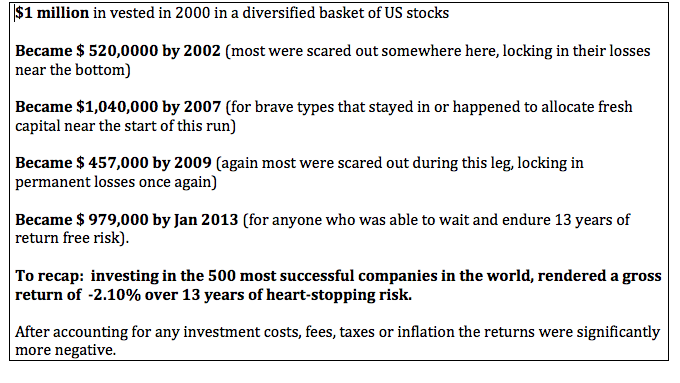
Starting from 1997 to 2000 we see stock prices take off in a parabolic fit of euphoria. All those who had shunned equities or had no investment capital when prices were cheap and then reasonable in the 80’s and early ’90’s came flooding into them in the final three years of the late great bull that ended in 2000. Since then we see that stock prices have been through a series of manic episodes on the road to literally no where. To make this clear, here is the math:

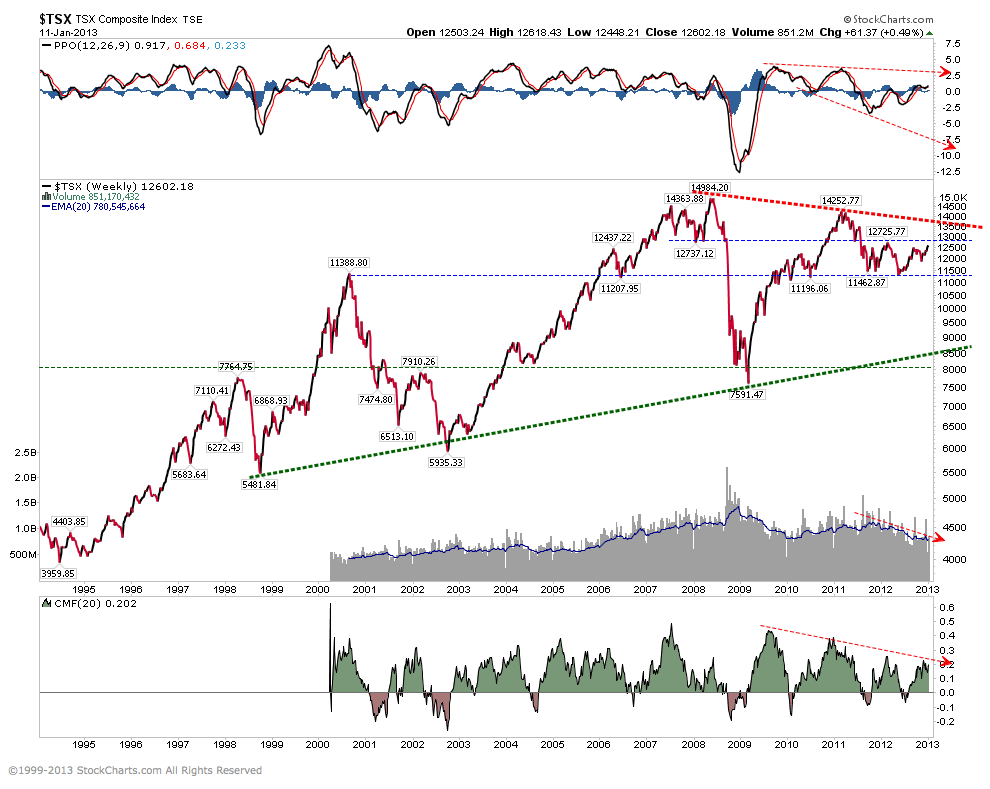
What about international diversification? Actually the lion share of international markets have fared worse than the US market over this same time frame. A “stand out” in this bunch would be the broad Canadian stock market (TSX composite index) which has slightly outperformed the S&P 500 as shown here:

Source: Cory Venable, CMT, Venable Park Investment Counsel Inc.

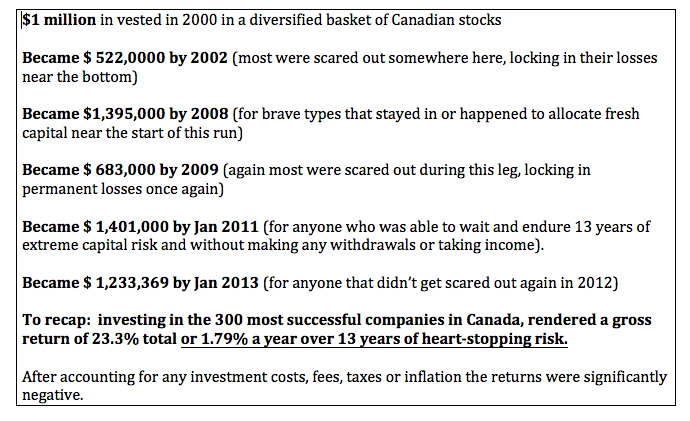
And here is the real life effect on savings sacrificed invested.

So what is the conclusion here. The facts remain that stocks today are once again dangerously over-valued thanks to central bank shenanigans, herd think, hubris and investment salesmanship. Now back near secular bear resistance, they are most likely to soon begin another major contraction. The history of secular bears tells us, this third down cycle could very likely take stock prices back toward the long term support of about 800 on the S&P 500 (-45% from present) and about 8500 on the TSX (-32% from present). Just imagine what the long term returns will look like for participants once this next leg completes.

The moral of this story is that stocks today are not a good risk/reward at present levels no matter how impatient or frustrated people may be to sit on the sidelines. Only those with the wisdom and discipline to wait and preserve their liquidity now will be able to profit from the next big fire sale when it finally presents.  And that is why most will suffer miserably once more.

Posted in Main Page | 8 Comments