Martin Feldstein, Professor, Harvard University Economics; Professor Emeritus, America’s National Bureau of Economic Research says the Fed will only help destroy the U.S. economy if it continues on its currency policy path. Here is a link to Feldstein’s Wall Street Journal article last week: The Fed’s dangerous direction. Here is a direct link to his interview on CNBC yesterday.
Many commentators of late are proclaiming that China has avoided a “hard landing” and will be rebounding to 8% growth any day soon. A more sober assessment warns realists to not jump to robust growth scenarios quite so fast.
China is the world’s second largest economy behind the US, and weakness there has huge knock off effects around the world. While its government has a history of unsustainable capital spending (60% of GDP) to keep workers busy over the past 10 years, the funding for that spending has come from export income. A tiny 37.7% of Chinese GDP is driven by domestic consumer spending, as still weak safety nets prompt Chinese citizens to save about 30% of their income.
Chinese exports soared on western demand from the time it joined the World Trade Organization in late 2001 to the credit bubble peak in 2008. But that export demand was based on a western credit bubble, that was based on a global housing bubble, that lead to a commodities bubble, all of which came to a spectacular bust in 2006-2008. Notwithstanding whacky amounts of global bank liquidity, Chinese export growth continues to be weak now that western consumers are living out a frugal chapter.
Since 2008, China has been increasing government debt and burning through excess capital reserves to try and keep their growth going. This morning inflation data out of China shows soaring food prices and weak domestic loan demand that will curtail the government’s ability to pump liquidity further. Growth of even 5 t0 6% would be considered a “hard landing” for an over-levered China. Meanwhile warehouses there are bulging with record stock piles of pretty much every commodity.
The end of the commodity bubble is negative for commodity prices, and commodity dependent countries and currencies, but eventually lower prices will help to bring down the cost of goods and services which will improve affordability for under-employed, over-indebted global consumers.
In this clip Societe Generale’s Stephen Gallagher explains the ramifications of a sharp slow down in China this year and looks at which sectors would be hit harder than others.
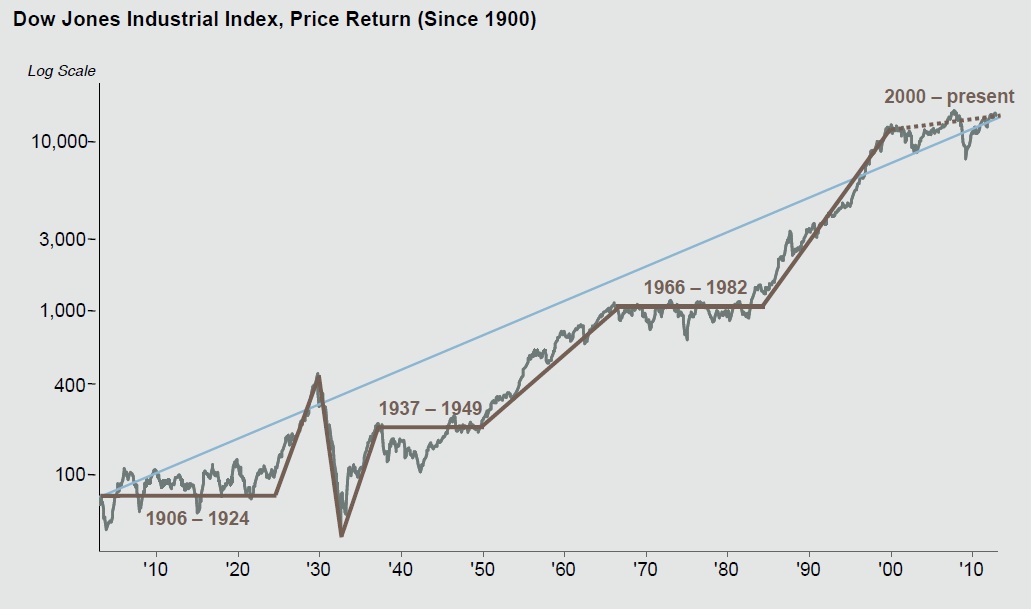
With the practically unanimous bullish sentiment today (not that most commentators are saying the economy is good, but most are betting bullish anyway with explanations that “they have no choice” or low yields are forcing them to strap on risk, their clients can’t wait etc. The following long-term chart of the Dow Jones Industrial Average serves as a good reminder of the length and breadth of secular bear periods including our own. It also shows us why present euphoria about the US markets now revisiting their 2007 peak (5 long years of a wild ride to no where), may end up being just one more cyclical swan song in 15 to 20 years of financial carnage.
Source: J.P. Morgan Guide to the Markets
Unless maybe this time is different and global markets have now completed this secular bear that began in 2000 in record time, ending at record highs in price and bullish sentiment. You know maybe the perma-bulls are right. With price multiples historically stretched (Shiller PE above 21), anemic yields that don’t even pretend to compensate for capital risk, levered players the most bullishly bet since 2007, fear (the VIX) collapsing, investors intelligence survey counting twice as many bulls as bears, ever-optimistic equity analysts now predicting S&P earnings growth of 12% in 2013 (notwithstanding that 90% of the 2012 S&P 500 earnings growth came from just 10 companies while the rest struggled!), while leading indicators like the US ISM orders and ECRI index all continue to signal a weakening economy, and this before the minimum 1.5% US GDP loss that the recent tax hikes and minimal spending cuts in March will bring.
“An explosive critique about the investment industry: provocative and well worth reading.”
Financial Post
“Juggling Dynamite, #1 pick for best new books about money and markets.”
Money Sense
“Park manages to not only explain finances well for the average person, she also manages to entertain and educate while cutting through the clutter of information she knows every investor faces.”
Toronto Sun