Markets rally on wishful thinking

The last minute mini-agreement limiting some tax increases has goosed risk markets today with a celebratory surge. The fun is likely to be fleeting. The fact is that while higher revenue was needed, even the smaller tax hikes are forecast to be a 1 to 1.5% drag on US GDP in 2013. From a barely beating maybe 2% growth in 2012, a loss of this magnitude will be felt and likely to translate into further job losses and consumption weakness this year. And that is before any further negative impact from the next phase of debt-ceiling theatre set to undermine public confidence over the next couple of months. And before any government spending cuts have been introduced at all. Surely some cuts (even if miniscule in the bigger picture) will come into play over the next few months? Or have the Republicans given up all their big talk for no walk whatsoever?

If there are no cuts then the US will continue spending at least 1 trillion more than they take in each year and will surely deserve another debt downgrade which should prompt higher borrowing costs that would in turn further extract cash flow that has been promised in support of the real economy. A perfectly negative fiscal loop seems to flow either way here.

At the end of 2012, US stocks were the third most expensive market on the planet with the S&P 500 trading above 21 times the cyclically adjusted Shiller PE. See comparative chart here. Further algo price ramps only make equities even less attractive to investors.

For those who prefer facts over false hopes, some end-of-year review charts offer some big picture reminders of where the US economy is actually beginning the new year. See NY Times: America in 2012: as told in charts

Also see: Five years later some countries still lag for more reality on the global”recovery” since 2007. Accept it or not, our generation’s secular bear deleveraging cycle is likely to continue having its way with the world for a while longer yet.

Posted in Main Page | 12 Comments

One certainty in 2013: US starting with slower growth

Dramatic late night meetings have arrived at a proposal to raise some additional US tax revenue heading into 2013. If the House approves the Senate’s bill today, Congress will have managed to kick the tough fiscal decisions into February.

The interim deal is to raise tax rates on those earning more than 450K per household. This is a higher threshold than previously proposed and so will raise less revenue over the next 10 years than had been expected. In terms of economic impact, more than 80 percent of households with incomes between $50,000 and $200,000 would also pay higher taxes as the 2 percent payroll tax cut, enacted during the economic slowdown, is being allowed to expire as of yesterday.

Increased tax receipts are a token in the right direction of more shared pain across the various income brackets. But unfortunately it is little more than a token. The proposed tax revenue continues to resemble a blade of grass at the base of a huge oak tree of Federal spending. See: Putting America’s tax hike in perspective for a helpful big picture chart.

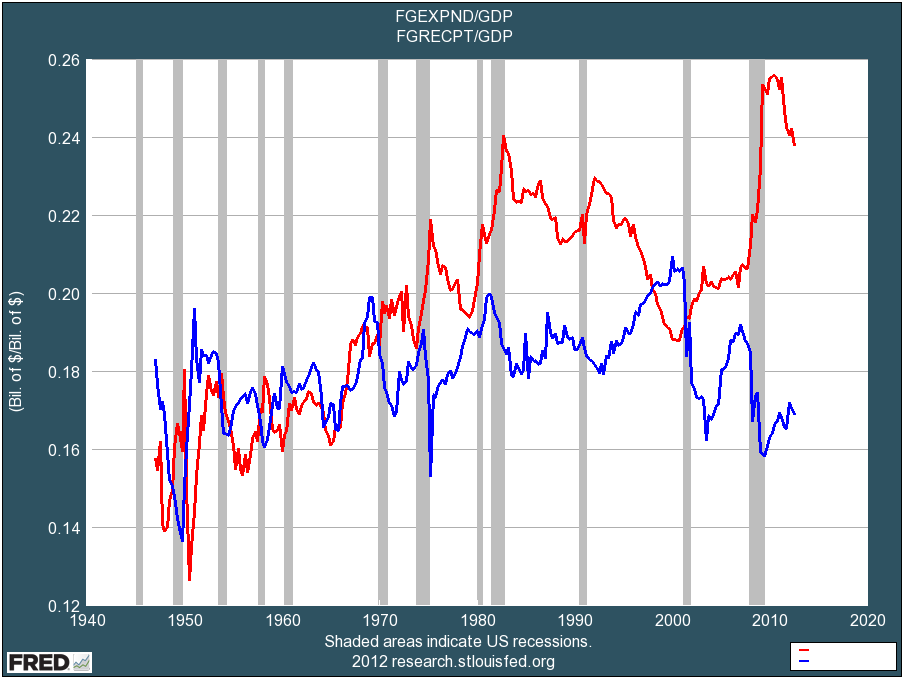
In reality the US debt problem continues to be one of too little income and excessive spending. As shown in the below chart, US spending is now running at 24% of GDP, which is high relative to the 22% average of the past few decades. Tax revenue, meanwhile, is running at only 17% of GDP, which is low relative to the 19% average of the past few decades. The gap in the middle of these two trends is how the debt has skyrocketed the past few years.

Posted in Main Page | 1 Comment

New study finds: ‘IQ a myth’

The multidimensional nature of human intelligence is fascinating. We humans can be so smart and yet so dumb all at the same time. I have always felt that “EQ” or emotional quotient has greater impact on one’s life success than book-smarts or “IQ” numbers. Now a new Canadian study out of the University of Western Ontario finds that the idea that intelligence can be measured by a single number — your IQ — is simply wrong.

The study, published in the journal Neuron on Wednesday, involved 100,000 participants around the world taking 12 cognitive tests, with a smaller sample of the group undergoing simultaneous brain-scan testing.

“When we looked at the data, the bottom line is the whole concept of IQ — or of you having a higher IQ than me — is a myth,” said Dr. Adrian Owen, the study’s senior investigator and the Canada Excellence Research Chair in Cognitive Neuroscience and Imaging at the university’s Brain and Mind Institute. “There is no such thing as a single measure of IQ or a measure of general intelligence.”

Rather, the study determined three factors — reasoning, short-term memory and verbal ability — that combined to create human intelligence or “cognitive profile…

The researchers advertised their tests through New Scientist magazine and on discovery.com. Word quickly spread around the world, far surpassing the expectations of researchers, who expected only a few thousand participants. It became the largest online study on intelligence, allowing them to gather data across demographic, age and gender lines.”

Researchers have posted their tests on line here at Cambridgebrainsciences.com and are hoping to collect data from more than 1 million subjects worldwide. Login and be part of the study.

One of the study findings apparently, “people who play video games performed “significantly better” in terms of both reasoning and short-term memory.” Oops this will not help my cause in my on-going argument with my son to “get off screens!”

Posted in Main Page | 3 Comments