Some high profile analysts and strategists have been publicly admitting their surprise this week that “defensive” income equities have been falling along with other sectors during the latest wave of this ongoing stock market correction. It is common for long-always firms to delude themselves and their clients into believing that dividend paying stocks are defensive during cyclical bears within secular bears. But market history assures us otherwise. There are a few key reasons for this:
- the low rate environment has pushed many people into dividend paying instruments at lofty prices because they are desperately reaching for yield. As this buying pressure abates, prices fall as defensive investors panic and sell.
- the income trade is also heavily populated today by algos and other levered traders who are only there for the apparent liquidity and hope of a quick buck. Once prices start to decline, they sell faster than the longer-term income investors can blink. As prices move down, this creates a cascade effect in waves of selling.
- Contrary to the complacent naive views of many holders, dividends are not permanent or etched in stone. Dividends are at the discretion of management and can only be paid out of retained earnings and net income. Companies can, should, and do reduce and suspend dividends when they enter a period of significant financial uncertainty or liquidity stress. Once dividend expectations are disappointed, then holders are left with the near certain prospect of capital losses since both long term investors and short term traders are quick to sell on the (always unexpected!) news. The higher the price when the company disappoints, the greater the downside risk to capital.
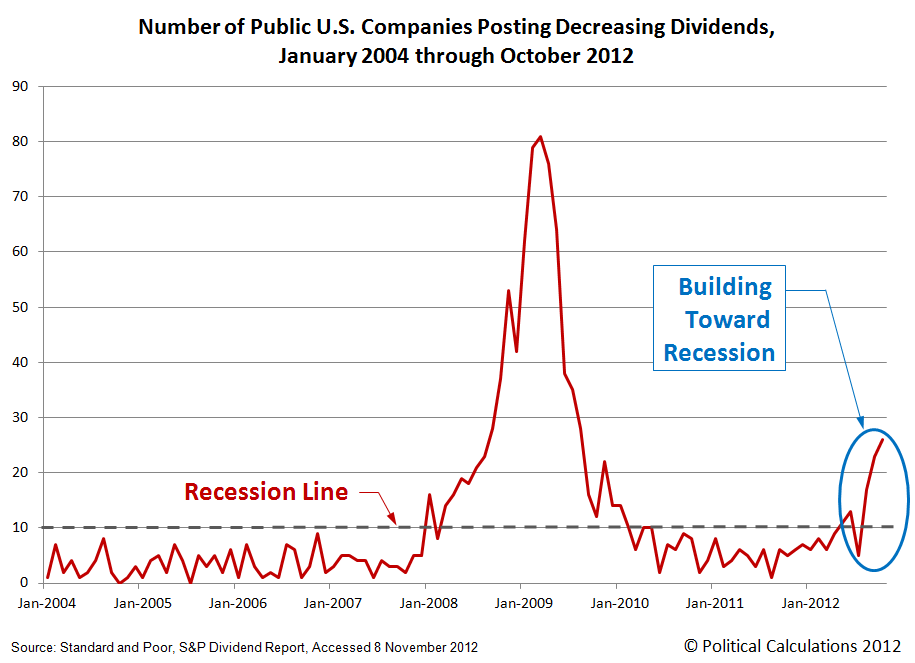
This article explains dividend disappointment trends as a leading indicator for recession, and points out that the US likely entered recession in the early summer of 2012.
“In October 2012, S&P recorded that some 2,471 publicly-traded companies making declarations regarding their dividends, with 165 announcing dividend increases and 26 announcing they would cut their dividends. To put that level of dividend cuts for the month of October 2012 into context…
If we then set the value of ten companies per month that act to cut their dividends as the threshold at which a recession in the U.S. is likely to exist, we find that the U.S. economy first dipped into recessionary territory in May 2012, exited briefly in July 2012, and re-entered more deeply into that recessionary territory again in August, going deeper in each month since.
So no matter what you might hear in the mainstream media or from the White House, this isn’t a situation that developed overnight because of the aftermath of Hurricane Sandy or the so-called “fiscal cliff”. Recessionary forces have been at work in the U.S. economy for many months now….”
See: Dividends: US deeper in recessionary territory.