Bond market tightens noose on highly indebted economy

Today, we have news that the Canadian and US economies are estimated to have created more jobs in September than forecast. Still, hourly earnings moved down, and unemployment rates in both countries have moved above cycle lows.

It is helpful to remember that unemployment is a lagging indicator, with the bulk of upward moves happening 12 to 24 months after central banks end their tightening efforts. As we enter the final quarter of 2023, central banks still threaten more rate hikes while contracting their monthly balance sheet (QT). Unfortunately, we are early in this job loss cycle.

Stock, bond, real estate and commodity markets are all in the red on the fear that more robust job creation will prevent central banks from loosening credit conditions. That may be true. But the bond market sell-off has already done a mother-load of tightening work for central banks, especially in the last month.

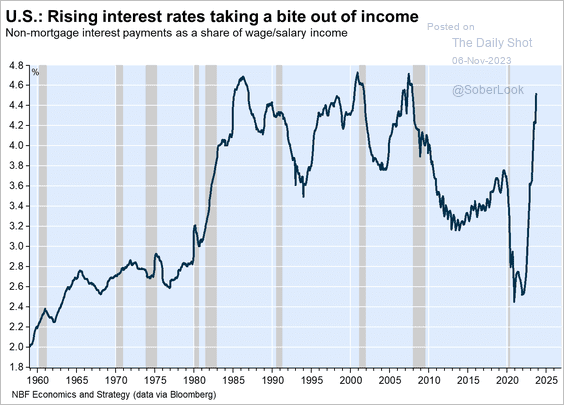
As bond prices have fallen, their higher yields have jacked financing costs for households, businesses, and governments to the highest in over 15 years. This is beginning to exert an enormous drag on the global economy and increases the odds that central banks will want to ease financial conditions in 2024 more than most imagine. See Treasury rout bolsters view that Fed will call time on rate rises. Buying power has slumped for all manner of goods, services, and assets, including share buybacks–all no longer enabled by cheap credit.


Posted in Main Page | Comments Off on Bond market tightens noose on highly indebted economy

Yield curve steepening signals more pain for stocks, real estate and economy

Bond analyst Alf Pecatiello warns that over the last 3 months, US bond markets have been in an aggressive and prolonged period of bear steepening of the yield curve. History shows if left unchecked, this steepening is likely to cause serious damage to equity markets and the economy. Here is a direct video link.

As shown below, since 1985 (courtesy of Game of Trades), a re-steepening yield curve has historically hammered stocks (S&P 500 in orange), especially when starting from above-average valuation periods, like in 2022, 2007 and 2000.

Posted in Main Page | Comments Off on Yield curve steepening signals more pain for stocks, real estate and economy

Harsh new reality for homeowners as listings rise and buyer-pool shrinks

In its 2023 Financial System Review, The Bank of Canada notes growing concern about the ability of households to service their debt, with mortgage holders facing payment increases of up to 40%. Compounding the issue is the fact house prices are falling and reducing the amount of equity owners have:

Higher interest rates have also contributed to declines in house prices across most regions of Canada over the past year (Chart 10). For households that purchased homes near the peak in prices and made smaller down payments, this decline could result in limited or negative equity in their home. Lower home equity limits a household’s ability to refinance and extend their amortization period to reduce their monthly payment.

The Bank notes that one-third of mortgages have already experienced payment increases since 2022. And, by 2026, all Canadian mortgage holders will feel the burn, with the largest shock hitting those whose previous term was taken out during the ultra-low rate (and bubble price) era of 2020-2022. The chart below shows the percent of mortgages by type and year due for renewal.

By kicking the can and letting variable-rate customers make fixed payments that do not cover the interest costs of their loans, four of the Big Six Canadian banks now have more than 23% of their mortgages with amortization greater than 30 years.

Of the Big Six, National Bank has a more conservative book, with two-thirds of its mortgages in fixed rate terms. Even then, as noted by CEO Laurent Ferreira last month, about 85% of its mortgage customers will face “a harsh new reality” when they need to renew those loans in 2024 through 2026. Not surprisingly, for-sale listings are on the rise.

Who can buy homes at present prices and rates? Very, very few. Who wants or needs to reduce their real estate holdings and related debt–more and more every day.

Home Builders will likely be cutting home prices over the winter of 2023 due to a big drop in home buyer traffic. The National Association of Home Builders reported that buyer traffic is collapsing again due to higher mortgage rates. This suggests that builders will need to begin cutting prices of houses again to avoid a big run-up in inventory. Here is a direct video link.


Posted in Main Page | Comments Off on Harsh new reality for homeowners as listings rise and buyer-pool shrinks