This week’s letter from John Hussman is worth a read. See Number Five.
“Examine the points in history that the Shiller P/E has been above 18, the S&P 500 has been within 2% of a 4-year high, 60% above a 4-year low, and more than 8% above its 52-week average, advisory bulls have exceeded 45%, with bears less than 27%, and the 10-year Treasury yield has been above its level of 20-weeks prior. While there are numerous similar ways to define an “overvalued, overbought, overbullish, rising-yields” syndrome, there are five small clusters of this one in the post-war record: November-December 1972, July-August 1987, a cluster between late-1999 and early 2000, early 2007, and today. The first four instances preceded the four most violent market declines in the post-war record, though each permitted a few percent of additional upside progress before those declines began in earnest. We do not know what will happen in the present instance, particularly over the short-run. But on the basis of this and a broad ensemble of additional evidence, we estimate that the likelihood of deep losses overwhelms the likelihood of durable gains. To ignore those four prior outcomes as “too small a sample” is like standing directly underneath a falling anvil, on the logic that falling anvils are an extremely rare occurrence….
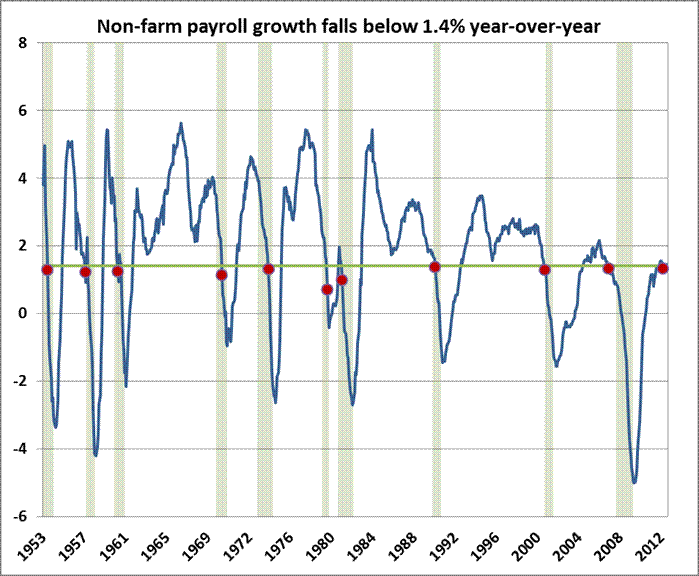
And even if we take the recent employment report at face value, the year-over-year growth in non-farm payrolls is presently just 1.37%, and we’ve never yet seen a decline in payroll growth below 1.4% year-over-year except during or just prior to U.S. recessions[see chart below]. This time may be different, but is difficult to see why that expectation is sensible given the broader context of economic evidence. “
This is how smart we humans can be when we put our minds to it. Inspiration + perspiration= innovation. V3 Solar Spin Cell Animation. Here is a direct link.
The Flashcrash of May 2010 was just a warning shot. As public markets have become the private casinos of a select few with technological weapons of mass destruction, the risk to investors and the global financial system have become overwhelming. The fact that the exchanges now make the bulk of their profits from high frequency trading, is the reason this madness continues to grow. Last week the Indian stock exchange was the latest market to “flash crash” as shown in this chart.
This is all quite simple to stop through the implementation of a financial transaction tax for minimum holding periods and a widening of the minimum bid-ask spread. Until that is done, madness and mayhem will continue to dominate. I disagree that it is just that the regulators are not vigilant enough. This is like saying that we don’t need laws that ban certain activities so long as you hire enough police and park rangers to keep an eye on things. What?
In my view this laissez faire grab-revenue-from-anywhere mentality is part of the move over the past 20 years toward legalized gambling. Most governments now collect a huge portion of their tax revenue from gambling as we all turn a blind eye to the social costs of this frequently self-destructive behavior for patrons. Condoning High Frequency Trading is actually worse than casinos, because with HFT dominated markets, it is not just those who “play” that are putting themselves at financial risk. Everyone who is trying to use public markets for investment purposes are left in harm’s way. The exchanges and prop firms are choosing to reap quick bucks with wanton disregard for the public health and security.
High Frequency Trading (HFT) deeply concerns Erik Hunsader, founder of Nanex. He worries that today’s investors, our regulators, — heck, even the HFT algorithms themselves — don’t fully understand the risks market prices face in the brave new era of bot-dominated trading.
For instance, Hunsader estimates that HFT algorithms are responsible for 70% of all completed transactions on our exchanges, and for 99.9% of all exchange quotes.
The pictures of trading floors you see on TV, where the people in bright jackets appear frantically busy in making their trades, have no bearing — claims Hunsader — on the actual trading action. The real action happens across fiber-optic cables, on racks of servers in cooled rooms; where an arms race defined by cable length and switching speeds is being waged
The reality is that the machines have taken over. When you buy or sell a security, the odds are extremely high the other side of the trade is being placed by an algorithm — one that cares nothing for the fundamentals of the underlying instrument. It simply is looking to make a quick profit, oftentimes measured in fractions of pennies. And this has vast repercussions for the stability and the fairness of our financial markets.
Because of speed advantages, HFT algos can see and react to prices faster than you can. Ridiculously faster. A second on the clock, to an HFT algo, is an eternity.
The deep pockets of the firms employing HFT algos combine with this speed to move asset prices around, sometimes wildly so, faster than most of us can comprehend. In the time it takes for your “real-time” quote system to refresh, an individual stock could have traded many percentages up and/or down — and you would have no idea.
See this clip for a good discussion of these issues. (ps. at the end of this clip he suggests individual investors can buy his trading service as a way to try and compete against the machines. I disagree with this idea of “if you can’t beat ’em join ’em” when it comes to HFT. That way lies madness.)
“An explosive critique about the investment industry: provocative and well worth reading.”
Financial Post
“Juggling Dynamite, #1 pick for best new books about money and markets.”
Money Sense
“Park manages to not only explain finances well for the average person, she also manages to entertain and educate while cutting through the clutter of information she knows every investor faces.”
Toronto Sun