Danielle was a guest with Jim Goddard on Talk Digital Network, talking about recent developments in the world economy and markets. You can listen to an audio clip of the segment here.
Also, see Department Stores are Maxed out. Bearish commentary from retailers, including Macy’s, paints a worrying picture of consumers.
It’s no surprise that there is a great deal of attention on the burgeoning crisis among insurance companies and their insured individuals and businesses because of the increase in the number and severity of major, destructive, and very costly climate events. The U.S. property and casualty industry suffered losses of $5 billion in 2021, which ballooned to losses of $26.5 billion in 2022. There have already been 15 confirmed weather/climate disaster events with losses exceeding $1 billion each in the U.S. as of August 8, 2023, with losses almost certain to exceed 2022.
The number of insurance companies going bankrupt, withdrawing from states, limiting coverage, and significantly raising premiums is increasing by the day. In addition, the reinsurance market, which is key for insuring major climate events, is facing reduced investor demand, which is going to decrease coverage while increasing costs even more. However, this isn’t just a crisis for insurance companies and their customers, as was emphasized at the meeting of The Financial Stability Oversight Council (FSOC) on Friday, July 28, 2023. The ongoing and worsening insurance crisis is the leading edge of a coming banking and financial crisis.
Posted inMain Page|Comments Off on Danielle’s bi-weekly market update
I have been following this issue for some time, and it’s not yet being widely factored into asset allocation decisions. How much of our net worth will we want in buildings that can’t be insured or where premiums go parabolic? How can we reduce and self-insure our risk in a world with hard-to-get or unaffordable insurance? Some people are starting to see the writing on this wall.
Remember the 2008 Financial Crisis? Experts warn that the same thing may be happening again, but this time, CLIMATE CHANGE is the culprit. Increasing natural hazards, from wildfires and hurricanes to rising sea levels and catastrophic flooding are threatening the very foundation of our real estate system in huge swaths of the country. State Farm, All State and Farmers Insurance all stopped writing new policies in the entire state of California. And we’re seeing similar stories unravel in other states due to different threats, like in Florida and Louisiana. Could the real estate bubble be popping? Where else might be affected?
Weathered is a show hosted by weather expert Maiya May and produced by Balance Media that helps explain the most common natural disasters, what causes them, how they’re changing, and what we can do to prepare. Here is a direct video link.
Posted inMain Page|Comments Off on Climate chaos to change thinking around housing
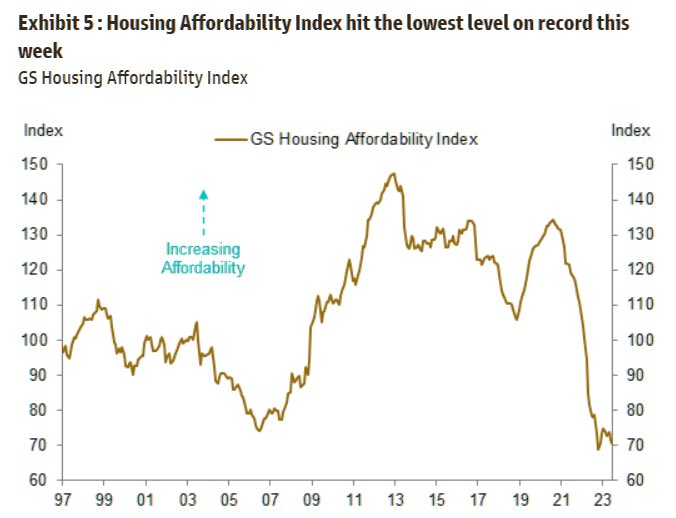
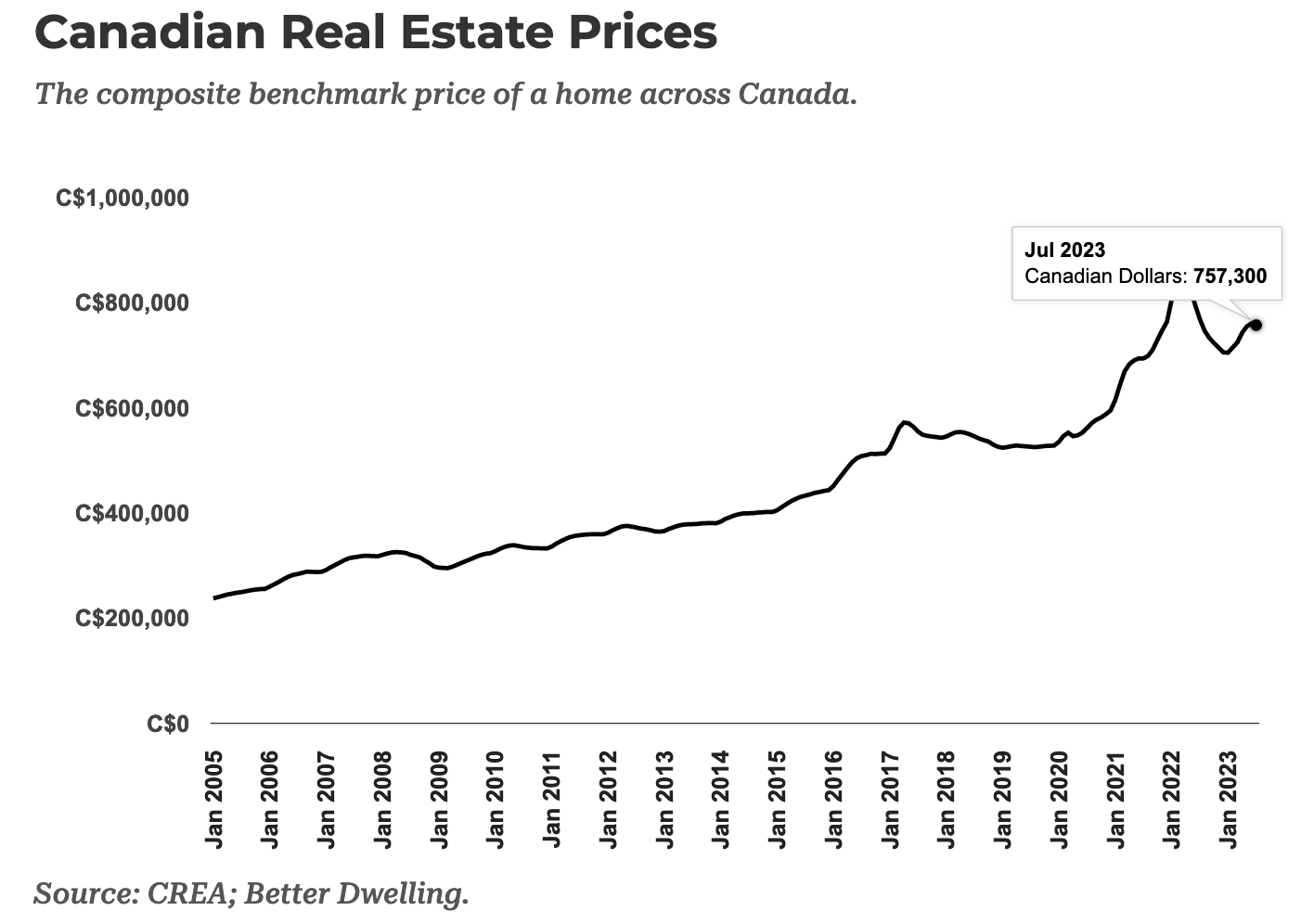
Today’s home affordability is the lowest on record, thanks to elevated prices and the highest mortgage rates in 23 years (US home affordability index below since 1997 courtesy of Goldman Sachs). Not to mention leaping insurance, utilities, property taxes, maintenance, and interest costs on the many other debt types. These are tough times for the masses. In March 2022, the popular 5-year Canadian fixed mortgage rate was under 3%, and the median Canadian home price peaked at $855,800. In July 2023, the benchmark price of a Canadian home was $757,300 (chart below since 2005, courtesy of Better Dwelling), and 5-year fixed mortgage rates were above 5.5 %. The combination of sky-high prices and historically average interest rates puts the median Canadian home price some 32% above the borrowing capacity of the median household income (Oxford Economics).
There’s much discussion of late about China’s heightened financial fragility because 70% of Chinese household net worth is based on real estate, which is now deflating. A 2022 Ipsos poll found that 77% of total household assets in Canada were based on real estate.
Canada entered the 2008-09 recession with moderately priced housing because it had primarily flatlined over the preceding decade. Mainly because of that, Canadians were much less indebted than their American counterparts in 2008, and thus, the Canadian economy fared relatively better than others during the global credit crisis. Canadian household debt to disposable income was less than 140% in 2008 versus 185% in 2023. Canadian household debt amounted to 75% of Canadian GDP in 2008 versus 103% today.
In 2023, some 77% of Canadian homeowners have a mortgage, and the average balance is north of $350k. Those under age 55 owe the bulk of the $2.8 trillion in household debt outstanding ($2.11 trillion of which is mortgage debt).
Sixty-three percent of homeowners with a mortgage say they are financially stressed today, compared with 59% of renters. This is particularly troubling since Canada’s official unemployment rate is just 5.5% and is destined to move higher in the months ahead.
The existing average rate on 5+ year fixed mortgages in Canada is 2.79% versus 5.99% on offer today. As fixed terms come up for renewal, a doubling interest expense will be difficult for most to absorb.
On the upside, these conditions suggest that more properties will be listed for sale, and more that have been held off the market for occasional use or vacation rentals will be seeking full-time tenants. These factors should help to bring prices lower over the coming months and possibly years.
In the meantime, the segment below looks at the present math for Americans. Things are not better in Canada.
The average American says they need to earn $233,000 a year to be financially comfortable. But in 2021, American workers on average made only $75,203 annually. With well over half of Americans living paycheck to paycheck, many are struggling to meet some of their modest financial goals. 72% of Americans said they currently weren’t financial secure, and more than a quarter of Americans said they’ll likely never be. So how did it become so difficult to be financially secure in America and what can you do about it? Here is a direct video link.
Posted inMain Page|Comments Off on Tougher times for the masses
“An explosive critique about the investment industry: provocative and well worth reading.”
Financial Post
“Juggling Dynamite, #1 pick for best new books about money and markets.”
Money Sense
“Park manages to not only explain finances well for the average person, she also manages to entertain and educate while cutting through the clutter of information she knows every investor faces.”
Toronto Sun