
Sellers vs. Fiduciaries

Elliot S. Weissbluth explains the critical difference (widely ignored) between those who sell and those who advise. To add further danger to one’s financial health, now realize that the butchers (brokers) and even most of the dietitians today (advisors) in the financial world are paid most when people are perpetually weighted in equity based products. This fact is in breach of a fiduciary duty to put the client’s best interests first and to disclose any conflicts of interest. And yet this unspoken conflict is endemic to the entire equity culture upon which “investment advice” now rests. This is why it is essential to completely sever the sales side from the advising side (banks and underwriters cannot own advising arms who use their trusting clients as “distribution channels” for the products they underwrite), and to have a fee based system for fiduciaries which has no incentive to weight more in any one asset class over another.

As soon as a fiduciary advisor sells their “assets” (which actually is their clients’ trust and capital) to a publicly traded financial firm or a firm that also has an underwriting or corporate advisory side, the contamination is complete, and the clients are no longer getting unbiased advice or risk management.

Over the past 30 years, reduced regulation and increased amalgamation and scaling among financial services have reduced most advice to one incestuous, harmful common denominator: a bias toward equity risk at every price, every age and through every market cycle. Peeling off the complex layers of conflict is key if financial advice is ever going to become a trust-worthy and valuable profession for its clients. In the meantime, good advice–that truly serves the clients’ best interests above all else–will continue to be extraordinarily rare. Here is the direct link.

Posted in Main Page | 1 Comment

Mapping out our secular bear in stocks

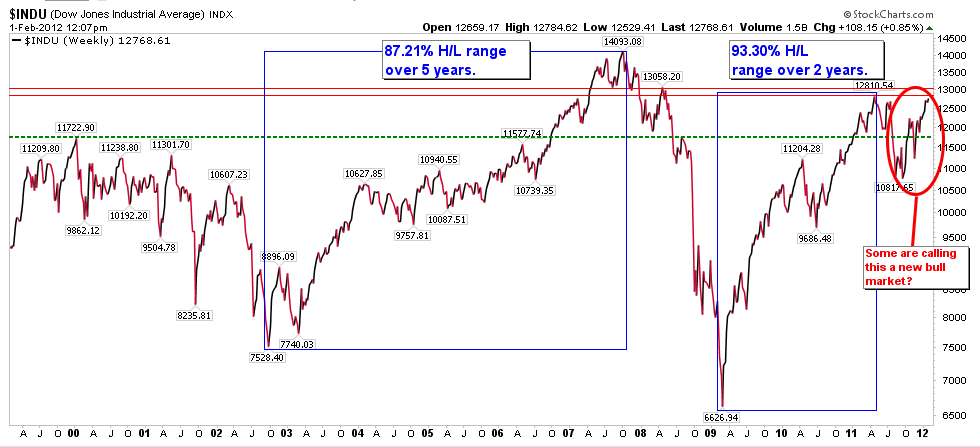
With the latest round of stimulus pump over the past few months, this time out of the European Central Bank, risk markets have lept up in another cyclical rally in our ongoing secular bear for stocks. This has led some to fall back in love with risk. This chart of the Dow’s trading range since this secular bear started in 2000 offers some clarity for those who wish to see.

Source:  Cory Venable, CMT, Venable Park Investment Counsel Inc.

This article is also a useful summary of where we are at today within our deleveraging- induced secular bear journey:  See more: Secular Bear Market

Posted in Main Page | 1 Comment

Excellent report: Why we must end TBTF now-chosing the road to prosperity

This is one of the most honest and clear statements I have read on what happened in the financial crisis and what we still need to fix in order to regain strength in the global economy. It is penned by the Dallas Fed Director of Research Harvey Rosenblum. I would like to highlight pretty much every word; but here are some key takeaways:

For capitalist economies to thrive, weak companies must go out of business. The reasons for failure vary from outdated products, excess industry capacity, mismanagement and simple bad luck. The demise of existing firms helps the economy by freeing up resources for new enterprises,leaving healthier survivors in place. Joseph Schumpeter coined the term “creative destruction” to describe this failure and renewal process—a major driver of progress in a free-enterprise economy. Schumpeter and his disciples view this process as beneficial despite the accompanying loss of jobs, asset values and equity…

An unfortunate side effect of the government’s massive aid to TBTF banks has been an erosion of faith in American capitalism. Ordinary workers and consumers who might usually thank capitalism for their higher living standards have seen a perverse side of the system, where they see that normal rules of markets don’t apply to the rich, powerful and well-connected. Here are some ways TBTF has violated basic tenets of a capitalist system:

Capitalism requires the freedom to succeed and the freedom to fail.

Hard work and good decisions should be rewarded. Perhaps more important, bad decisions should lead to failure—openly and publicly. Economist Allan Meltzer put it this way: “Capitalism without failure is like religion without sin.”

Capitalism requires government to enforce the rule of law.

This requires maintaining a level playing field. The privatization of profits and socialization of losses is completely unacceptable. TBTF undermines equal treatment, reinforcing the perception of a system tilted in favor of the rich and powerful.

Capitalism requires businesses and individuals be held accountable for the consequences of their actions.

Accountability is a key ingredient for maintaining public faith in the economic system. The perception—and the reality—is that virtually nobody has been punished or held account-able for their roles in the financial crisis.

The idea that some institutions are TBTF inexorably erodes the foundations of our market-based system of capitalism.

Read the whole report here:Choosing the Road to Prosperity

Posted in Main Page | 1 Comment




