
China’s demographic tsunumia now underway

Excellent article today on the greying of China. 

“Bloomberg Businessweek reports in its Jan. 9 issue: The latest government census shows 178 million Chinese were over 60 in 2009. That figure could reach 437 million — one third of the population — by 2050, the United Nations forecasts. While the elderly were looked after in the past by their children, urbanization and the nation’s one-child policy have eroded the tradition of family care.
“It’s a demographic tsunami,” says Joseph J. Christian, a fellow at the Asia Center at the Harvard Kennedy School, and former DLA Piper partner in Hong Kong, who specializes in senior housing issues in China. “The whole multi­generational housing model has disappeared.”
China’s challenge is similar to that faced by Japan in the 1990s, with one essential difference: China will grow old before it gets rich….

Read the whole article here.

The aging population and its fiscal drag (as with the Baby Boomers in the western world) presents significant risks to those still banking that Chinese led growth will continue to feed the world with insaitable demand for commodities and things like west coast real estate in North America.
Posted in Main Page | 2 Comments

Egos aside, customers create jobs

In my adult life I have started three businesses from scratch.  Each time I had to give to get.  I had to take on financial risk and invest my own capital and time up front before ever making a nickel for myself.  Each time I had good ideas, education, strong ethics, dedicated work habits, focus, devotion and integrity.    None of these things created jobs for others.  Build it and they will come–only our customers created revenue and jobs. 

Good customers are the life-blood of every business.  Succesful long-term entrepreneurs understand this most important economic fact and never forget it.  Without enough stable customers, every business will struggle and eventually fail.  

That said, there is a common human tendency in some owners and managers to become intoxicated by success.  They go native.  They start to believe revenues are a direct product of their own genius and initiative.  They forget where their business comes from–they start to take all of the credit.  They begin to believe that they–not their customers– create jobs. 

A reader sent me this article a while back and I finally got to read it yesterday.  Everyone should.  See Reward true job creators: Nick Hanauer.   Until we get more customers back on stream, with jobs–not one-off hand outs or emergency benefits but recurring, regular income to spend in our domestic businesses–our economy will continue to stagnate and struggle.   

Those with successful businesses and high incomes cannot keep all of our cake through low tax rates and also expect our economy to have a robust customer base too.  We used excessive consumer debt to fund spending deficits over the past 30 years and now we are all paying for the weight of this burden through a prolonged period of asset deflation and slow growth.  Most of those who have the highest wealth today made it as customers, financial institutions and governments became recklessly indebted and capital depleted over the past three decades.  That path has now been exhausted.  Time to change tactics. We all have to help refill the fiscal tank and clean up the mess of the world’s wild spending orgy.  Bailing out more banks and weak businesses will not do it.  In the end we will all pay, one way and another. 

Also see this excellent piece from Dylan Ratigan today: Encouraging the right kind of greed

Posted in Main Page | Leave a comment

A promising picture

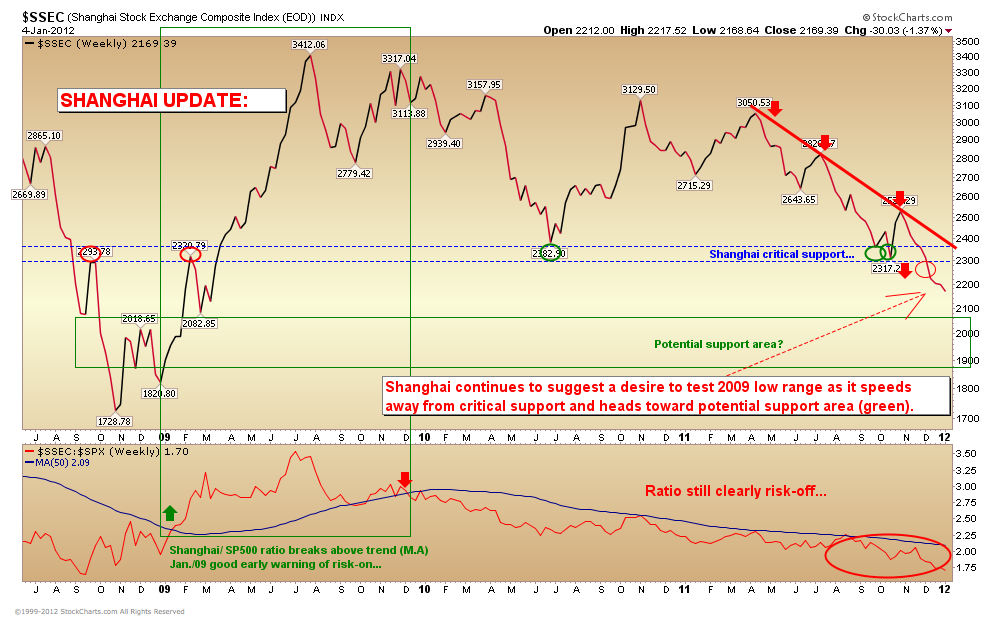
For those waiting for economic reality to re-couple with North American stock prices, this update of the Shanghai composite offers promise of lower prices ahead. The chinese market tends to lead North American stocks and commodities by 4 to 6 months. We have been watching this index closely for hints as to whether global stocks may re-test the 2009 lows this down cycle. Re-testing prior lows is actually a recurring feature during secular bear markets, but figuring out the ‘when’ is always tricky.  With the Shanghai still falling and now just 400 points or 20% above its liquidation low reached in November 2008, global markets clearly face further downside risks over the next couple of quarters.
Source: Cory Venable, CMT, Venable Park Investment Counsel Inc.

Posted in Main Page | 6 Comments





