Risk appetite is back “roarin’ for a priest” today on fresh hopes of European miracles. Here’s the Wall Street Journal:
“European stocks soared and the euro advanced strongly as European leaders edged closer to a fresh financing package for Greece and contain possible effects in other debt-laden members of the bloc of euro-using nations.”
We have seen these euphoric episodes repeatedly over the past year, only to prove a fleeting preface to the next phase of market decline. Today the word is that the German and French leaders are cobbling together an agreement that would allow the European Financial Stability Facility (EFSF) to be used as a TARP like patch able to lend money to troubled governments, recapitalize troubled banks and buy sovereign debt on the bond market. The ECB also has indicated that they may now reverse their long standing (very rational) rule of not accepting defaulted paper as collateral for loans. This latest mad plan would allow Greek’s junk paper to be tendered as respectable collateral and thereby extend and pretend the Greek banking system a little while longer. This is a farcical patch and everyone knows it. Risk traders are buying the news all the same.
For those of us who have learned to be skeptical of prestidigitization, math cannot be ignored. The successive bailouts and QE’s have worked to bring negative economic growth trends back to about zero over the past couple of years. However this has distracted many from the reality about where future growth prospects actually sit today, even assuming the patches are passed.
The European debt crisis started out in a periphery (Ireland, Greece and Portugal) which represents 5-6% of Eurozone GDP. Having now highlighted the over-indebtedness and remaining property bubbles in Spain and Italy too, the debt crisis now affects countries that together comprise more than 35% of European GDP. Even assuming the best of scenarios where the bailout patch is successful in stabilizing the Eurozone from here, Spain and Italy are forecast to grow at less than 1% annually for the next 5 years. Greece and Portugal will continue to labour in years of deep recession and brutal unemployment as far as the eyes can see. Even miraculous Germany is projected to grow at just 2% GDP for the next couple of years.
On the back of unprecedented fiscal and monetary stimulus US GDP has managed to limp by on less than 2% growth for the first two quarters of 2011. Japan is still in its post-quake recession. The UK is on life support. China is struggling to resolve its own problems with a banking system brimming in bad loans and a manufacturing index which contracted below 50 to 48.9 in July.
Ok don’t worry be happy, Canada and Switzerland have relatively less government debt. Too bad they can’t self-fund their economies without healthy trading partners, but alas both are heavily dependent on exports for growth.
Nevertheless both currencies are this week soaring, with the Canadian dollar now 5 cents above par and some 10% above fair value. See chart courtesy of Cory Venable.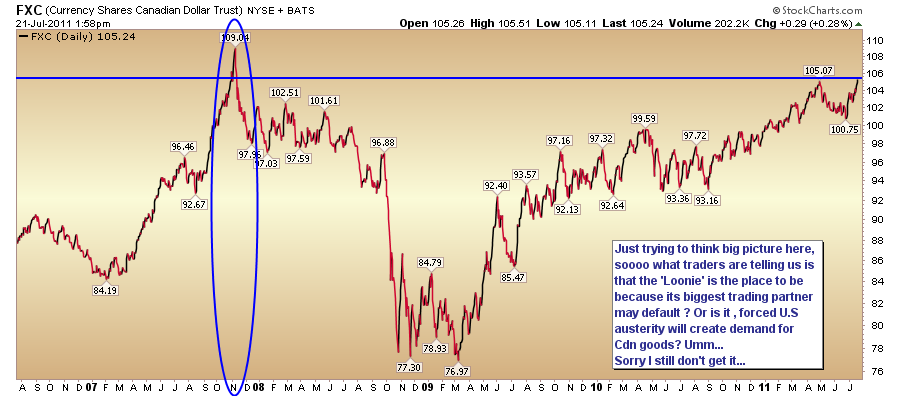
This was the Bank of Canada in its monetary policy report released yesterday:
“Net exports remain weak, reflecting modest US demand and ongoing competitiveness challenges, particularly the persistent strength of the Canadian dollar…the bank expects [hopes!] growth in Canada to re-accelerate in the second half of 2011…The Bank’s projection assumes that authorities are able to contain the ongoing European sovereign debt crisis, although there are clear risks around this outcome.”
If only monkeys could fly. Facts will eventually demand respect. They always do in the end. The OECD leading economic indicator is now below zero (-.2%). It followed this same year over year decline in October 2007 as the recession was beginning and the stock market was slipping into its last 50% decline. The Wizard is a wizzled little man hiding behind a curtain on a stool. I wish it were otherwise. Practical people must govern their risk accordingly.