Corporate bankruptcy wave just started

Unlike government bonds that typically rise while stock prices fathom bear market lows, higher-risk corporate bonds tend to fall with risk appetite and equity prices. That trend has held over the past 15 months as most corporate securities have lost value.

As US junk bond prices have tumbled, their yields have risen to around 8.75% from sub-4% in 2021, when desperate and undisciplined funds were eschewing risk management for “there is no alternative” madness.

The rapid doubling in yields is an encouraging trend for value-conscious investors. But it’s early days yet. A ton of low-rate debt is not yet up for renewal. A growing default, reorganization and bankruptcy wave suggest that firesale prices (and hence higher yields) are yet to come. See, The corporate bankruptcy wave will get even uglier:

Business bankruptcies are surging around the world, in some countries reaching volumes not seen since the aftermath of the 2008 financial crisis. It’s likely just the start of a wave of corporate defaults: A decade of cheap money instilled a false sense of invincibility in business executives and private equity managers who forgot that bust normally follows boom. Now, a combination of weakening demand, surging inflation, over-indebted balance sheets and much higher borrowing costs will prove too much for weaker borrowers.

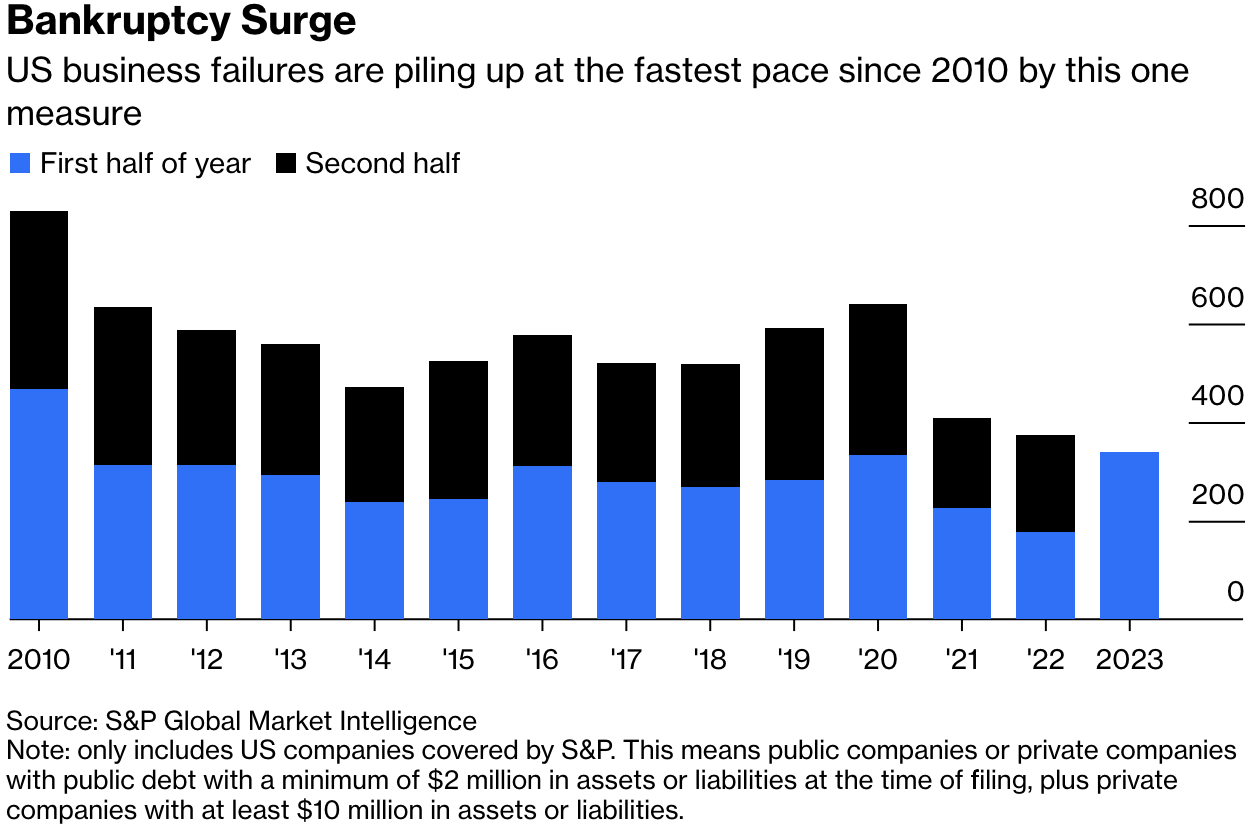
US bankruptcies in the first six months of 2023 were the highest since 2010 among the companies covered by S&P Global Market Intelligence. In England and Wales, corporate insolvencies are near a 14-year high. Swedish bankruptcies are the highest in a decade, while in Germany bankruptcies jumped almost 50% year-on-year in June to the highest level since 2016. In Japan, bankruptcies are at their the highest in five years.

US business failures in the first half of 2023 were already the highest since 2010 (blue bar below). Insolvency pressures are set to intensify in the second half.
Rapid Ratings CEO James Gellert reviews corporate refinance troubles for upcoming debt maturities. Here is a direct video link.

Posted in Main Page | Comments Off on Corporate bankruptcy wave just started

Yields testing resistance (and nerves)

The Visual Capitalist chart below shows the pace (in months) and percentage points of Fed hiking cycles since 1988 and confirms that the 2022-23 cycle (in yellow) has, by far, been the sharpest in at least 35 years.
In the process, interest-sensitive assets–commodities, bonds, equities and real estate–have all sold off.

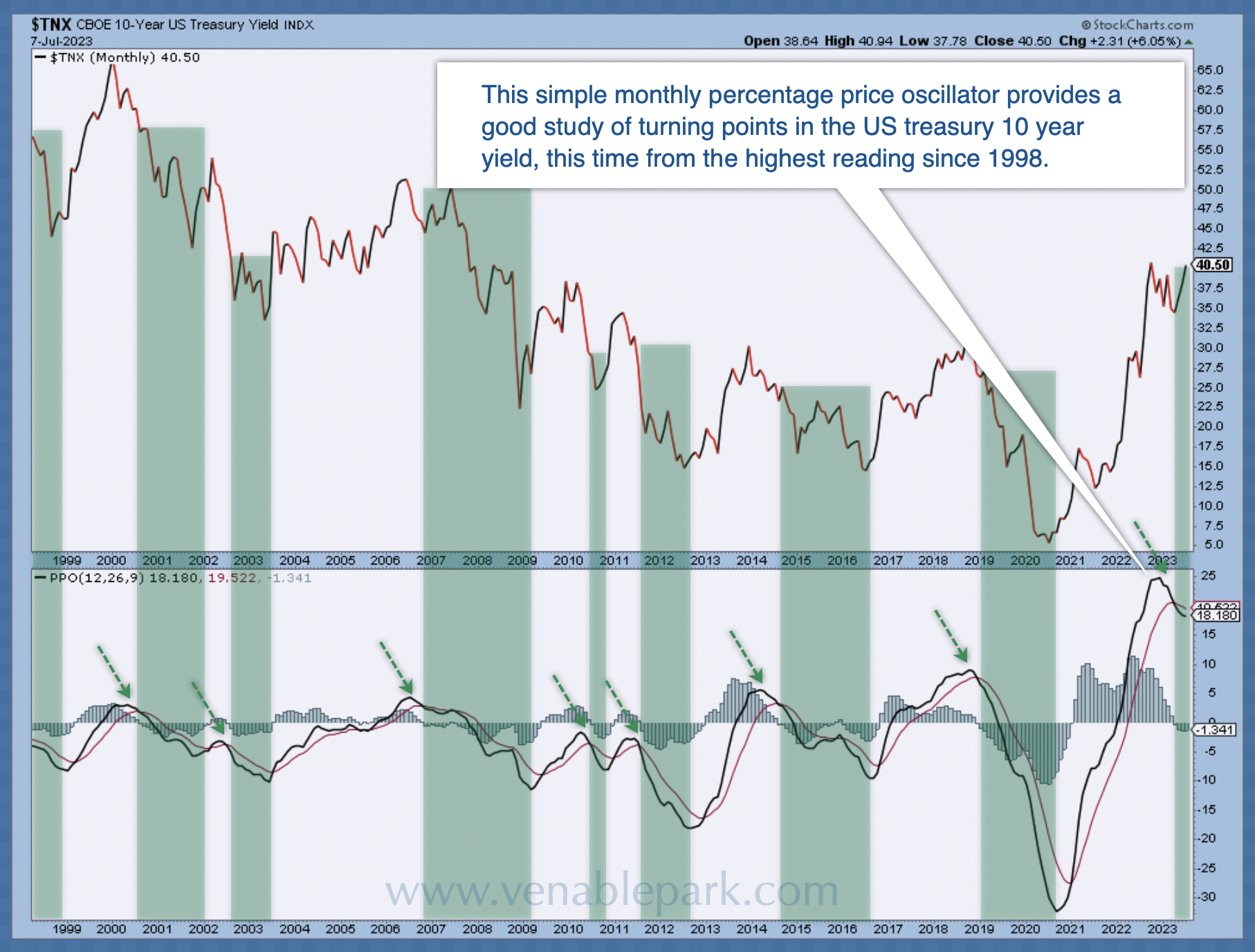
In the last week, the US 10-year Treasury yield tested 4% for the eighth time in 15 years. Is 4% the 10-year peak this cycle? As shown below, since 1998, courtesy of my partner Cory Venable, prior yield spikes of lesser magnitude have been followed by financial shock, economic weakness and falling treasury yields/rising government bond prices for many months afterwards (green bars).
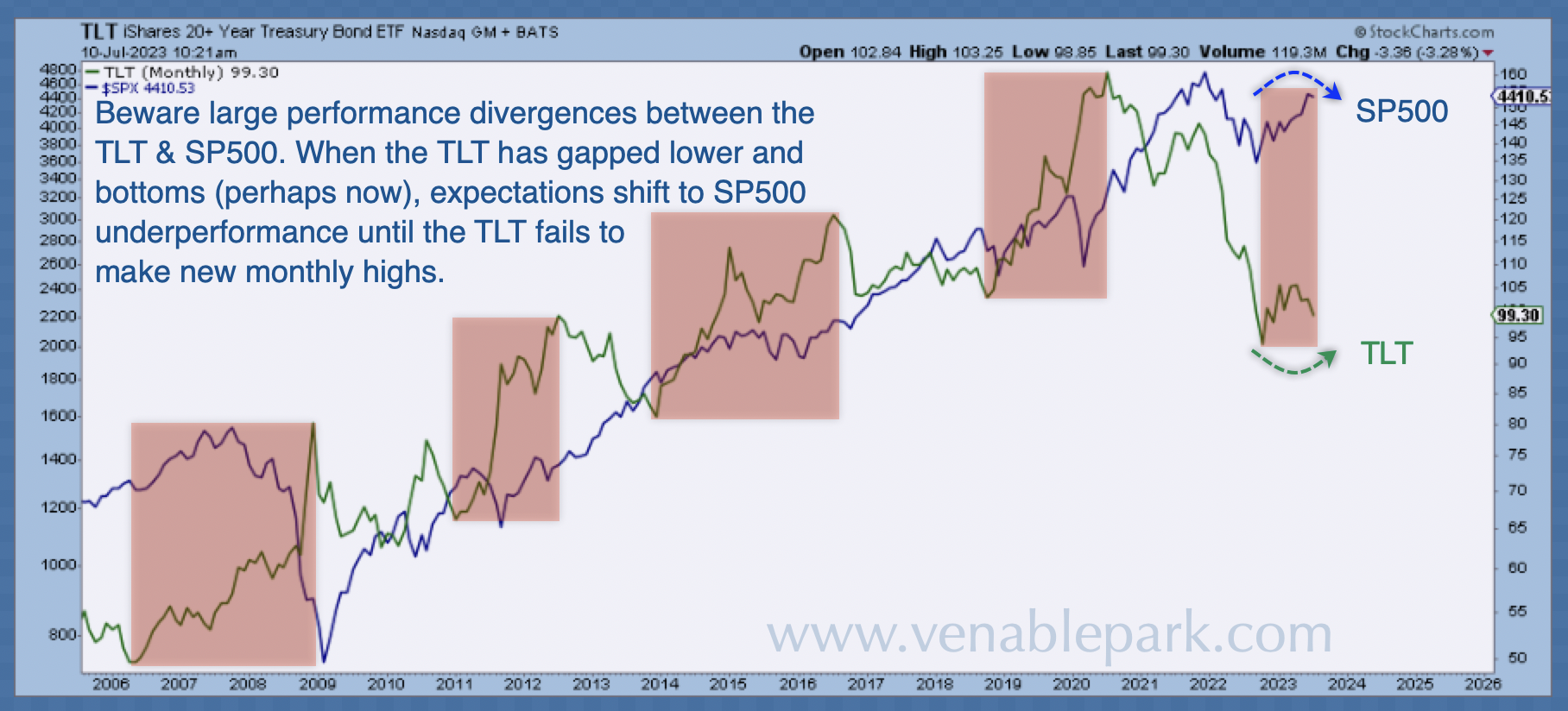
Stocks (S&P 500 below in blue since 2005) have traditionally tumbled when the price of the US 20-year Treasury bond (in green) rises (yields falling), and the gap between stock and treasury prices today is the largest we have seen in at least 20 years. This suggests that when treasury bonds next rebound, their upside and downside for equities are larger than average.
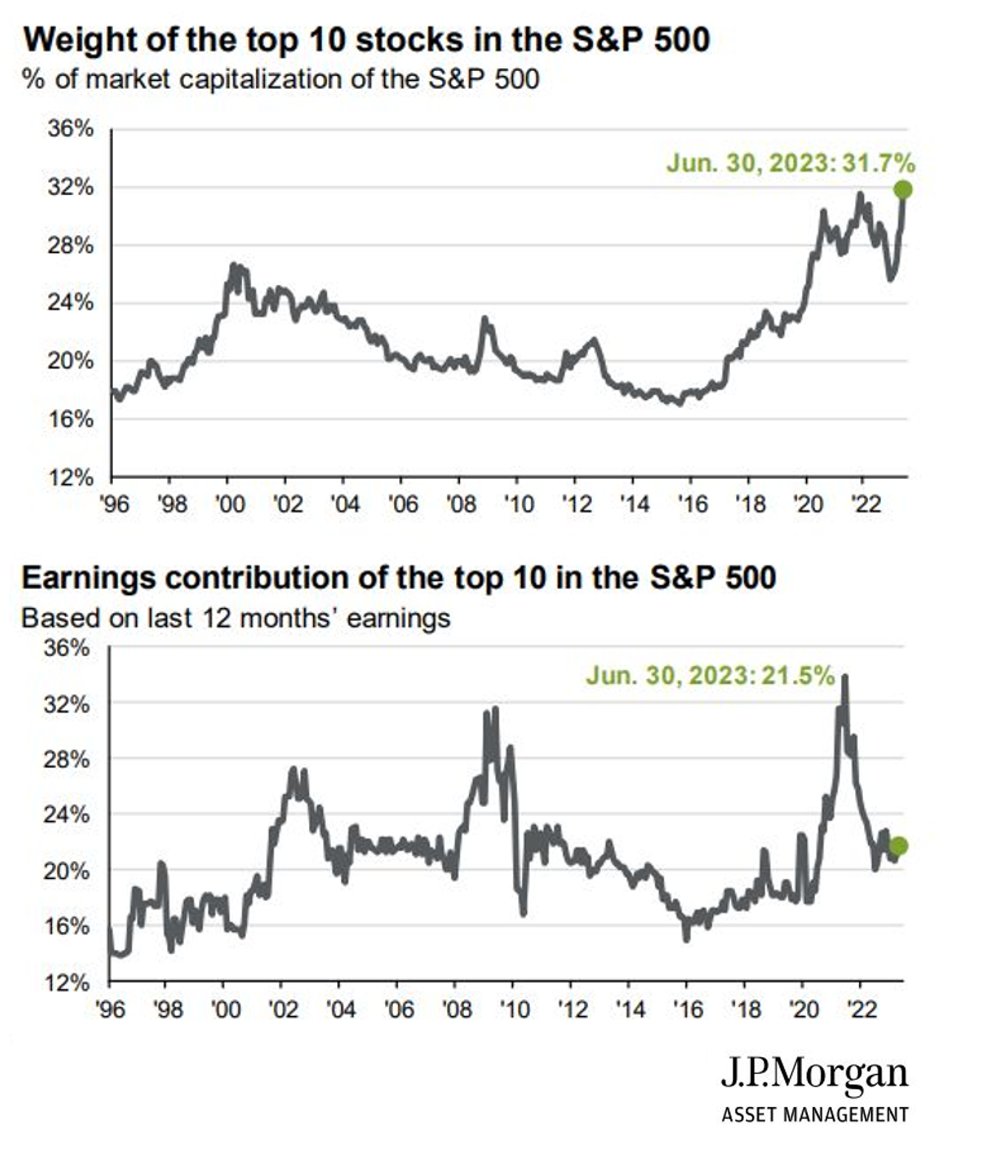
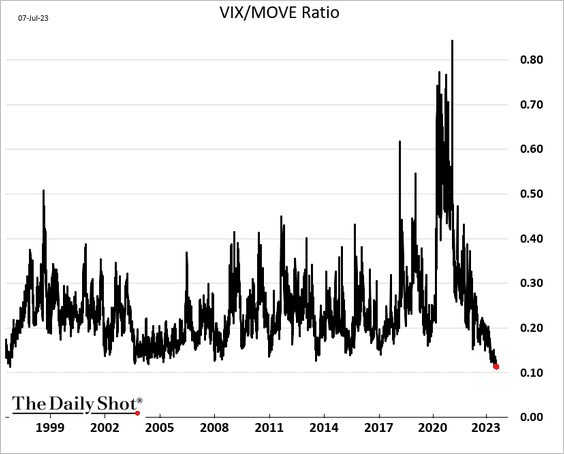
Even worse than the 2000 top (S&P 500 top chart below since 1996 ), stock market risk has been magnified this cycle by a whopping 31% concentration in the ten most expensive companies–mainly in the tech space. These ten have driven the bulk of index rebounds since last October, even as their earnings contribution has tumbled (lower chart). #irrationalexuberance. Most other companies and sectors remain flat and negative year-t0-date. Like other cycle tops, the worst market losses typically unfold as the last leaders finally stumble. The extremely suppressed equity market volatility (VIX) versus high Treasury rate volatility (MOVE index) below since 1997, courtesy of the Daily Shot, is screaming for mean reversion. The beachball of equity volatility is never held down indefinitely. We can never know when equity markets will recover cycle highs. They don’t come with due dates, and most individual companies ultimately fail, taking shareholder and lender capital with them. History warns that after manic valuation peaks, even the companies that endure typically spend years before reclaiming their prior highs. This is why buying corporate securities at low valuations is so critical when their risk/reward prospects are most favourable. Ben Graham called this margin of safety.

Government bonds have been a rough ride since 2021. Still, unlike the rest, they have the lowest odds of default, prescribed interest rates, return of capital dates and appreciate as bear markets drive risk-fleeing capital toward them.

Today’s setup for the highest quality bonds (yield plus capital gain prospects) is the most favourable in decades.

Posted in Main Page | Comments Off on Yields testing resistance (and nerves)

Heal your gut

I was present when this one was recorded live. No news to me, but the science and insights are critical for health and should be shared

Rich Roll sits down with Dr. Alan Desmond to talk about the importance of a healthy gut microbiome and how it can be achieved through a plant-based diet. To read more about Alan and peruse the full show notes, go here👉🏾https://bit.ly/richroll766. Here is a direct video link.

Posted in Main Page | Comments Off on Heal your gut