A deflationary recession is the goal of central bank policies today. They’re determined to get there, and they will succeed. Make no mistake. Eric’s update is worthwhile. Eyes on the prize. (You can fast-forward through the channel’s crypto commercials).
On today’s episode of On The Margin, Eric Basmajian Founder of EPB Research joins the show for a discussion on the business cycle slowdown that suggests a “recession is imminent”. With Eric’s research following leading, cyclical and lagging indicators, he manages to keep a pulse on the current economic environment and its ultimate impact on markets. Here is a direct video link.
Posted inMain Page|Comments Off on Recession is the policy goal and it will be achieved
Recession Guessing Game — DiMartino Booth and Charles Payne of FBN Answer Questions. Here is a direct video link.
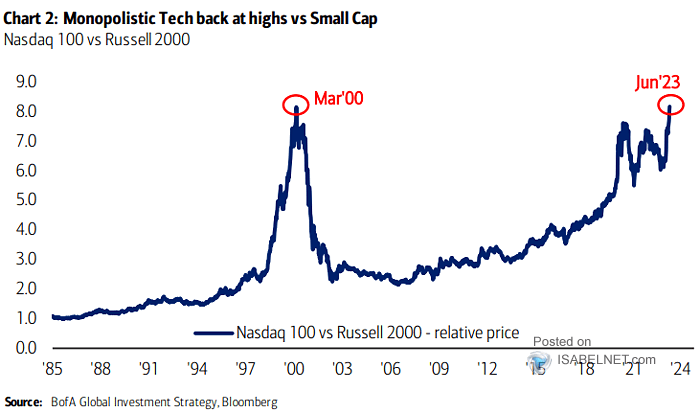
The five most expensive tech companies now comprise 25.7% of the S&P 500 (a record since the infamous Nifty Fifty stocks in 1972). Rebounding 33% year-to-date, the tech-centric Nasdaq 100 (30.51% weighted in information technology companies and 28.46% in electronics and hardware) has risen the most compared with the economically-sensitive Russell 2000 (small cap index) since the stock market peak in March 2000 (as shown below since 1985, courtesy of ISABELNet.com). In the 2000 cycle, the US Fed paused tightening efforts in May 2000, with the first rate cut in January 2001, and a mild recession was officially declared (after the fact) to have started in March 2001. Broad stock markets fell 42% in the 29 months after the Fed pause.
When such rare mania pricing reversed historically, the splatter hurt stocks broadly and produced a generational investment opportunity a couple of years after the cycle tops. Sadly, by then, buy-and-holders were in the fetal position with little cash or mental strength to take advantage of anything. Most liquidated in losses after the crash and did not buy back in until valuations and capital risks were high again.
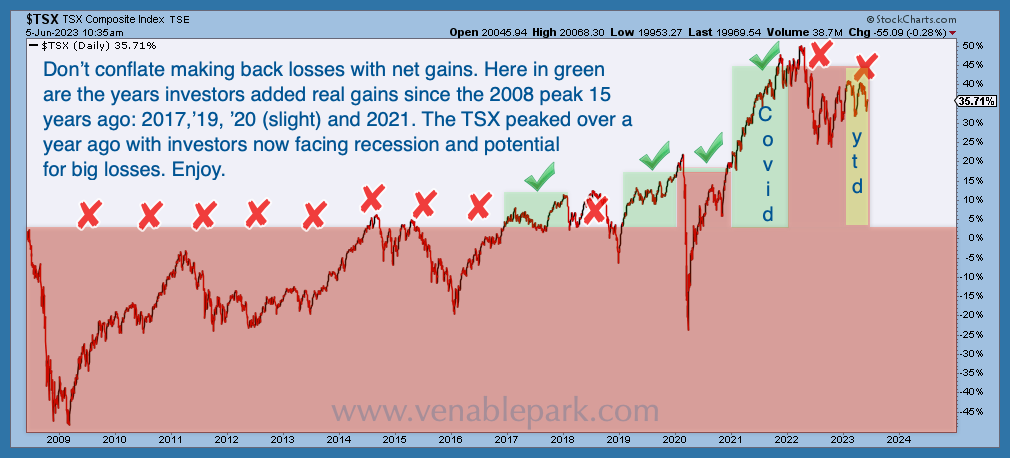
A long-term view of Canada’s TSX index tells a similar story (shown below since 2008 courtesy of my partner Cory Venable). Even with a 3% rebound year-to-date, the Canadian stock market has gone nowhere in 24 months, with very poor risk-adjusted returns since its commodity-mania top 15 years ago. A retest of the pink band below is the base case during a recession and would evaporate all capital gains since 2008.
Maintaining a valuation discipline is hard, but not having one is much worse.
Posted inMain Page|Comments Off on Recession start date and stock markets
Always a relief to hear an admission that Emperors are naked…
If you spend any time reporting on the world of crypto currency and Bitcoin, then you’re going to run across the name Molly White. She’s a software engineer who has been called “the cryptocurrency world’s biggest critic.” Michael Lewis gets her on the line for a lively conversation about why she spotted hucksterism and fraud early on in crypto’s rise.
Posted inMain Page|Comments Off on Against the Rules: crypto skeptic proven right
“An explosive critique about the investment industry: provocative and well worth reading.”
Financial Post
“Juggling Dynamite, #1 pick for best new books about money and markets.”
Money Sense
“Park manages to not only explain finances well for the average person, she also manages to entertain and educate while cutting through the clutter of information she knows every investor faces.”
Toronto Sun