
2023 comes in like ongoing bear for stocks and commodities

Two thousand twenty-two vaporized $25 trillion of notional equity value from global balance sheets, and the global bond market lost nearly $10 trillion more. Together, the decline in these two asset classes amounted to about a third of the world’s 2022 103.86 trillion GDP, not counting ongoing losses in real estate, commodities, or the crypto space.

So far, 2023 has come in like an ongoing bear for stocks and commodities, while government bonds have seen their best start to any new year in more than 20 years. These moves make sense in the macro context of a 2023 global recession where revenue, profits inflation and interest rates are due to decline.

Stocks remain especially vulnerable since, even with last year’s drubbing, they enter 2023 still at the high end of historical valuations. The S&P 500’s Shiller CAPE (shown below since 1870) closed in 2022 at 28, down from 38.3 at the end of 2021. A CAPE of 28 is nearly identical to the stock market peak in October 2007 and nearly double the 50-year mean of 14.6. At past cycle lows like March 2009, this reading was 13.3, 22 in October 2002, 17.8 in July 1990, and 6.6 in August 1982. We still need to head significantly lower in equity valuations if we are to restore longer-term investment prospects. Thus far, the Powell-led Fed seems willing to serve as the repricing catalyst. 
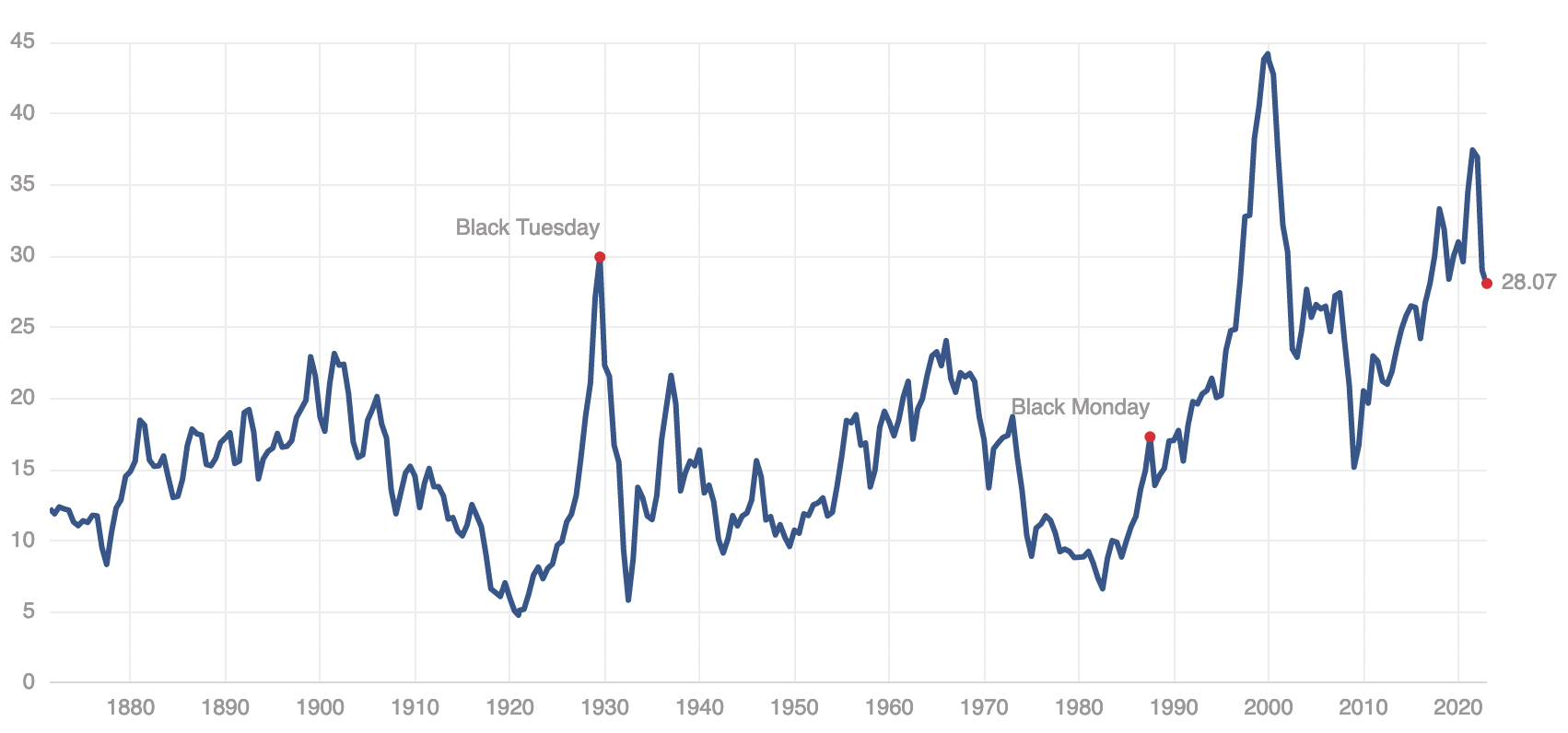
For those hoping that 2023 will bring positive equity returns because 2022 saw losses, it’s worth noting that past equity bubble busts in 2000-02 and 1973-74 saw consecutive negative return years.

It takes some effort to appreciate the extent of the asset bubbles that have been, but doing so helps to imagine the mean reversion that would be historically typical from here.

One of many poster children for the mania aftermath is Tesla. Tesla’s fundamentals have been solid, with new car deliveries (+185% between Q1 2020 and Q3 2022), revenue (+175%)  and net income (+1876%). Yet, Tesla shares have fallen nearly 74.5% from their cycle peak in November 2021 (from $411 to $105 at yesterday’s close). Still, even with the deletion of 75% of notional equity over the last 13 months, Tesla shares remain 268% higher in the previous three years. They are vulnerable to further mean reversion as speculative mania enters its typical depression phase.

Valuable investment opportunity lies ahead for many asset classes, potentially within the next year or so.


Posted in Main Page | Comments Off on 2023 comes in like ongoing bear for stocks and commodities

Cheers to healthful longevity

Seventy-two percent of Americans (Canadians, about the same) are now overweight and obese, reducing the quality and quantity of their life. Not to mention crushing the sustainability of our sick-care system. Study after study shows that it’s the type and quantity of things we are consuming. Here’s to delicious things that don’t promote cancer, heart disease and diabetes in ourselves and our loved ones.

The U.S. is one of the most prosperous nations on the planet—and yet, our country has never been more unhealthy. Here to offer us a fact-based prescription for living longer and better is the intrepid Dan Buettner.A true renaissance man, Dan is an investigative journalist, a National Geographic Fellow, a legit, boots-on-the-ground longevity expert, an in-demand public speaker, a serial entrepreneur, and a world explorer with three endurance cycling world records to his name…Today marks Dan’s fourth appearance on the podcast, and he’s presenting a gorgeous new offering: The Blue Zones American Kitchen. A must-read primer on healthy living, it’s a cookbook meets road trip in which he excavates the history of American cuisine and food culture and unearths the original, indigenous American diet, which, let’s just say, is very Blue Zones. Here is a direct audio link.

Posted in Main Page | Comments Off on Cheers to healthful longevity

Home prices are falling for good reasons

I recently reviewed Canadian real estate metrics in Canadian home prices need to fall. The segment below reviews similar affordability deficits in US home prices.

The median US household income is $54,000, while the household income needed to qualify to buy the median US single-family home is $87,000 (up nearly 50% year over year). Real estate presently makes up some $46 trillion on US household balance sheets compared with $33 trillion before the pandemic. Notional equity is now in retreat.

It’s now hard to deny that the housing bubble 2.0 popped in 2022 as mortgage rates more than doubled. But the fallout, especially in terms of price declines, has likely only just begun. The real damage from this bubble burst should occur over the coming year. How bad is it likely to get? And where will the pain be felt most? For answers, we turn to housing analyst Nick Gerli of re: venture Consulting, who is kindly returning to the program to provide his latest outlook. Here is a direct video link.

Posted in Main Page | Comments Off on Home prices are falling for good reasons



