Cryptodoom and AirBnBust

The policy-induced everything bubble is imploding globally, as it must.

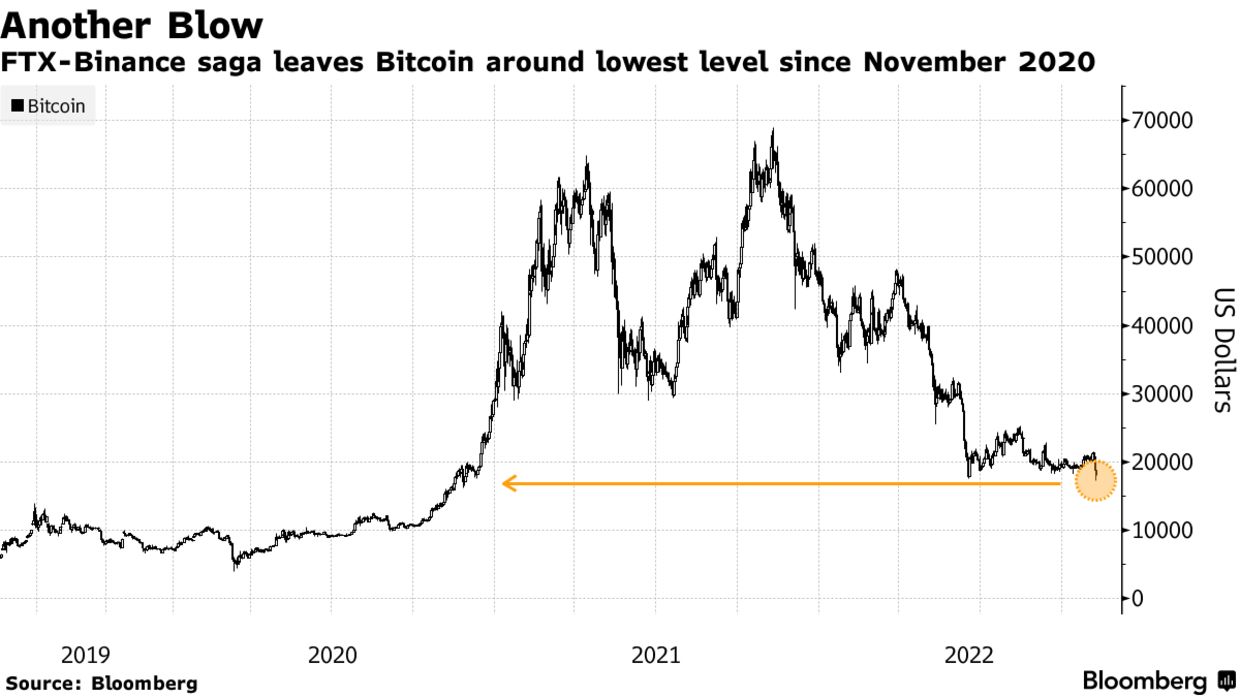
Overnight, we see contagion from highly levered Ponzi schemes in the crypto space as liquidity evaporates and panic justifiably spreads. Many naked emperors will be exposed here. Grandaddy Bitcoin (shown below) has tumbled to the lowest price since November 2020. See. Crypto markets tumble to a 2-year low on FTX contagion concern.
The fact that pension funds have allocated significant member capital to this madness reveals a dereliction of duty and the speculative madness that was. A quote of the day goes to Marc Weinstein of Mechanism Capital Ventures:

“I think if this bear market has proven anything, it’s that the emperor has no clothes. Even seasoned institutional investors can get swept away investing in hot deals at unreasonable valuations in a bull market.”

At the same time, the meltdown in real estate is just getting started. One area of increasing strife and mounting new supply for longer-term rental and sale emanates from the short-term rental sector.

Years of historically low-interest rates emboldened many to buy homes for the sole purpose of short-term rentals on Airbnb and other sites.  Of the 1.2 million Airbnb listings in the US, 62% have been added since 2020, according to short-term rental analytics firm AirDNA. The number of available Airbnb listings grew to 1.38 million in August 2022, up from about 1.07 million year-over-year, according to AirDNA.This buying pressure helped to drive bubble pricing into 2022. See Business Insider: Airbnb hosts worry about an Airbnb bust.

From March 2020 through March 2022, some 40% of purchases in Canada and the US were bought as second homes for ‘investment,’ occasional use and/or short-term rental.

Meanwhile, problems with inattentive landlords and disruptive tenants have prompted municipalities to increasingly ban or restrict short-term rentals. Next came the year-to-date leap in utility and mortgage rates, with bookings in retreat amid a consumer-led downturn. Perfect shitstorm.

A recent Wealthion discussion illuminates trends unfolding in the US. Here is a direct video link. The setup in Canada is arguably worse.

I conducted an interview on Twitter Spaces theother day about the unfolding catastrophe happening with AirBnb properties across the US.

Posted in Main Page | Comments Off on Cryptodoom and AirBnBust

Liquidity contraction remains dominant trend

The midterm election is historically a negative for the president’s party, and this year is expected to be no different. Exit polls suggest that Republicans are poised to sweep the House and the Senate in today’s mid-term. Bulls insist that this outcome would be a positive for equity markets regardless of the macro backdrop.

Thinking people might consider how a shift in US Senate seats can ameliorate the most significant monetary contraction and real estate-led global downturn–since 2008 (chart of global house price trends below since 2001 courtesy of ISABELNET.com). Voters cite fixing the economy as job number one, but this economic cycle is not bowing to anyone’s aspirations any time soon. Any interim rebound in still-overvalued asset prices will worsen investment prospects and increase the commitment of the US Fed to hike further for longer. #catch22 indeed.

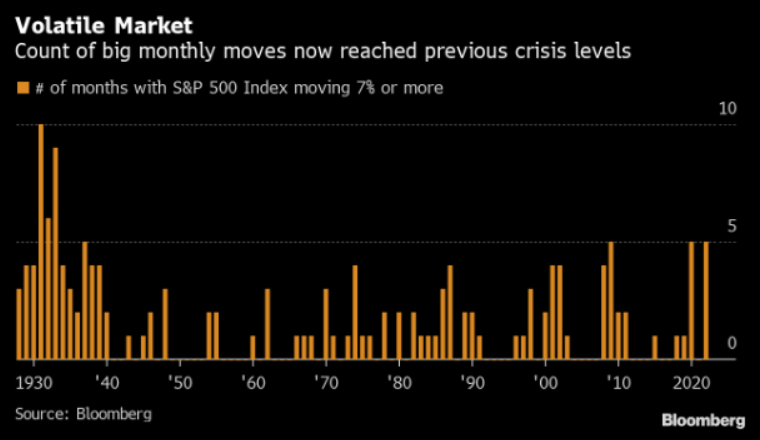
As shown below, market volatility has already been the most since 2008 and the dirty ’30s before that. After five monthly swings greater than 7%, the S&P 500 opens today -20 percent since January and has gone nowhere since June.
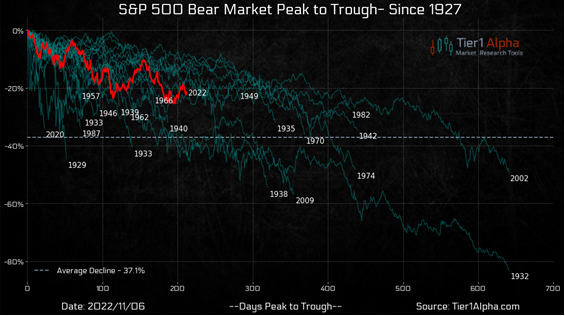
Losses thus far have not been enough to squash a speculative predilection among retail investors. Over the past month, retail buyers ploughed another $58 billion into equity exchange-traded funds, the most since March. While 45%% of inflows went to large, mid-cap and broad equity funds, just 7% went into US government bond funds ⁦@DataArbor. Flows into US equities outpaced all other regions significantly (chart since 2016, courtesy of ISABELNET.com). Bullish dreams notwithstanding, the bulk of stock market losses have historically come after the US Fed has stopped tightening and then ‘pivoted’ to loosen monetary conditions once more (S&P 500 price moves shown below since the 1960s courtesy of Thomas Thornton.) No pivot yet: the US Fed says it’s determined to tighten into 2023. This S&P bear market (red line below courtesy of Tier 1 Alpha) has been in motion for 211 trading days. Historically, since 1927, drawdown periods that did not end within 200 trading days extended to 300 days and beyond.
On the other hand, government bond yields (below in black via The Daily Shot) typically follow the ISM prices paid index with a three-month lag (dashed line top panel) and bank credit (dashed line lower panel). Both signal lower yields over the next 18 months (higher government bond prices) as contracting liquidity lower economic output and, finally, inflation at a lag.

Posted in Main Page | Comments Off on Liquidity contraction remains dominant trend

Slower growth for China is paradigm shift for world economy

Unverified online posts about the potential reopening of China continue to inspire periodic rebounds in commodity and stock prices. After nearly two years of disappointment and $6 trillion of losses, last week, Chinese stocks soared on frenzied speculation that a bottom has finally arrived.

Then, on the weekend, bullish dreams were dampened once more as Chinese Health officials stated an “unswerving” adherence to current COVID controls as the country faces increasingly serious outbreaks. See Bloomberg: China to “unswervingly” keep to COVID-zero policy, dashing hopes.

China Beige Book analyst Leland Miller recently explained the paradigm shift unfolding in China and why many incorrectly extrapolate past growth and demand patterns forward.

Markets plunged on Monday after Xi Jinping clearly signalled to the world a new era within China. Leland Miller walks through the paradigm shift in China’s growth model going forward and how this spills-over into politics, economics, business and everything in between. Expecting a “slower, healthier” level of growth going forward, Leland helps investors walk through the new landscape he has been identifying for many years to come, but to hear that, you’ll have to tune in!

Also, see: China’s exports shrink in October, badly missing expectations for growth.

Posted in Main Page | Comments Off on Slower growth for China is paradigm shift for world economy