
Tech leading lower

Technology shares led overall markets higher from 2020 through 2021 as government hand-outs, low-interest rates, and spare time enabled both a retail spending boom and a gambling frenzy in financial markets.

From the March 20, 2020, COVID crash lows of 6,879, the tech-heavy Nasdaq composite index broke through 10,000 by July 2020 (not 3 months later) and 16,000 by November 2021. The benchmark then tumbled 33% to 10,646 by June 16, 2022. After rebounding into mid-August, the Nasdaq relapsed and, this morning at 10,569, is a new 52-week-low and back to where it was in July 2020. We are now less than 9% above the pre-COVID cycle high of 9,731 on February 9, 2020, but still 53% above the March 15, 2020 crash low. We are early days yet, March 15, 2020’s low remains our base case retest this cycle.

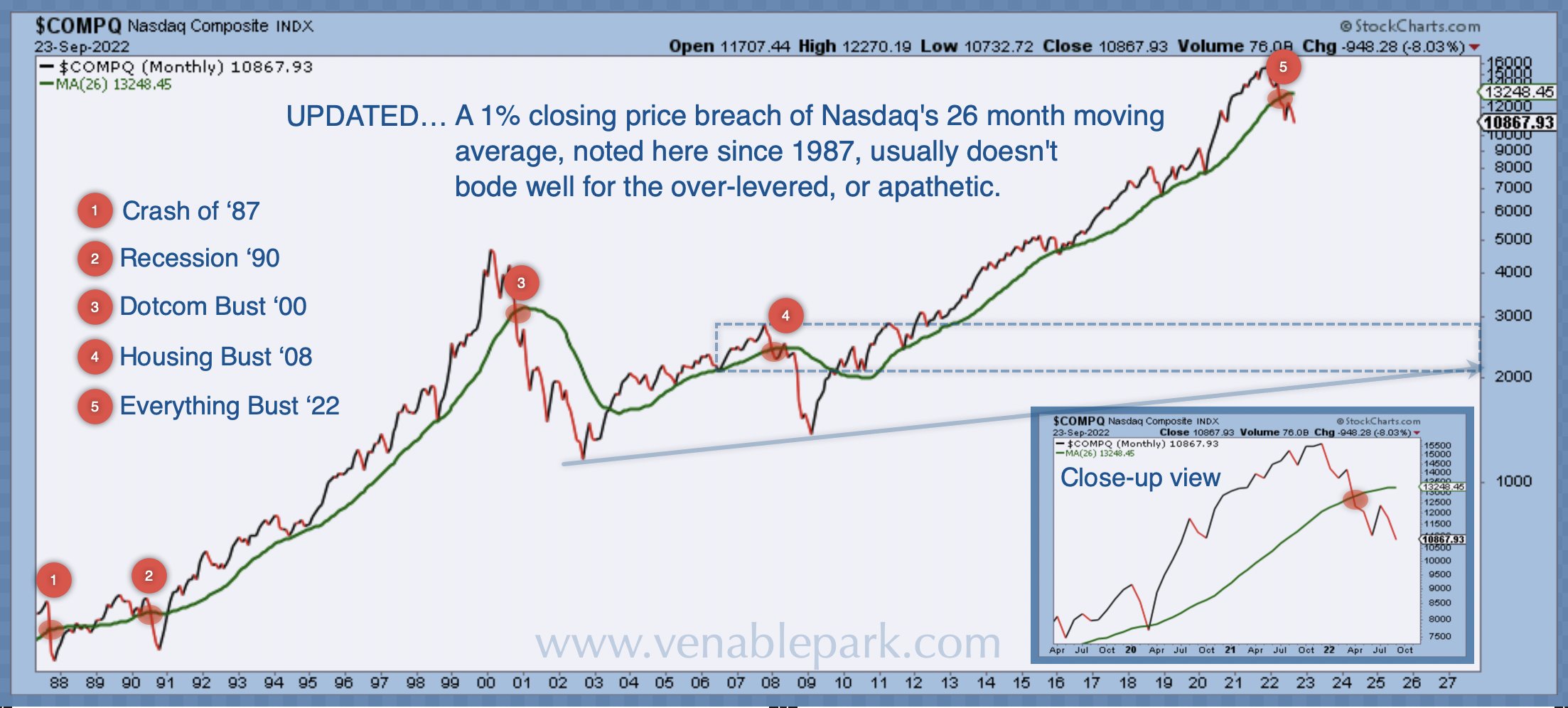
As shown below by my partner Cory Venable, the Nasdaq composite’s September 22, 2022 close at 10,876, was more than 1% below its 26-moving average for only the 5th time since 1987. The previous four incidents (see red circles) marked the onset of the last three recessions and major equity bear markets. The massive valuation overshoot in the recent everything bubble–and hence the downside now–is hard to appreciate until quantified and compared historically.
While tech has led the overall stock market, semiconductors–a critical component of the most widely used technology–have historically led the technology sector. Last week the semiconductor index (SMH) closed below the previous June low, now -40%  since November 2021 and the lowest since July 12, 2020, but still 44% above its March 15, 2020 crash.

Thanks to its heavy weight in financials, fossil fuels, and materials, Canada’s TSX is still just over 15% under its March 2022 top and following at a lag, just as it did in 2008 (peaked in June 2008, when the Nasdaq peaked in July 2007) and in 2000 (TSX peaked in September 2000 when the Nasdaq peaked in January 2000). There’s no precedent to hope that the TSX’s relative outperformance will hold. As shown below, a breach of the July low of 18,329 and then the pre-COVID high of 17,944 are the next downside tests, but the March 2020 low remains a surreal 39% below Friday’s close.

The damage to Canadian balance sheets and the economy from plunging equity in homes and stock markets is about to get ugly. Unfortunately, financial mania has earned it.

Posted in Main Page | Comments Off on Tech leading lower

Remember, USD love is cyclical not permanent

With most assets dropping in 2022, the US dollar (DXY) has been a rare standout, up 25% against a basket of global trade currencies since December 20, 2020, and 17% year to date. As with most trends, it’s common for humans to expect the status quo to continue indefinitely. Nothing ever does.

After bouncing for a couple of days earlier this week, risk markets are under pressure again, and the DXY topped $112 this afternoon, up from $110.06 on October 5.

The greenback has gained against Canada’s petro-dollar even as oil has bounced this week on news of OPEC output cuts. The USD/CAD, above $1.374 today, is nearing the $138.26 high last touched on September 30.

It is important to remember that markets are discounting mechanisms and relative moves are cyclical, not permanent. It’s typical for the USD to outperform in the early stages of recession and bear markets as commodity demand falters with global manufacturing and trade, and capital flows seek relative safety. We are there now.

The World Trade Organization joined the bearish chorus this week in lowering its global 2023 economic growth to 2.3% (below 3% is considered recessionary) from earlier expectations of 3.3%. They also warned of an even sharper slowdown if central banks continue sharp monetary tightening to squash inflation.

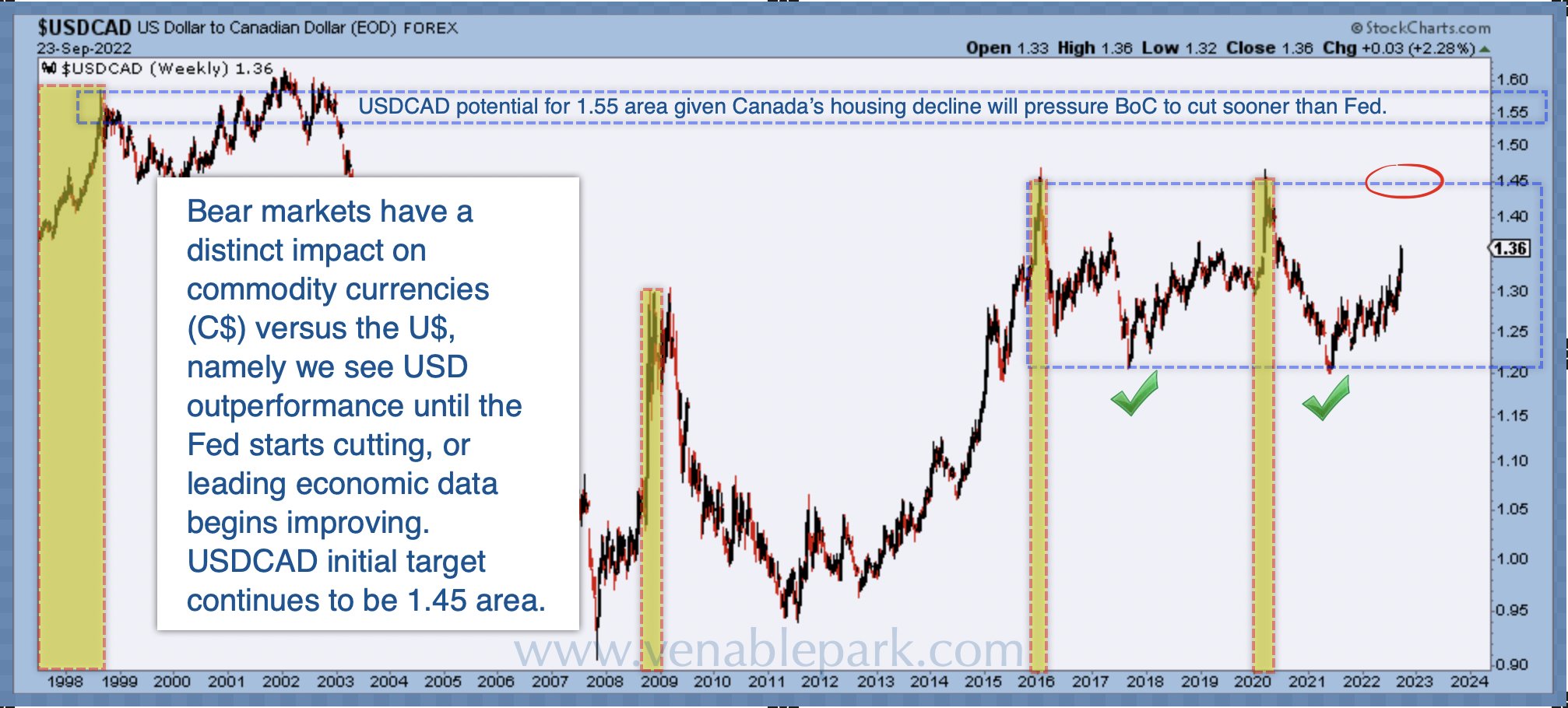
As shown below, since 1998, from my partner Cory Venable, the USD/CAD could well trade up to the 1.40-1.45 range (red circle) in the coming months as equity markets work towards a bottom. With the double whammy of housing weakness in Canada’s highly levered economy, we could even see the loonie revisit the $1.50+ area reached during the 2000-02 equity bear market. Canada didn’t enter a recession in 2001, but our dollar still dumped, and our stock market halved. The great white north comes into this downturn with a more vulnerable setup than in 2000 or 2008. We shall see.

The US Fed will eventually abandon its demand and inflation-crushing mission; however, monetary policy moves through the economy with a multi-month lag. When the Fed pauses, USD weakness and a fleeting stock market rebound are typical, but the economy does not turn on a dime.

Equity bottoms have historically come with loonie bottoms several months after the Fed returns to slashing rates again (marked with yellow bands above). Still, wise capital management does not bet on definite timing for these cycles to unfold.

Posted in Main Page | Comments Off on Remember, USD love is cyclical not permanent

Huberman Lab: health effects of cannabis

In this episode, I discuss cannabis (aka marijuana), including the biological mechanisms underlying its effects on the mind and body, its known medical applications, its impact on libido, creativity, hunger, hormones and more. I also cover the known adverse health consequences of chronic and even acute (one-time) use and the factors that determine if cannabis is helpful or harmful. Here is a direct audio link.

Posted in Main Page | Comments Off on Huberman Lab: health effects of cannabis




