
Wild abandon bounces back

As risk markets have rebounded over the past month, FOMO has resumed with retail flows moving back to the sketchiest and over-valued securities and shorts being forced to buy back positions. The basket of most-shorted stocks tracked by Goldman Sachs is up almost 39% this quarter. As shown below (from Goldman Sachs Prime), the past month has seen the 3rd biggest hedge fund short-covering event of the last decade.
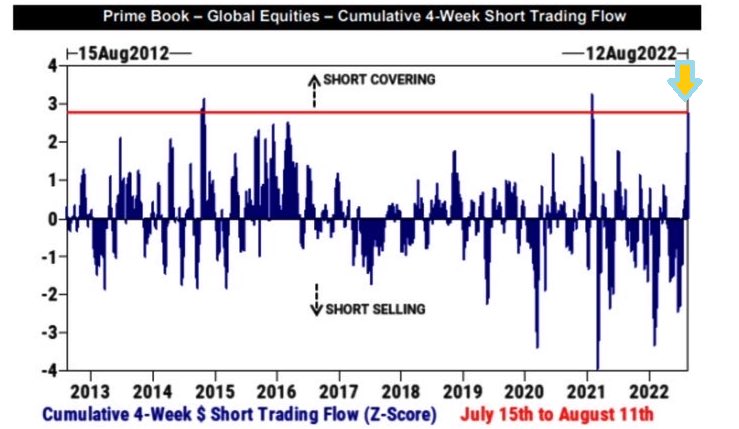
See Every Wall Street Trend Goes Haywire as Stock Bears Are Crushed:

Retail investors, who watched their post-pandemic profits wiped out this year and dashed out of stocks in June, are rushing back. Share purchases from small-fry traders jumped 62% during the week through Tuesday, industry data compiled by JPMorgan Chase & Co. show.

Like Monty Python’s Black Knight, animal spirits have been injured year to date, but they’re “not dead yet.”

So long as wild abandon and gambling permeate, we can be sure that the cycle bottom is nowhere nigh. As in 2003 and 2009, when cycle lows finally present, very few will have the cash or will to buy.

The first down leg was triggered by concern about central banks hiking interest rates and the reality that higher rates reduce free cash flow and profits. With some $130 trillion of private debt globally, up 250% since 2000, the next down leg will come amid spreading solvency problems. Those capital injuries are always more grave. See more in Volatility Investor Warns of False Dawn for US equities market:

“We are getting close to the end of phase 1, a repricing of growth. Phase 2 is more interesting to me. It is more of a credit cycle. People are upset that they’ve lost money, but there is no fear. The headlines in Q4 and Q1 are going to be of people having trouble refinancing, and nervous investors will start selling. By Q4 or Q1 it will switch to fear.”

Posted in Main Page | Comments Off on Wild abandon bounces back

Grantham: bear market update

As stocks rebound on disinflation data and hope for less central bank tightening, the tech-heavy Nasdaq is +21% from its June low but remains -18% from its November high. Meanwhile, commodity speculators are back to bidding up prices even as excess inventory of many goods mounts and global demand contracts. Bonne chance tout la monde.

While some proclaim a new bull market, realists note that 20% price rebounds have historically been common within ongoing bear markets. We are very early days in this one, and downside for markets, the economy, animal spirits and interest rates, still looms large.

In a late July video interview, cycle expert Jeremy Grantham offered context for what’s happening now as follows:

“There’s nothing as quick and spectacular as a bear market rally. With hindsight, they signify very little, but at the time, they frighten the pants off bears, and they give hope that all is over, all is forgotten, and it’s back to the races.” (Grantham suggested the current rebound in stocks could continue into September.)

“In terms of the entire bear market, it would be unusual for it to bottom out anywhere near this high. I would expect that by the low, the S&P would have declined by 50% from the peak in real terms.”

The Business Insider summarized ten standout quotes from the interview here. The full far-reaching discussion is available below.

Jeremy Grantham is the co-founder and Chief Investment Strategist of Grantham, Mayo and van Otterloo or more commonly known as GMO – a Boston-based asset-management firm. I last spoke with Jeremy almost exactly a year ago on episode 371 and I highly recommend you revisit it to see how prescient his predictions were at the time. In this episode, I wanted to get Jeremy’s thoughts on how the markets have materialized since we last spoke, but I also wanted to dive deeper into his knowledge around climate change. Here is a direct video link.

Posted in Main Page | Comments Off on Grantham: bear market update

Tracking grizzly bears

This morning (so far), stocks and bonds are rebounding on relief that US CPI in July eased to 8.5% (consensus forecast was 8.7%) from 9.1% in June, suggesting that the US Fed may hike less than 75 bps in September. The drop in price pressure was led primarily by disinflation in used vehicles, air travel, communication and apparel, while inflation continued in essentials for the masses like shelter, food and medical care.

Most importantly for the economic outlook and earnings, real incomes and productivity continue to slump to the lowest level in decades.

This morning marks Nasdaq’s 5th 2% gap-up day since the 2022 bear market began, and such rebounds are typical within ongoing bear markets.

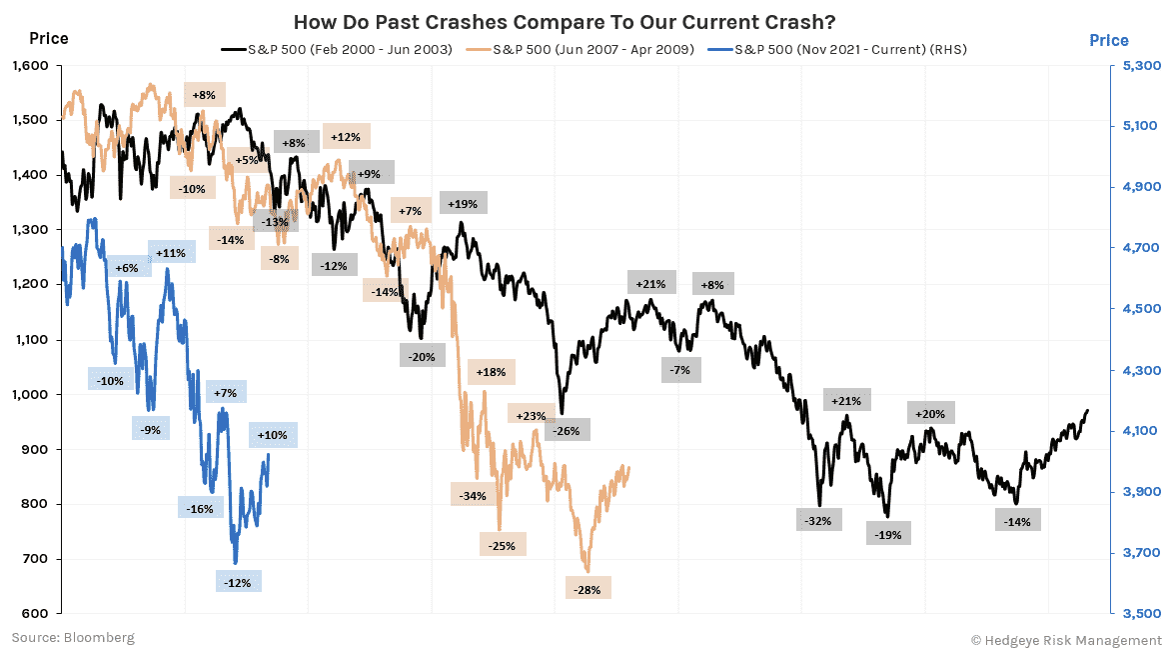
In the chart below, Hedgeye Macro analyst Ryan Ricci plots the S&P 500 recessionary bear markets of 2000 and 2008 compared with the current downturn. In terms of duration, the latest bear has lasted just 20% as long as 2000 and 37% as long as 2008.
Numbers on the chart show the interim bounces and drops within each bear cycle:

For 2000, the average up move was +15%, and the average down move was -18%.
For 2008, the average up move was +12%, and the average down move was -19%.
For the current bear, the average up move is +9%, and the average down move is -12%.

Ricci offers some useful context for the bullish chorus who never see downturns coming and continually urge us to buy stocks regardless of macrocycles:

“The largest bear market bounce in our current market is +11%, in 2008 +23%, and in 2000 +21%. Our current max bear market bounce (+11%) is lower than the average bounces in 2000 and 2008! Can you imagine all the talking heads in this country when there is a +23% bear market bounce?”

BOTTOM LINE: Patience should be a core asset allocation.”

Macro analyst Alfonso Peccatiello offers more historically informed insight in Bear Market Rally or Turning Point.

After a sharp decline in markets throughout 2022, many investors were caught off guard by the recent rally in equites. Is the bear market over? Should we expect a rally from here? “Hold your horses” says Alfonso.

Posted in Main Page | Comments Off on Tracking grizzly bears




