
Easy money has cost a ton

For three decades, the theory was that ultra-low interest rates allow borrowers to save on interest costs. In reality, low rates prompt most to borrow more and go deeper into debt.

Last year, Bank of Canada (BoC) research acknowledged that thirty years of lower interest rates had worked to inflate home prices and attract capital from productive investment to non-productive speculation in financial assets.

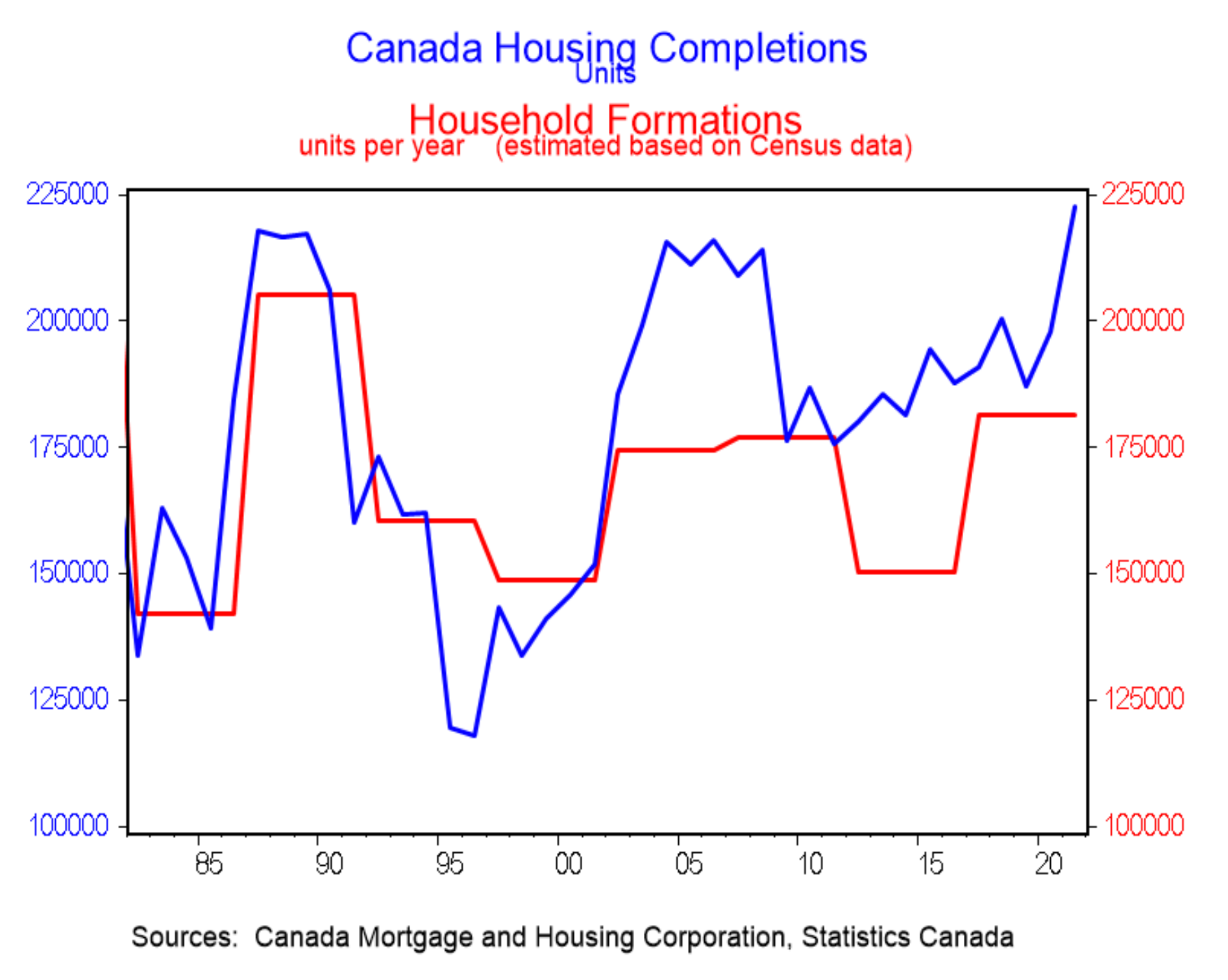
What about the ‘Canada is short housing supply’ trope? Also wrong (household formation in red versus housing units completed in blue below since 1980). See Canada’s housing supply has outpaced household formation for two decades:

New data from the national statistics agency challenges the narrative of Canada’s housing supply shortage. “Canadian Census data on private dwellings occupied by usual residents suggest that household formations have consistently lagged new housing supply for the better part of two decades, even accounting for some likely underestimation of formations,” said Sal Guatieri, a senior economist at BMO.

His calculations show household formations average just over 181,000 in the five years leading to 2021. In contrast, last year the market saw nearly 223,000 newly completed homes, as home prices continued to accelerate. Over the past 5 years, he estimates a surplus of 92,000 homes — eclipsing demolitions, less than half that number on the high estimate.
It will take a combination of lower home prices and higher incomes to enable the household formation needed to sop up our excess housing supply. That’s going to take some years, not just months.


Posted in Main Page | Comments Off on Easy money has cost a ton

What happens in China doesn’t stay in China

In 2021, the median Canadian home price was $531,000 and some 161% of the median Canadian household net worth ($329,000 per the latest available StatsCan data 2019). In February 2022, the average Canadian home price at $816,720 was some 145% of the average Canadian household net worth ($562,000 in 2021). Other studies estimate that real estate makes up 65% of Canadian household net worth.

A slightly higher 70% of household wealth in China is estimated to ride on real estate.

In recent years, families in both countries have been pooling resources to ‘help’ each other enter otherwise unaffordable home markets. This activity can seem reasonable when prices rise. But, it’s hard-hitting when they fall, magnified because the overall economy became co-dependent with the real estate boom now turning to bust.

Canada saw a record influx of capital from Chinese property buyers over the last decade. As commodity demand slumps with property prices, what happens in China won’t stay in China. Disgruntled masses are on the rise in many countries for similar reasons. See, Xi faces surprise revolt from Chinese homebuyers on Mortgage Boycott:

“[President Xi Jinping] now faces a surprise challenge from middle-class homeowners who are watching their family wealth slip away with a sustained slide in the property market, which makes up a fifth of China’s economic activity. Some 70% of household wealth in China is tied up in property, far more than in the US, making it one of the most sensitive political issues for the Communist Party.

For months Xi has stood firm in reining in over-leveraged Chinese developers, spurring a record wave of defaults that spooked global investors and brought at least 24 leading property companies to the brink of collapse. In the process, more than $80 billion has been wiped from its offshore bond market.

But now ordinary Chinese people are publicly revolting, with rapidly escalating boycotts on mortgage payments spread across at least 301 projects in about 91 cities. These homeowners accuse developers of failing to deliver apartments they’ve already paid for: the value of mortgages that could be affected has swelled to an estimated 2 trillion yuan ($297 billion).

“Chinese homebuyers usually pool the whole family’s resources to buy a home,” said Alfred Wu, an associate professor at the National University of Singapore’s Lee Kuan Yew School of Public Policy. “It is a life-and-death matter for them if their homes become negative assets.”

Also watch:

China may allow homeowners a grace period of mortgage payments for stalled property projects without incurring penalties. Here is a direct video link.

Posted in Main Page | Comments Off on What happens in China doesn’t stay in China

Must watch: Dopesick

The story behind the OxyContin epidemic is dramatized in the Hulu mini-series Dopesick now available on Disney+. The usual suspects of greed, regulatory capture and wilful blindness all play leading roles in this ongoing tragedy. Obvious parallels with other industries and behaviour patterns make it an illuminating watch. Very well done.

From Executive Producer Danny Strong and starring and executive produced by Michael Keaton, “Dopesick” examines how one company triggered the worst drug epidemic in American history. The series takes viewers to the epicenter of America’s struggle with opioid addiction, from the boardrooms of Big Pharma, to a distressed Virginia mining community, to the hallways of the DEA.  Here is a direct video link to the trailer.

Posted in Main Page | Comments Off on Must watch: Dopesick



