
WEALTHTRACK: Imminent recession-extended bear market

Those of us who diligently do clear-eyed, independent, financial and macro analysis, know how to assess market cycle characteristics with historically reliable indicators. Today, we are looking more top than bottom-like.

The segment below offers more sober updates. One caveat to David’s comments on ‘defensive’ equity suggestions: the preface should be “if you have to hold equities.”  The majority of funds and portfolios are set up to be long always with perpetual allocations to equities, and corporate debt–even though doing so is virtually guaranteed to lose money. The bias is a corporate securities culture where client accounts are viewed as distribution channels for the highest risk (and fee-generating) allocations.

When markets start dropping, most managers look for sectors that will lose less than others and weight holdings in that direction. They consider this defensive even though the risk of capital loss far outweighs any prospect of lasting reward, and it usually takes several years to grow back losses. By then, most clients have long since jumped out of fast-moving vehicles, crystalizing losses and missing out on any chance of recovery.

Individuals are not required to stay perpetually exposed to the stock market. Doing so when valuations are extreme, heading into a recession, is a recipe for unnecessary suffering.

Ouch! The S&P 500 ended the first half of the year with its worst performance since 1970, down more than 20%, cementing its bear market status. And the recession drumbeat is getting louder…

Our guest is David Rosenberg, President, Chief Economist, and Strategist at his independent economic consulting firm Rosenberg Research which he founded in January 2020. High inflation is at the top of the Federal Reserve’s, Washington’s, and Wall Street’s list. Rosenberg says they are looking at the wrong numbers and that disinflation is already taking hold. Interest rates are expected to go higher for longer. Rosenberg cites evidence of economic slowing which will require easing sooner than expected. As I just mentioned, the likelihood of recession is still being debated. Rosenberg is forecasting a recession this year. What about the already steep bear market decline? Rosenberg warns about the lure of bear market rallies. Which prevailing views is Rosenberg challenging now? Here is a direct video link.

Posted in Main Page | Comments Off on WEALTHTRACK: Imminent recession-extended bear market

Danielle’s 10 Timeless Truths on effective allocation decisions

President and Portfolio Manager at Venable Park Investment Counsel, Danielle Park takes the stage at the 2022 VRIC to lay out ten timeless truths that all investors should ponder when deciding where to allocate capital.Here is a direct video link.

Posted in Main Page | Comments Off on Danielle’s 10 Timeless Truths on effective allocation decisions

Recessions squash inflation and risk assets

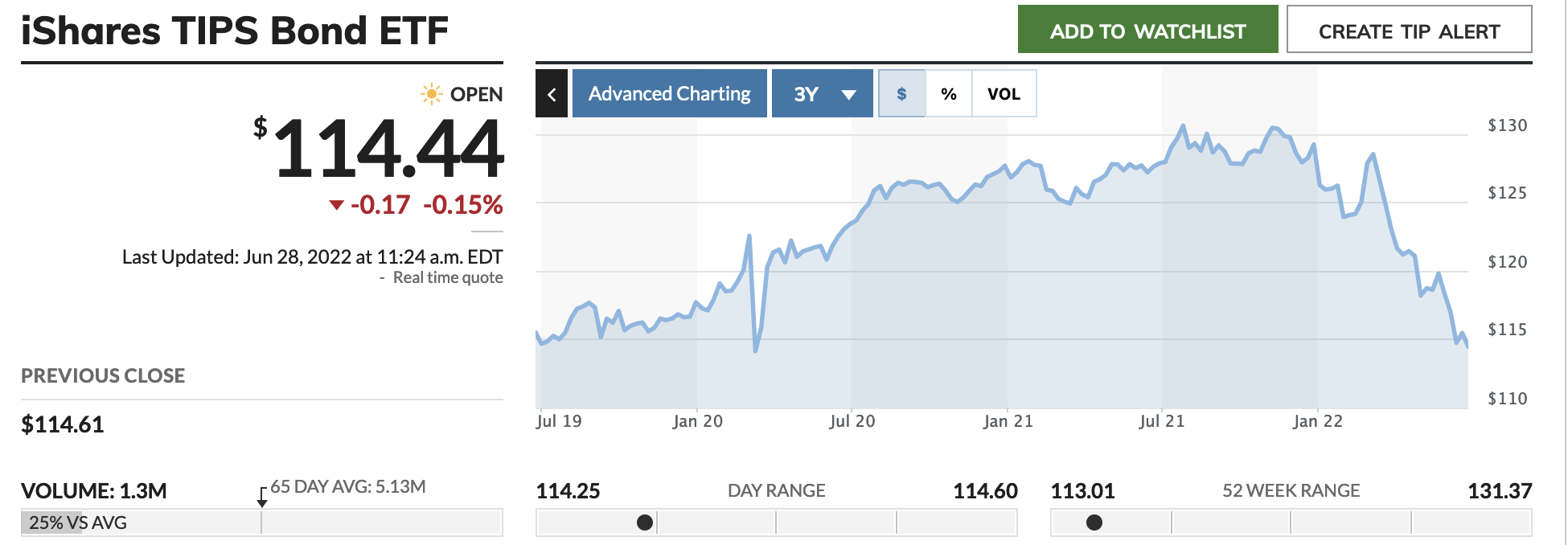
Amid the highest inflation readings in decades (a backward-looking lagging indicator) and talk of central bank tightening through 2023, it’s worth noting that Treasury inflation-protected securities have fallen 12% since last summer.

The TIPS ETF price (below since July 2019) is now back to the same level as in March 2020, when markets were staring down the steepest global recession in decades.

Commodities (used in the production of goods) are considered a leading indicator of inflation. The CRB commodities index has fallen 9% since June 9th, while many key constituents are down more: oil -15% since March, natural gas -30%, copper -24%, aluminum -36%, nickel -54%, wheat -28%, cotton -38% etc. The price of goods makes up 40% of the consumer price index (CPI).

There’s never been a time when US inflation (8.6% annualized reading in May) rose above 5% that the economy did not fall into recession. There’s never been a recession that didn’t help squash inflation, commodities, profits, employment, equities and corporate bond prices while boosting government bonds (lower yields).

Real estate prices have a 93% correlation with equity prices. Periods of falling real estate prices (the most widely held and leveraged asset) have coincided with the deepest recessions in history.

Recessions are officially recognized many months later in retrospect by NBER, often after they have ended. Recessions are a normal corrective phase of the economic cycle, but politicians, central banks, most financial advisors and economists never see them coming.

The average S&P 500 decline accompanying a recession has been 42% over 16 months. Even when central banks go back to easing, monetary policy works at a multi-month lag, so stock markets typically don’t bottom until some 15 months after the Fed’s first rate cut, when the masses are liquidating in losses.

Central bank policies can help inflate asset bubbles but cannot prevent their bust phase. It’s up to individuals to anticipate and manage financial risks.

Posted in Main Page | Comments Off on Recessions squash inflation and risk assets




