Easy credit comeuppance

After leaving base rates in the banking system at zero for two whole years (March 2020 to March 2022), the US Fed hiked yesterday for the third time in as many months, this time going a panicked .75– the first such single increase since 1994. It’s now expected that the Bank of Canada will follow suit on July 13 and a stream of hikes into 2023.

The two years of policy-enabled ‘free money’ (cheap credit and government largesse) helped fuel a consumption boom amid supply disruptions caused by the first global pandemic in 100 years. Fuel and food supplies were further stressed by Russia’s February 24 invasion of Ukraine. Together, these factors inflated the cost of housing and most goods to unsustainable levels.

Now, central banks are responding to public and political angst by aiming to ease inflationary forces through demand destruction (aka recession). Plunging asset prices and economic activity suggest they are starting to succeed. The first quarter US GDP growth was -1.5% and Q2 is now tracking at zero. Excess supply, disinflation and falling Treasury yields follow–inflation always falls during recessions.

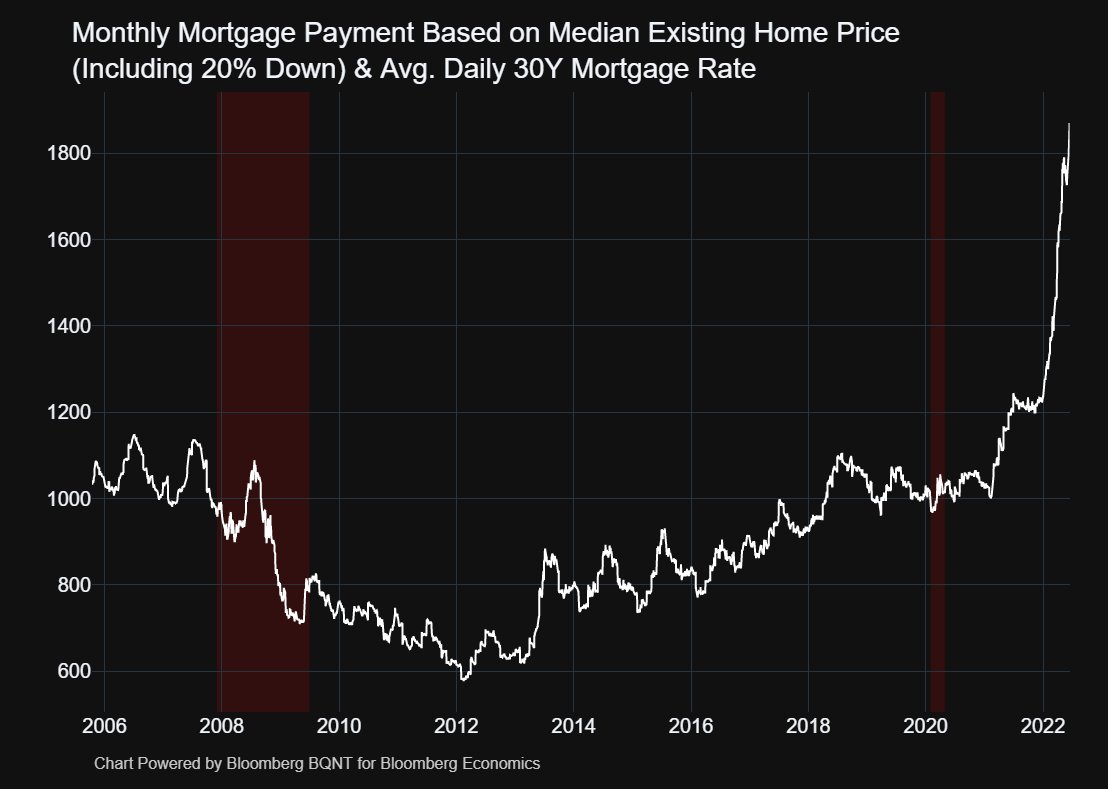
Lofty home prices plus sharply higher interest rates drove a 50% increase in America’s median monthly mortgage payment over the past six months (shown below, assuming a 20% downpayment). Even worse in Canada because Canadian median home prices came into this rate crunch an excruciating two times higher than America ($816,000 vs $375,000 in March 2022). The pain in shelter costs comes with a 50% leap in the median price of gasoline year to date and a 10% increase in average food costs, while the median average hourly wage has risen just 3.3%. Households cannot make these ends meet and with home prices starting to slump, the refi ATM is no longer cooperating. No wonder credit card usage has surged–the last of the lifelines for many. Layoffs are now beginning.
The prior errors of too much slack are becoming a collective comeuppance—lots of pain to go ’round.

Danielle DiMartino-Booth offers an excellent summary in this segment. Here is a direct video link.
Posted in Main Page | Comments Off on Easy credit comeuppance

Return of principal matters most

The policy-inspired and behaviour-driven ‘everything bubble’ is fulfilling its destiny, morphing into the everything bust.

Cryptocurrency grand-daddy Bitcoin is off 70%, and others in the space are faring worse. Two trillion in sketchy market valuation has been vaporized in the crypto space alone. The much-hyped Purpose Bitcoin ETF, Canada’s first crypto ETF touted as an “innovation” “helping” people get into the crypto space, is -71% since November.

Another $10 trillion in market cap has been deleted with the S&P 500’s 22% tumble. The NASDAQ is -32% in seven months, and we might be halfway through this bear market. Large-cap stocks typically don’t bottom until the economy is in the latter third of a recession, the US central bank is back to easing monetary conditions, and the US 10-year Treasury Bond has rallied enough that its yield falls an average of 160 basis points from the high (hat tip: Rosenberg Research). Today, a recession has not yet been recognized, and central banks are still racing to outdo each other with the most aggressive tightening efforts in decades.

For the first four months of this year, so-called value companies were holding up better than growth names, but since April, both are tumbling together. Likewise, bonds of all credit grades have seen the most negative price action since 1940.

Initially, attention was mostly on rising rate expectations with little focus on the relative resources of borrowers. As risk-seeking appetite persisted, high-risk corporate bonds sold off less than investment grade and government treasuries into April. This is short-sighted because government bond yields set interest rates in the economy, and their sharp repricing is now hitting hard. In just one shocking wallop: 30-year US mortgage rates hit 6.28% this week, from 5.5% last week and 2.9% one year ago. Budget-blowing for borrowers.

With cheap money evaporating, the realization is spreading that governments have taxation ability and the deepest resources while companies and households will have more trouble refinancing debts and meeting payments. See the WSJ.com The Fed Pricked The Everything Bubble:

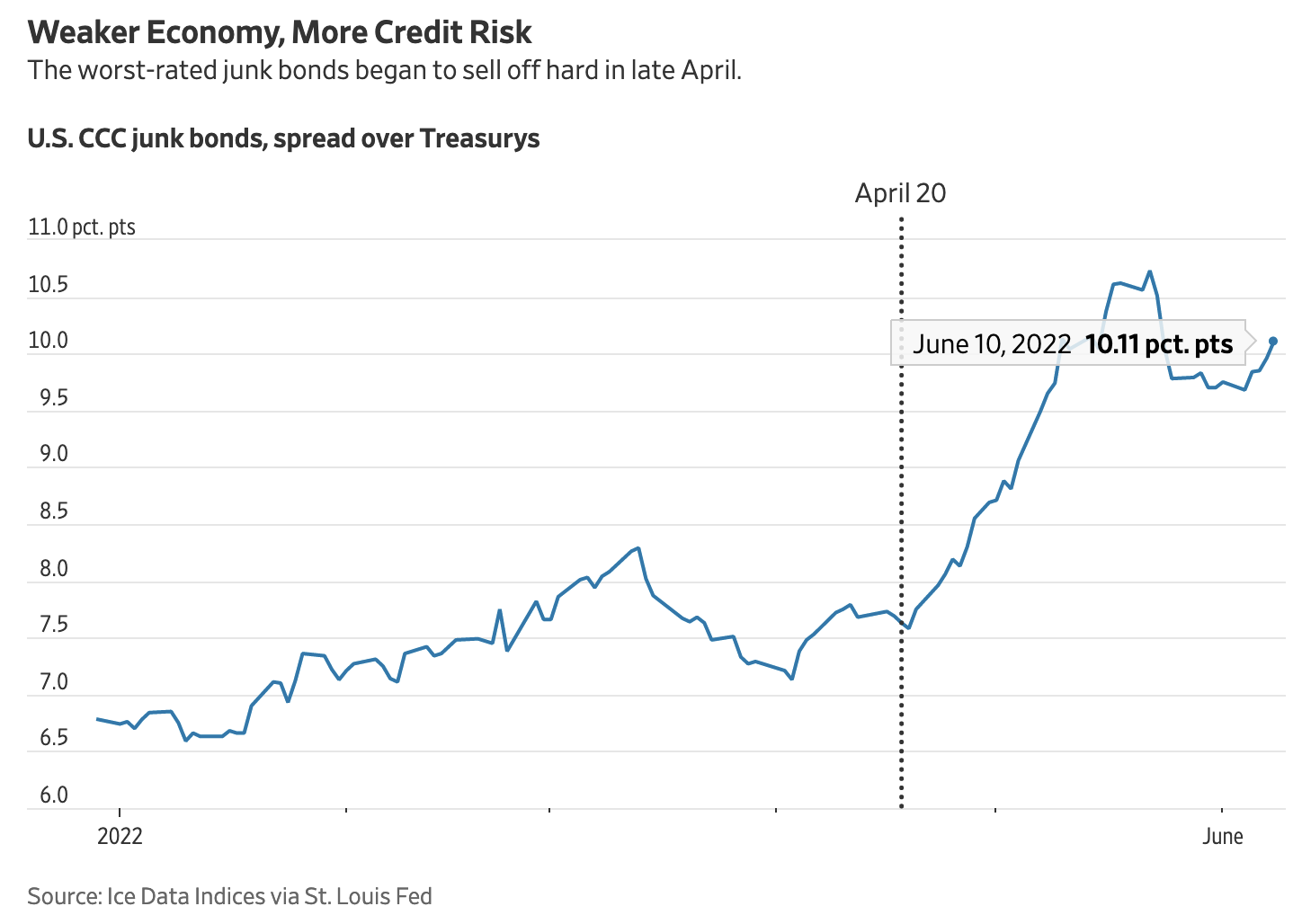
Until late April, the weakest junk bonds, those rated CCC, had fallen mostly in line with Treasurys. It was only last month that they sold off much more than safe government bonds, as fears rose that Fed tightening would create trouble in the economy.

Since April, as shown above, the weakest public corporations (CCC credits) have seen their borrowing costs leap from 7% to more than 10% above treasuries–a 30% increase in two months.

When money is virtually free for borrowers and near-nil yielding for investors, many people do dumb stuff with it. But when rates rise sharply, the riskiest bets blow up, and investors get reminded that capital options are far from equal.

Return of principal matters most in the end; only bonds are obliged to return it, and borrowers’ ability to do so varies greatly. Credit quality is the next big theme for markets to reprice.

Posted in Main Page | Comments Off on Return of principal matters most

Hypothetical returns designed to disappoint

It is important to understand that advertised investment returns typically assume that all interest and dividends are reinvested with no withdrawals for fees or spending–ever.

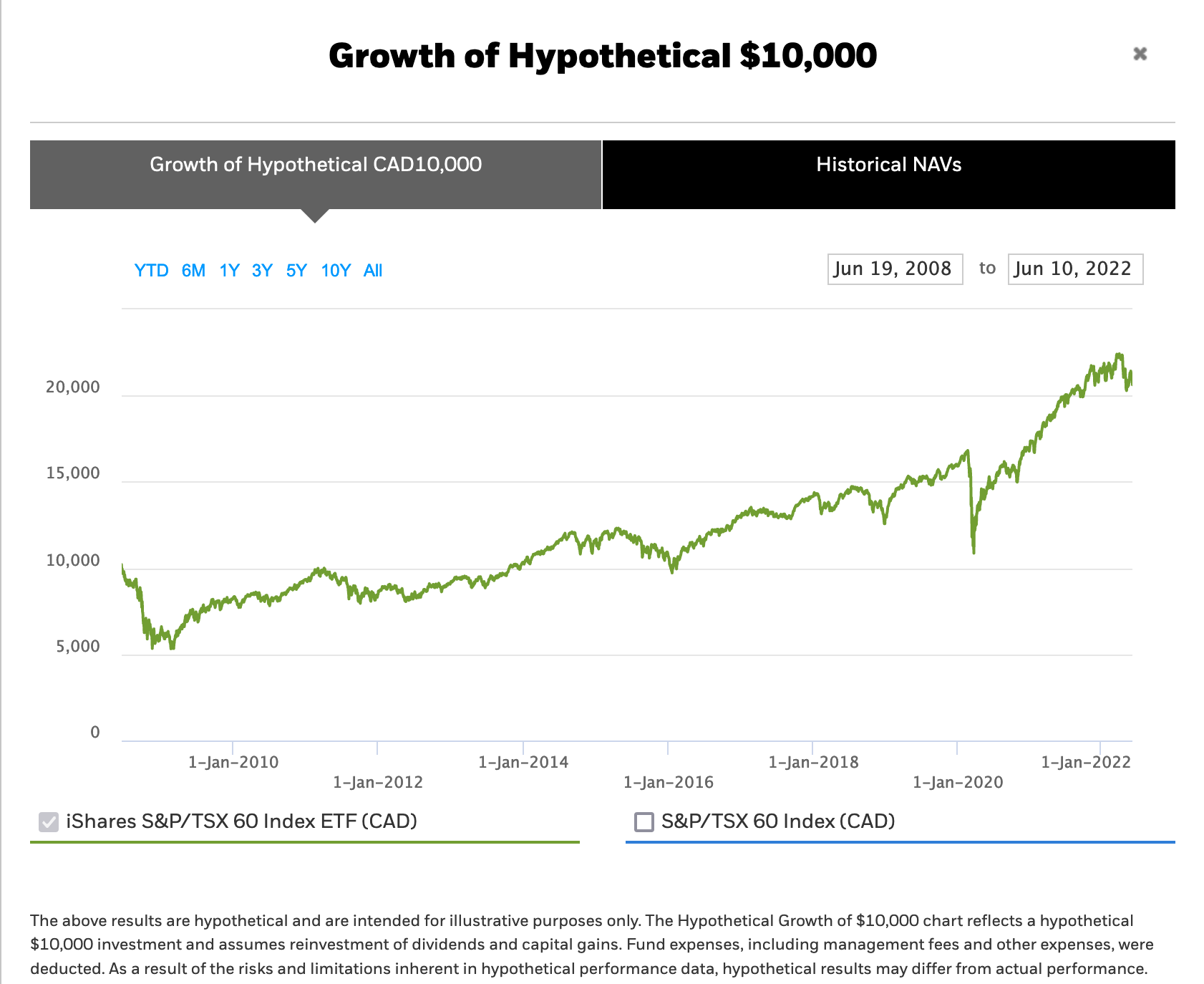
In this way, as charted below and here, the notional annual compound return of Canada’s investable TSX 60 index (XIU) over the 14 years to June 10, 2022, was advertised as 5.05%, with 3.16% of that assumed to have come from reinvestment of the 2.6% average annual dividend yield.

Hypothetical returns indeed; in reality, intermittent deposits and withdrawals are par for real life, and actualized returns rise and fall with asset valuation cycles.

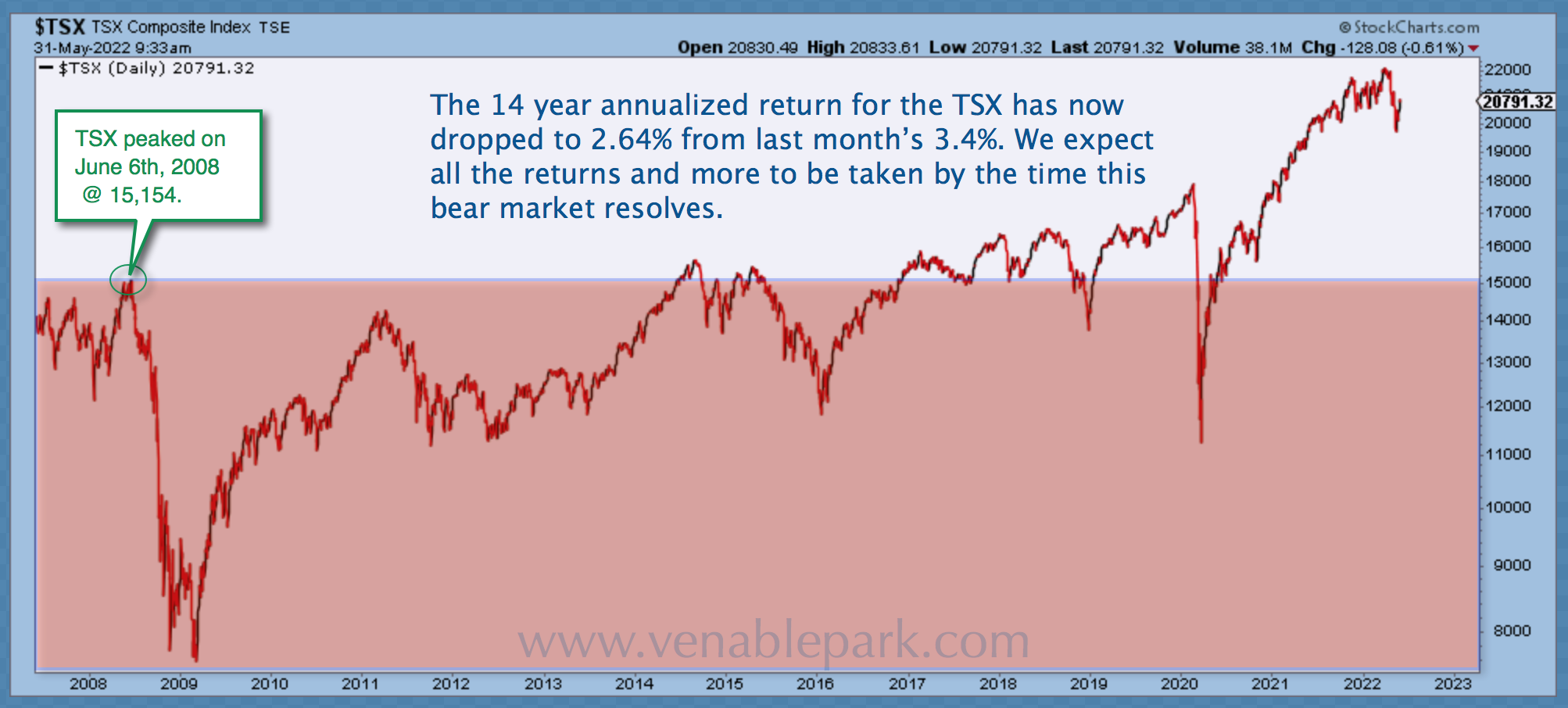
Case in point, at its 22,000 peak in April 2022, Canada’s TSX composite index had managed to appreciate 3.4% per year since 2008. As shown in my partner Cory Venable’s chart of the TSX index below, as the market dropped into the end of May, capital returns over the prior 14 years had eroded to 2.64% annualized.

Under 20,000 today, just 10% below its April peak, the annualized capital appreciation rate for the TSX since 2008 has fallen to 1.89%.

Historically, the average S&P 500 decline has been 29% over 12 months if the economy was not in recession and 42% over 16 months when it was; the TSX has roughly tracked along for the ride.

A further 32% decline for Canadian stocks from here (taking the index back to the 13,000 range) is our base case and a relatively mild outcome given the present extremities of over-valuation, indebtedness, and economic deceleration. Such a price move would retest the March 2020 COVID crash low and evaporate all capital appreciation for the TSX for the past 14 years.

As horrible as that would feel for many, the truth is that negative returns have been the most probable outcome for conventionally allocated portfolios because irrational exuberance has repeatedly goosed valuations far above historical norms since the late 1990s.

A return to the long-term historic mean on critical financial metrics will require years where ratios stay below average–that’s how averages work.

The masses do not understand mathematical probabilities, or they don’t turn their minds to them. Like engineers, financial analysts are trained to take measurements, assess and recommend best construction practices for efficiency, stability and safety. That’s actually the easy part. However, most work for entities where they’re paid to ignore time-tested formulas and principles to encourage people into risky structures.

That a building or bridge goes years before collapsing doesn’t mean it was soundly constructed, nor that those who warned about its frailty were wrong. The same is true in finance.

Posted in Main Page | Comments Off on Hypothetical returns designed to disappoint