News from the mortgage frontline in Canada…worth a listen.
What’s Happening to Mortgages Now That Rates Are Up? with Ron Butler | DFI30 | Well it appears that real estate prices are down in many parts of Ontario after record increases. Not surprising since the Bank of Canada has indicated it will raise rates again. But what has this done to mortgages? What’s happening when people renew? How has mortgage qualification changed? Enter Ron Butler, mortgage broker extraordinaire. On today’s podcast, Ron is back to give us an update on what he’s seeing on the ground with respect to mortgages. Here is a direct video link.
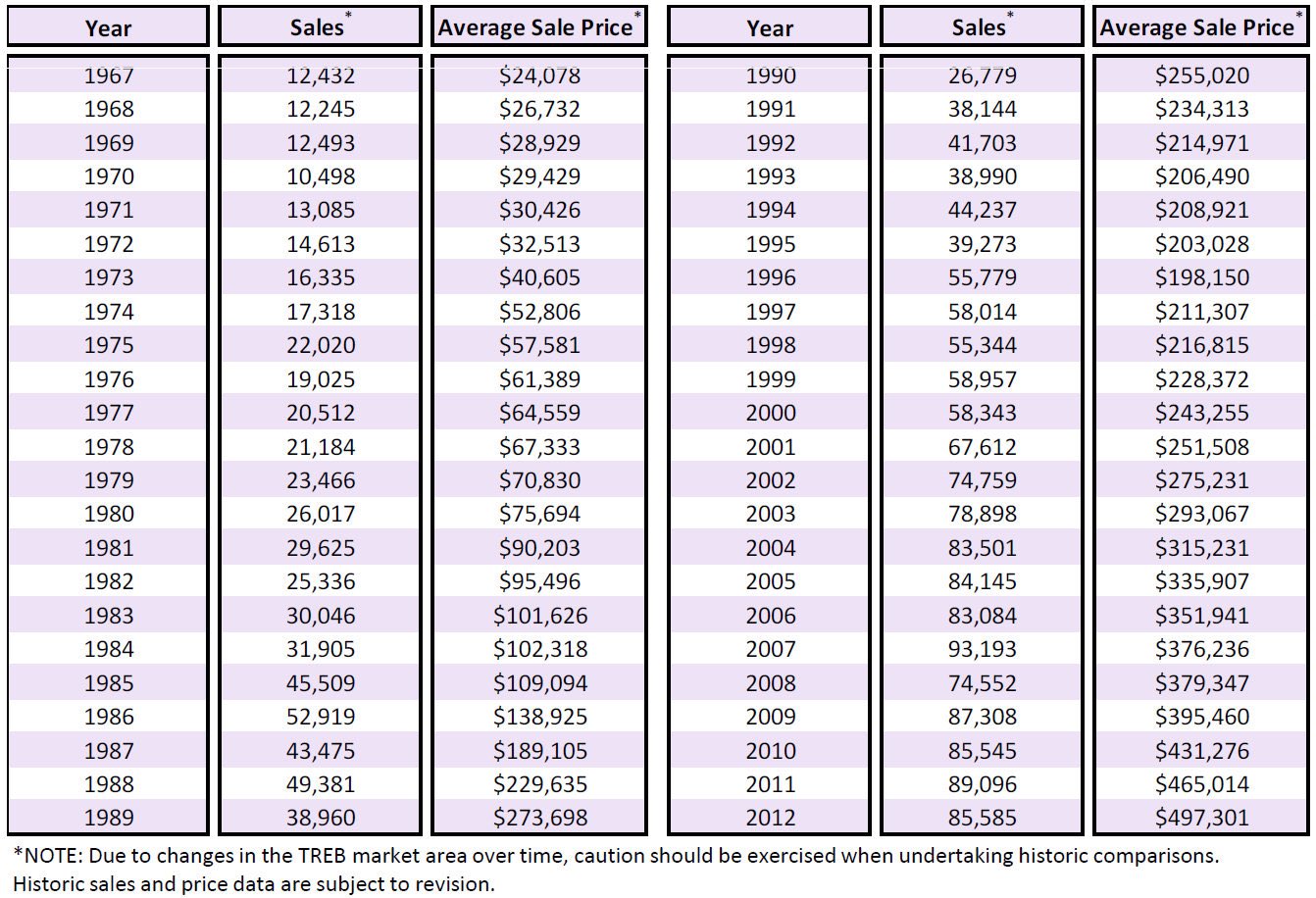
It’s worth noting that after Toronto home prices topped out in 1989, they fell an average of 28% to 1996 and did not recover 1989 levels until 2002 (see table below). I remember this vividly. The pattern is pretty typical of housing bust cycles historically, and yes, it can happen here again. Different cycle, similar behaviour = similar outcome.
Posted inMain Page|Comments Off on What’s happening in mortgage land?
Since its peak at the end of 2021, nearly $8 trillion in market cap has been knocked off the S&P 500 alone. This comes with a 24% loss in the average NASDAQ stock and a 55% drop in Bitcoin, not to mention even larger declines in many individual stocks and crypto-currencies globally.
Asset bubbles give and then their busts taketh back. Losses naturally hit the wealthiest most since the top 1% owns more than half of US equities and equity funds, while the bottom 90% owns less than 12% (Fed estimates).
So far, the two wealthiest people in the world, Elon Musk and Jeff Bezos, who made fortunes as their company shares ballooned in recent years, have lost an estimated 41% and 39% of their net worth since just November. Though still billionaires, net worth declines tend to have a negative psychological impact on everybody. For the masses though, significant losses can be life-plan-harming.
At the same time, borrowing costs have risen and corporate profits are declining. The combination is starting to prompt the usual cutbacks and layoffs just as households are indebted, cash light and highly levered on a housing bubble that’s now also beginning to mean-revert. This has broad impacts because the bottom 90% owns more than half of the housing market cap (the top 1% holds less than 14%).
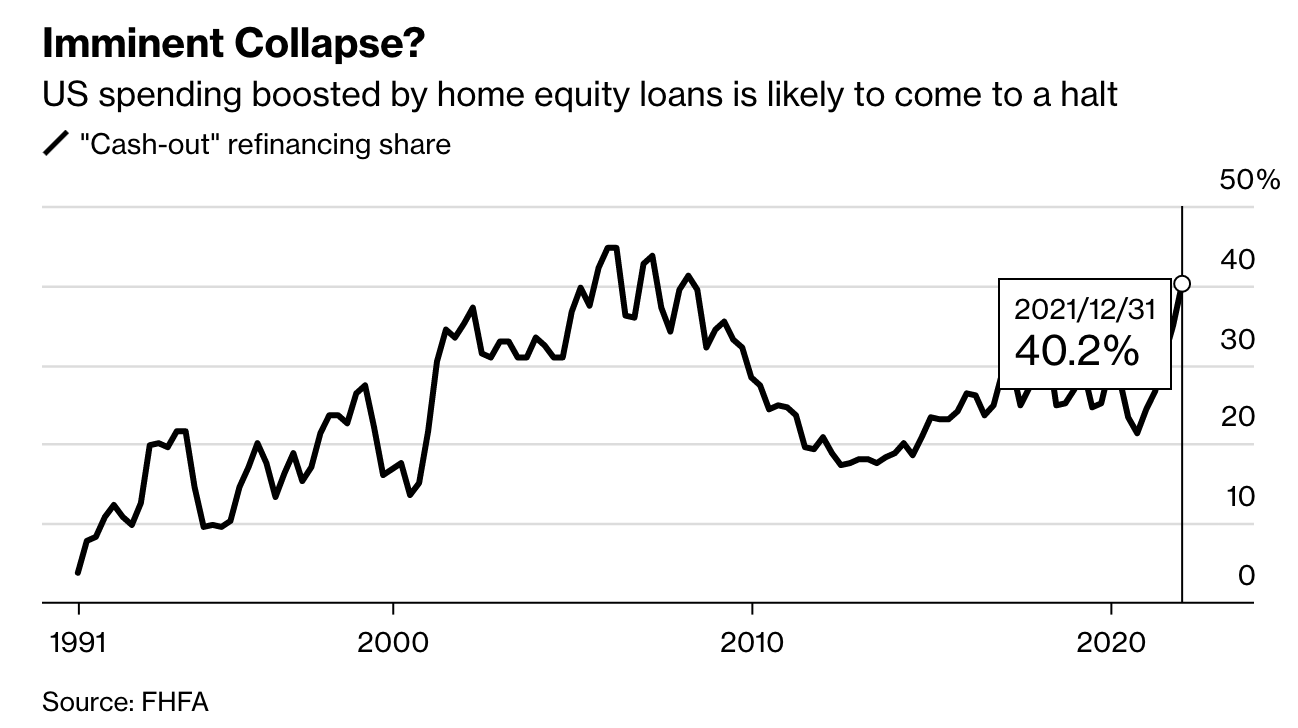
As home prices were leaping over the past few years, households sustained spending by borrowing against their rising equity. As shown below, the US ‘cash-out’ refinancing share revisited 40% at the end of last year. See: A ‘wealth shock’ is cracking American’s nest eggs. We saw this movie in the 2003-06 cycle when low rates drove similar behaviour into the 2007 bubble top. Now that rates have risen and home prices are stagnating and reversing in many markets, consumers are less able to tap their home equity to access more credit. Home prices that rose 30 to 50% in the last two years can decline that much and only return to where they were before the pandemic.
A ‘paper loss’ of home equity does not have to be a big deal for those who have not borrowed against notional prices in recent years. But for those who have, it can be catastrophic. Many used ‘cash out’ loans to buy other inflated assets or help family members also lever into the property bubble.
A correction of 20% can completely evaporate the notional equity that conventional mortgagors thought they had and leave negative equity for years to come. This is why housing busts tend to be deeply scarring– financially, psychologically and economically.
It’s spooky that this cycle has combined the worst elements of the 2000 tech top and the 2007 housing top into one super-bomb for net worth and the consumption-dependent global economy. And yet, here we are.
The 2022 Housing Crash has started. Home Prices are dropping by 20% in some neighborhoods. Check Zillow to see for yourself. The US Housing Market Bubble is turning into a Crash very fast. Here is a direct video link.
Posted inMain Page|Comments Off on This asset bust combines the worst of the 2000 and 2008 cycles
Worthwhile discussion in this segment in terms of the bear market progress and sentiment to date and the value of cash in softening portfolio declines and preserving liquidity.
Even though both the stocks and bonds have had a dismal start to the year, most investors aren’t panicking yet. Instead, there’s a lot of talk about the bottom being near. And hope that much of the recent losses can be regained. That kind of optimism isn’t seen in a real bear market, cautions seasoned financial advisor Ted Oakley, Managing Partner & founder of Oxbow Advisors. In a true bear market – which he sees as likely to arrive as the year progresses – pessimism rules. It gets to the point where no one thinks stocks can ever go up again. We’re far from that kind of capitulation in sentiment right now. Here is a direct video link.
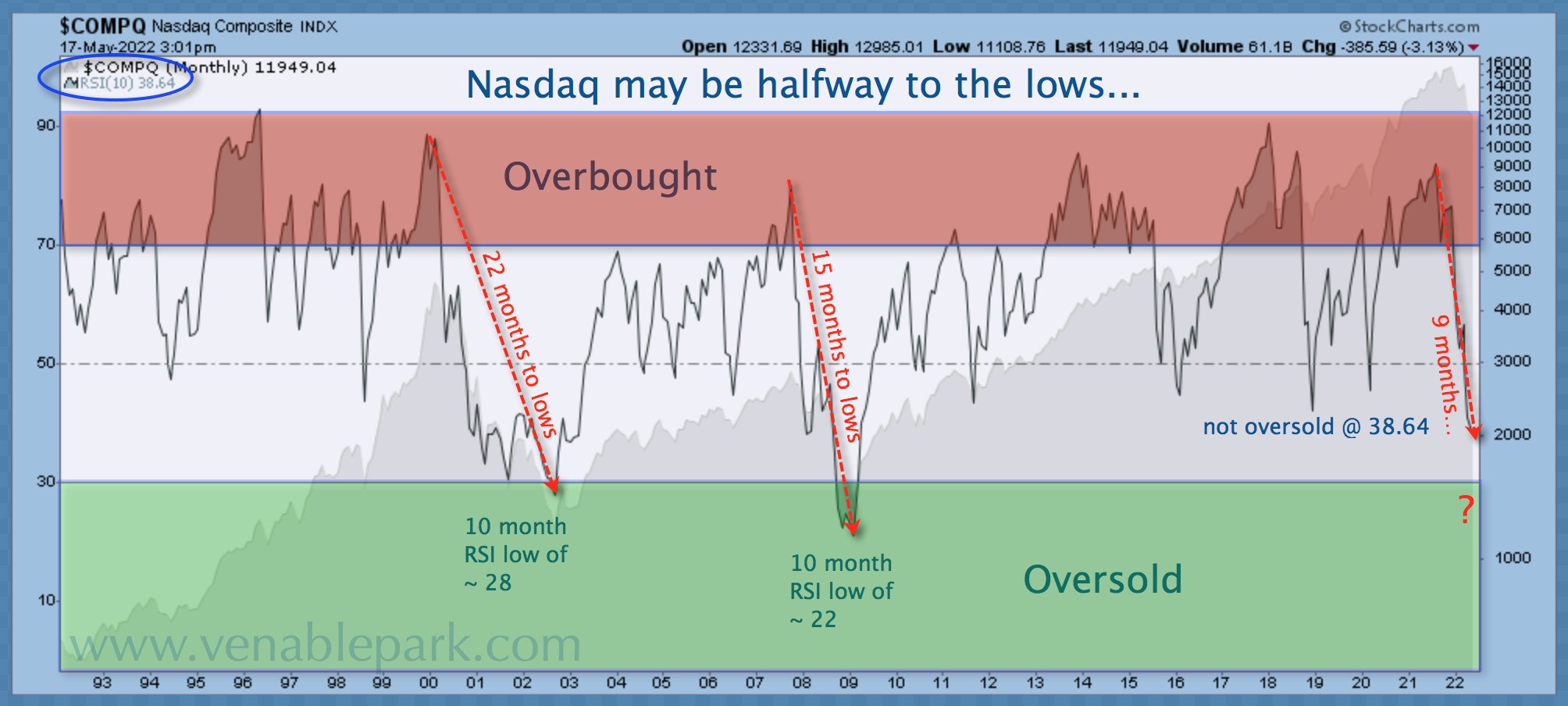
My partner Cory Venable’s latest analysis of the NASDAQ’s 10-month relative strength indicator since 1992 (below) suggests that the 25% decline to date may be the midpoint of the ultimate loss this cycle. Not nearly oversold yet.
Posted inMain Page|Comments Off on Bear market update
“An explosive critique about the investment industry: provocative and well worth reading.”
Financial Post
“Juggling Dynamite, #1 pick for best new books about money and markets.”
Money Sense
“Park manages to not only explain finances well for the average person, she also manages to entertain and educate while cutting through the clutter of information she knows every investor faces.”
Toronto Sun