Contagion: rising rates, falling stocks, home prices and the economy

Interest rates have risen sharply, and financial and housing markets are under pressure. With households holding a record amount of their net worth in highly-levered assets, this cycle’s contagion risks are higher than average.   It’s another good time to read or re-read Robert Frank’s timeless 2011 book The High Beta Rich. Nicholas Gerli connects the dots very well in the segments below.

Netflix and Robinhood recently announced large layoffs. Both are large tech companies whose stock prices have collapsed in recent months. This is part of a crash in the stock market with the S&P 500 down 14% and NASDAQ 22% Year to Date. As the performance of these companies continue to erode, more layoffs will be announced. That’s because a shocking number of companies in America LOSE MONEY. 44% of the NASDAQ has negative earnings. 67% of Public Companies in San Francisco. 57% of Companies in Boston. As interest rates and inflation continue to rise, these companies will struggle to fund operations and be forced to layoffs employees. And potentially shutdown altogether. This could trigger a massive Recession and Housing Crash, particularly in tech-driven cities and Housing Markets such as San Francisco, Seattle, Boston, Austin, and Denver. The Netflix and Robinhood layoffs were just the start. Historically, it takes about 6-months from a big correction in the stock market before heavy layoffs in the economy begin to occur. That’s what happened in the Dotcom Bust of 2001 and the Financial Crash in 2008. That suggests the layoff spike in April 2022 could be a prelude to much larger layoffs, and unemployment claims, in the Summer of 2022.  Here is a direct video link.

How likely is coming correction in the housing market? If one occurs, how bad could it be? Which markets are most vulnerable? And which looks best positioned? For answers to these important questions, I’m pleased to welcome Nicholas Gerli to the program. Nick is the CEO of re: venture consulting which provides business analytics and market research on US real estate.  Here is a direct video link.
Posted in Main Page | Comments Off on Contagion: rising rates, falling stocks, home prices and the economy

Worst annual start on record- are stocks and bonds going to diverge?

As we await the next rate hike from the US Fed, some big picture is worth considering.

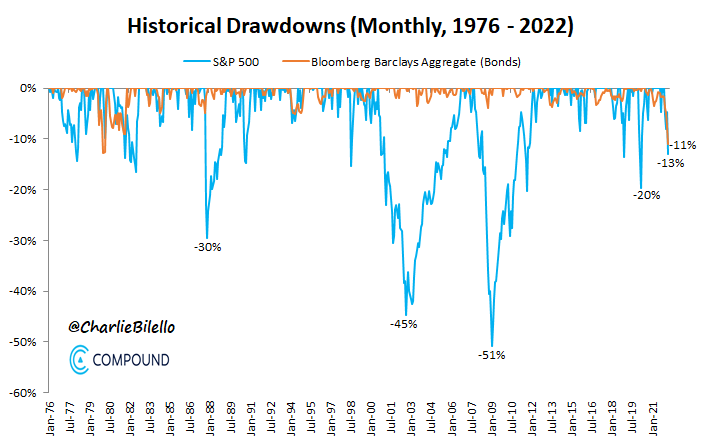
As shown below, courtesy of Charlie Bilello, year to date has been the most negative start for stocks (S&P 500) and bonds (aggregate index of investment-grade bonds) together since at least 1976, and the first time that both have lost more than 10% at the same time. Moreover, while the -11% decline for bonds (yellow below) has already been the worst on record, it bears mentioning that the -13% for large-cap stocks (blue line) is just a fraction of the total index drawdown seen in the recessions and bear markets of 2020, 2007-9, 2000-02 and 1987-88. Beyond the broad S&P benchmark, 45% of NASDAQ 100 stocks are already off more than 50%, which only happened as part of the larger-than-historically-average bear markets of  2000-02 and 2008-09.

The last eight times the S&P 500 was down in a calendar year, bonds finished the year up as higher interest rates slowed consumption and inflation.  The question is: will this time be different?

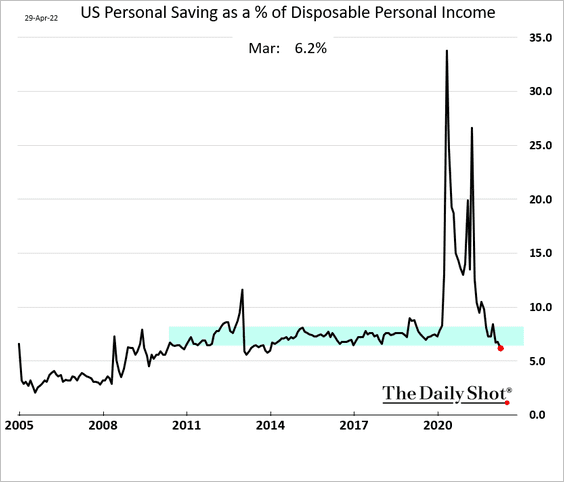
So far, the University of Michigan’s April consumer sentiment poll found the percentage of households still bullish on the stock market at a high 56.6% and those bullish on bonds tied for an all-time low of just 3% (Rosenberg Research).  At the same time, cash levels and personal savings as a percentage of disposable income (on the left since 2005, courtesy of The Daily Shot) have fallen back to pre-pandemic lows.  The liquidity crunch and capitulation selling for ‘weak hands’ has barely begun.  And they’re not holding bonds.

Posted in Main Page | Comments Off on Worst annual start on record- are stocks and bonds going to diverge?

A Dilemma of the Fed’s Own Making

Danielle DiMartino Booth, founder and CEO of Quill Intelligence, joins Jack Farley and former senior Fed trader Joseph Wang to share her outlook on this week’s FOMC meeting. Booth argues that the Federal Reserve’s lateness to fight inflation has caused it to lose a lot more credibility, and makes the case that it risks to lose even more credibility if it fails to recognize that the economy is slowing rapidly. Booth notes that credit spreads are widening rapidly and argues that it will be a credit market blow-up, not an equity market drawdown, that forces the Federal Reserve to change course.

Wang and Booth discuss how rising mortgage rates will deter the Fed from shrinking its holdings of mortgage-backed securities (MBS), and they each give their take on the continued sell-off in Treasury bonds.  Here is a direct video link.

Posted in Main Page | Comments Off on A Dilemma of the Fed’s Own Making