Canada’s unaffordable housing comes with long-term financial drag

The price of the average Canadian home hit $816,720 in February, its highest level on record (Canadian Real Estate Association).

The $816,720 average selling price is up 20 percent compared to last year’s level. In the most populated areas of the Greater Toronto and Vancouver areas, the average selling price exceeded $1 million. Without these two cities, the national average price was also a record high at $638,720.

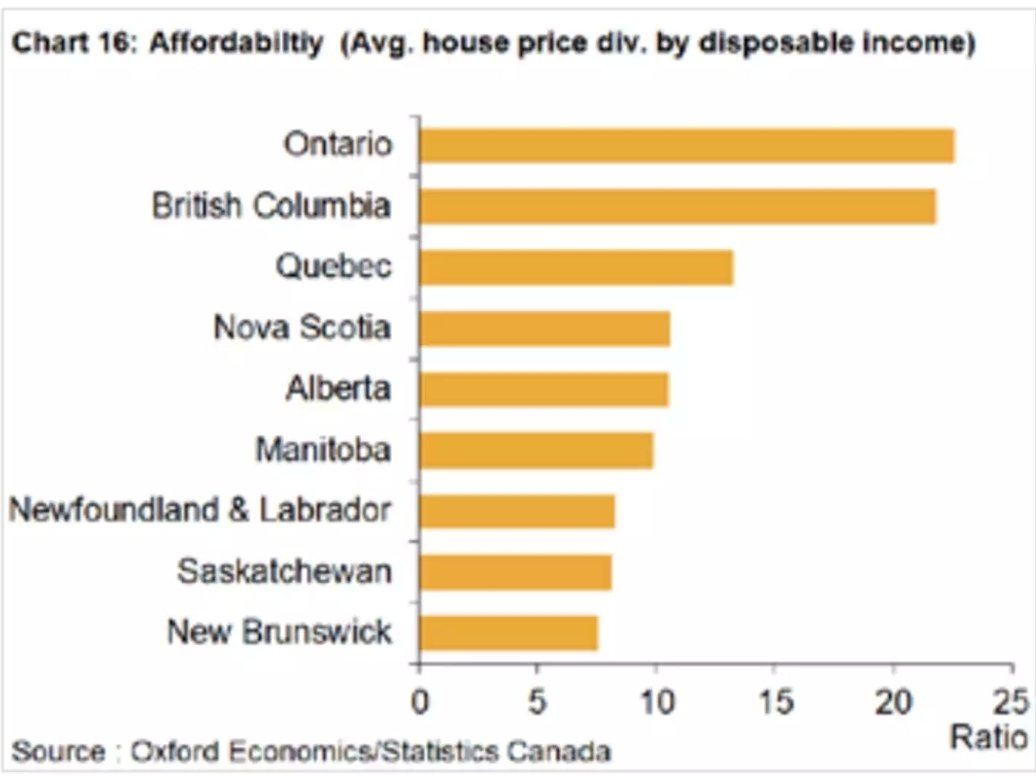
The average house price divided by disposable income is a precarious 23 in BC and Ontario (chart below). Many have necessarily given up on homeownership dreams. Many of those who do own are so indebted that they cannot meaningfully accumulate savings for other critical goals like retirement, education, emergency funds and new business creation. All of this has a long-term economic drag on households and the economy.
After doubling with the oil patch boom from 2004 to 2008, Calgary home prices fell 25% and largely flatlined for 15 years to 2020 (a typical historical pattern that followed past housing booms in Canada and other countries). Then, over the past year, relative value has attracted inflows (average price in Calgary $487,000 per CREA), and benchmark prices in the city leapt almost 9% in the past three months–the fastest clip since the heady days of 2006.

As with everything, high prices ultimately become the cure for high prices and this credit and speculation-driven cycle is unlikely to end differently than the hundreds that have preceded it globally.  Those who lever in late are likely to suffer one way and another.

Institutional investors and funds hoover up existing homes, pushing up prices and rents while funding new supply at a record clip (see Wall Street’s favourite suburban housing bet is getting crowded). The value of building permits in Canada hit $11.2 billion in November—the highest ever recorded. New private housing units under construction in America hit a 49-year high in January, with 1.543 single- and multi-family units in process—the most since 1973. Population-adjusted this matched the peak of the U.S. 2004-2007 building frenzy. In January, the 1.899 million U.S. building permits were also the highest since December 2006.

Bank of Montreal economist Robert Kavcic noted last week:  “Demand has been boosted by expectations of rising prices and a last-ditch effort to lock in cycle-low mortgage rates. But sentiment can change in a hurry, and this market could find balance very quickly the moment that it senses softer prices.”

While prices in Canada’s hot housing market continue to hit record highs, experts predict they could cool down if the supply increases alongside further interest rate hikes.  Here is a direct video link.
Posted in Main Page | Comments Off on Canada’s unaffordable housing comes with long-term financial drag

High gas prices accelerate energy evolution

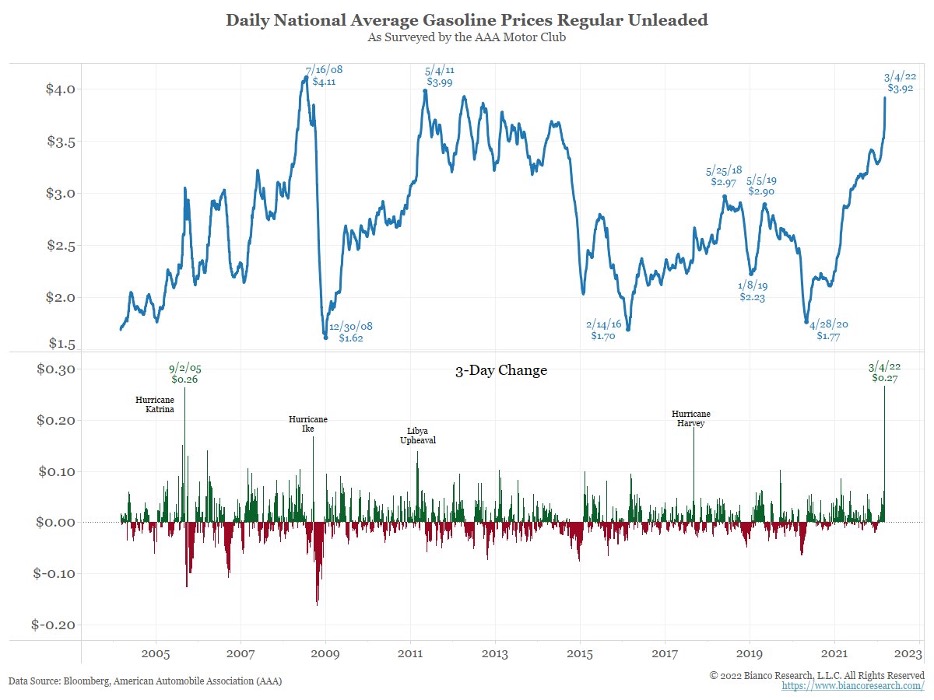
Just as employers are stepping up return to office mandates, gasoline prices are the highest in eleven years. Consumer pain is a valuable behavioural catalyst.

Half of the Canadian respondents to a recent Leger poll survey said they were now using their vehicles less; one-third said they were looking to buy an electric vehicle. I can attest to this trend as people are approaching daily to ask about our electric cars. Yes, we charge them in our garage overnight for about $5.00, and they can go 400 km on a single charge.  In addition, their cost of operation is dramatically reduced by 90% fewer parts to repair, replace and service, and a life expectancy greater than 800,000 km.

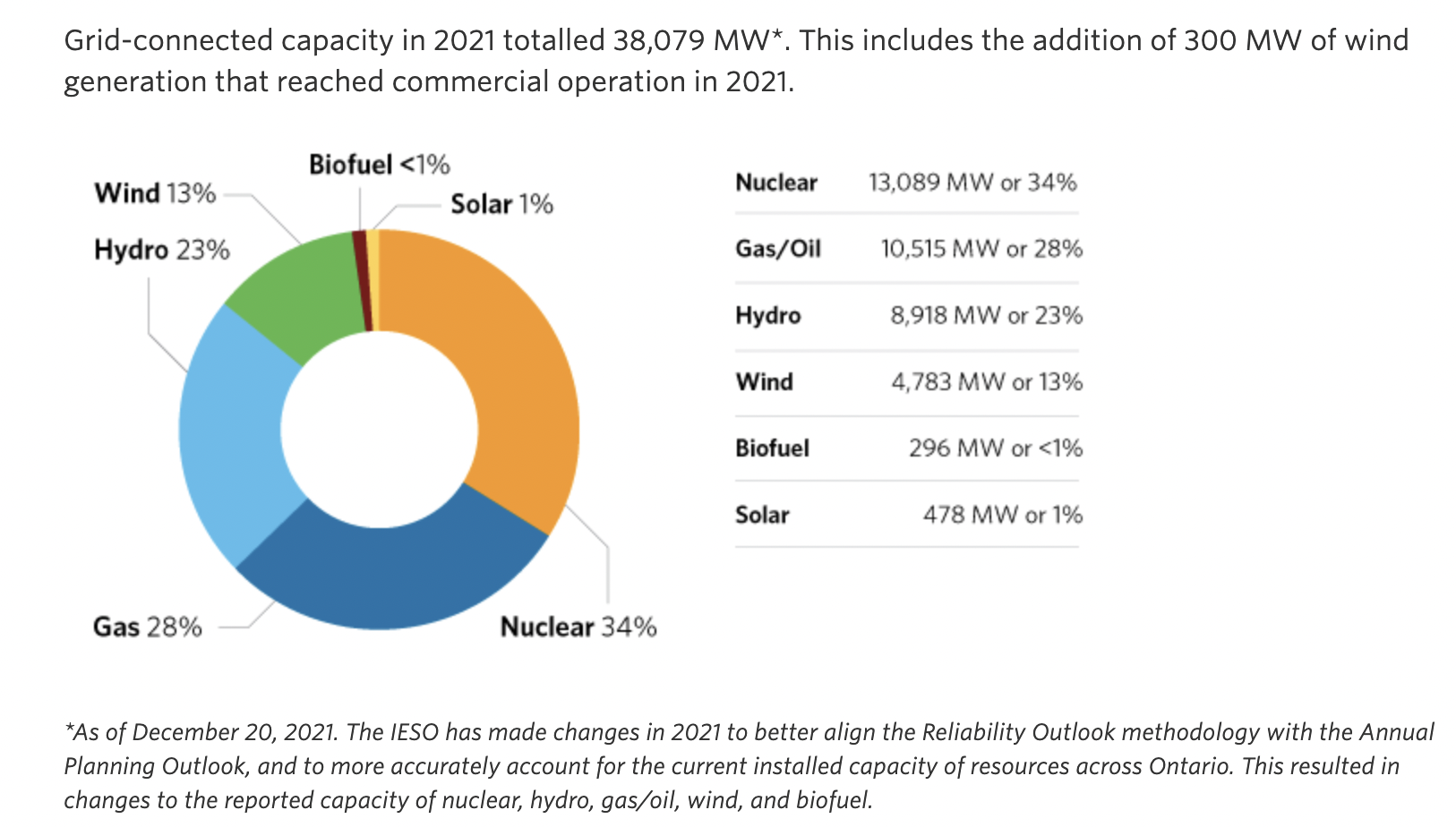
Yes, electrical power is more efficient and a lot cleaner than burning oil and gas in Ontario because 72% of the grid is powered by renewable energy sources as shown here.

Yes,  a shortage of nickel–an integral component of most lithium-ion batteries — is a hurdle.  And that is why metals recycling and alternate battery types are now seeing massive investment and innovation globally.

Six years ago, think tank RethinkX’s co-founders Tony Seba and James Arbib correctly anticipated that Russia would become a geopolitical flashpoint in the 2020s. Read: How Energy Disruption Led to Russia-Ukraine Crisis – and How the Crisis Will Accelerate Disruption.

Seba and Arbib told US military leaders that they would need to consider the probability of Russian aggression in the early-2020s. Seba’s projections showed that the acceleration of solar, wind, batteries, and EVs would make incumbent fossil fuel industries economically obsolete by 2030. The military and geopolitical systems these industries and countries are predicated on also become obsolete in the process. Countries primarily dependent on fossil fuel industries– and to perpetuate their internal political hierarchies–are at risk of resorting to traditional strategies of self-perpetuation and control to keep the cash flow going as long as possible.

350.org founder Bill McGibbon explains the opportunity and necessity in using the ongoing fossil fuel crisis to accelerate the transition to renewable energy in his latest article, In a world on fire, stop burning things. He speaks directly to Canadians:

Canada has fossil-fuel reserves totalling a hundred and sixty-seven petawatt hours, which is a lot. (A petawatt is a quadrillion watts.) But, he said, it has potential renewable energy from wind and solar power alone of seventy-one petawatt hours a year. A reasonable question to ask Trudeau would be: What kind of country finds a windfall like that and simply leaves it in the sky?

McGibbon talked to the CBC’s The Current on March 18 here in Fighting Putin and climate change at once.

Nothing about this necessary transition is easy. A war effort is required, to be sure. But then, nothing about the status quo is easy, affordable or sustainable. We evolve or die.

Posted in Main Page | Comments Off on High gas prices accelerate energy evolution

The Great Disruption: Energy, Transportation, Food & Agriculture

Failure to understand the S-curve adoption of disruptive technologies is a common blind spot.  Tony Seba explains the forces shaping the world in this August 2021 virtual update.

Virtual presentation to the Council of State Governments on the occasion of the CSG East 2021 Annual Meeting. Here is a direct video link.

Posted in Main Page | Comments Off on The Great Disruption: Energy, Transportation, Food & Agriculture