
Retirement plans for reappraisal as asset prices fall

The aging population drove a steady rise in retirees over the past decade.  The pandemic accelerated this with a surge in those opting to retire sooner than previously expected (shown below courtesy of Dailyshot.com).
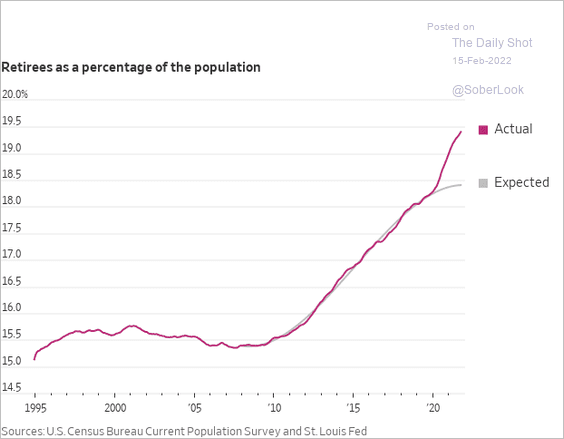
The motivation has been partly fear and risk around contracting COVID-19 and greater workplace stress amid pandemic protocols.  It was also encouraged by a surge in emergency support from governments and central banks, which boosted household income, savings and speculative fervour, goosing asset prices far beyond historical norms.

The downside is that asset gains are not permanent and, ex-government transfers, real incomes have not recovered their pre-pandemic trend (below courtesy of EPB Macro).
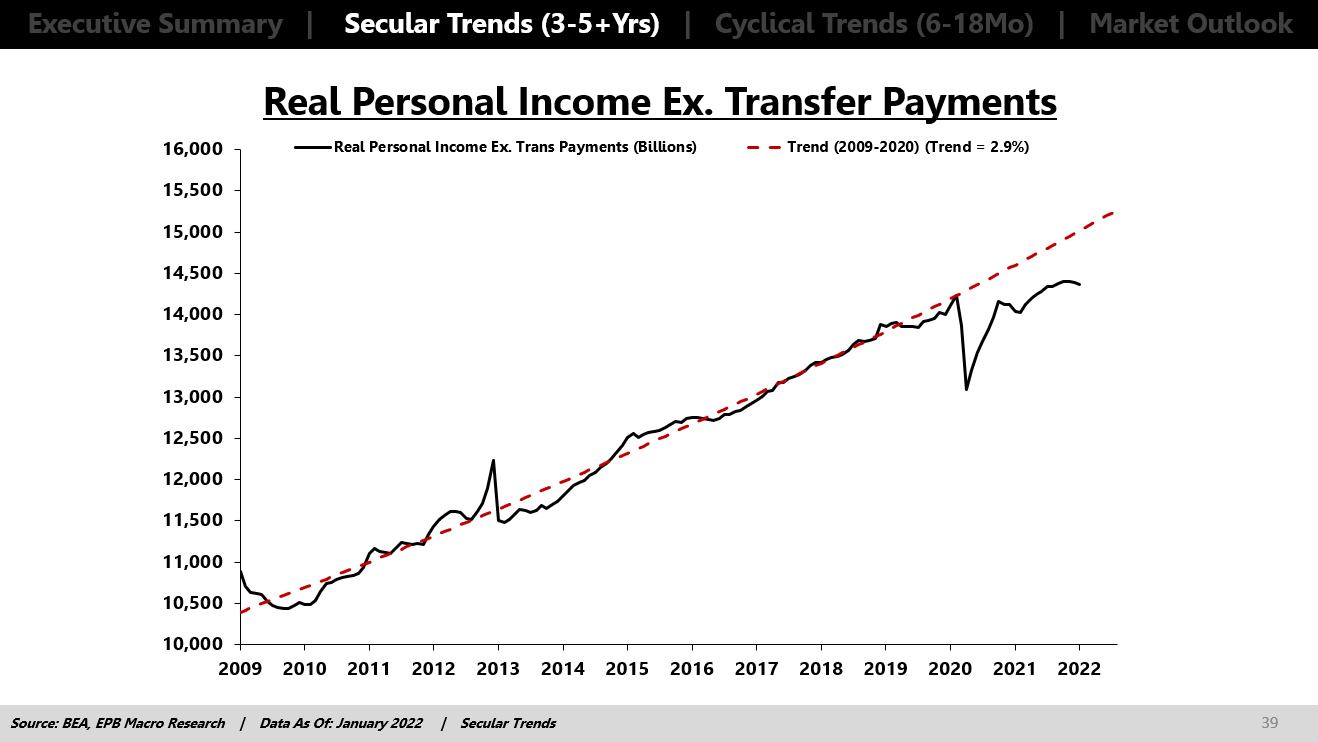
After two years of debt-addition and extreme price inflation in homes and corporate securities (equities and debt), households are now more risk-exposed than at any time in decades, just as the downcycle itself is poised to be larger and longer than average.

As a percentage of U.S. household assets, bonds fell to an all-time low of 2.3% in 2021.  Recent Fidelity data showed that 40% of retirement accounts for 60- to 69-year-olds were 67% in equities at the end of 2021.  In the process, equities, at the highest valuations in decades, became 40% of the entire financial asset mix from a long-term norm of 18%.

This level of equity concentration means that capital losses will hit twice as hard as past bear markets, just as owners are that much older and less able to wait years growing back losses.

It’s not just that individuals hold a record amount of their self-directed savings in equities and equity-based products.  Fund managers’ allocations (shown below since 2005), ETFs and pensions are overweight too.
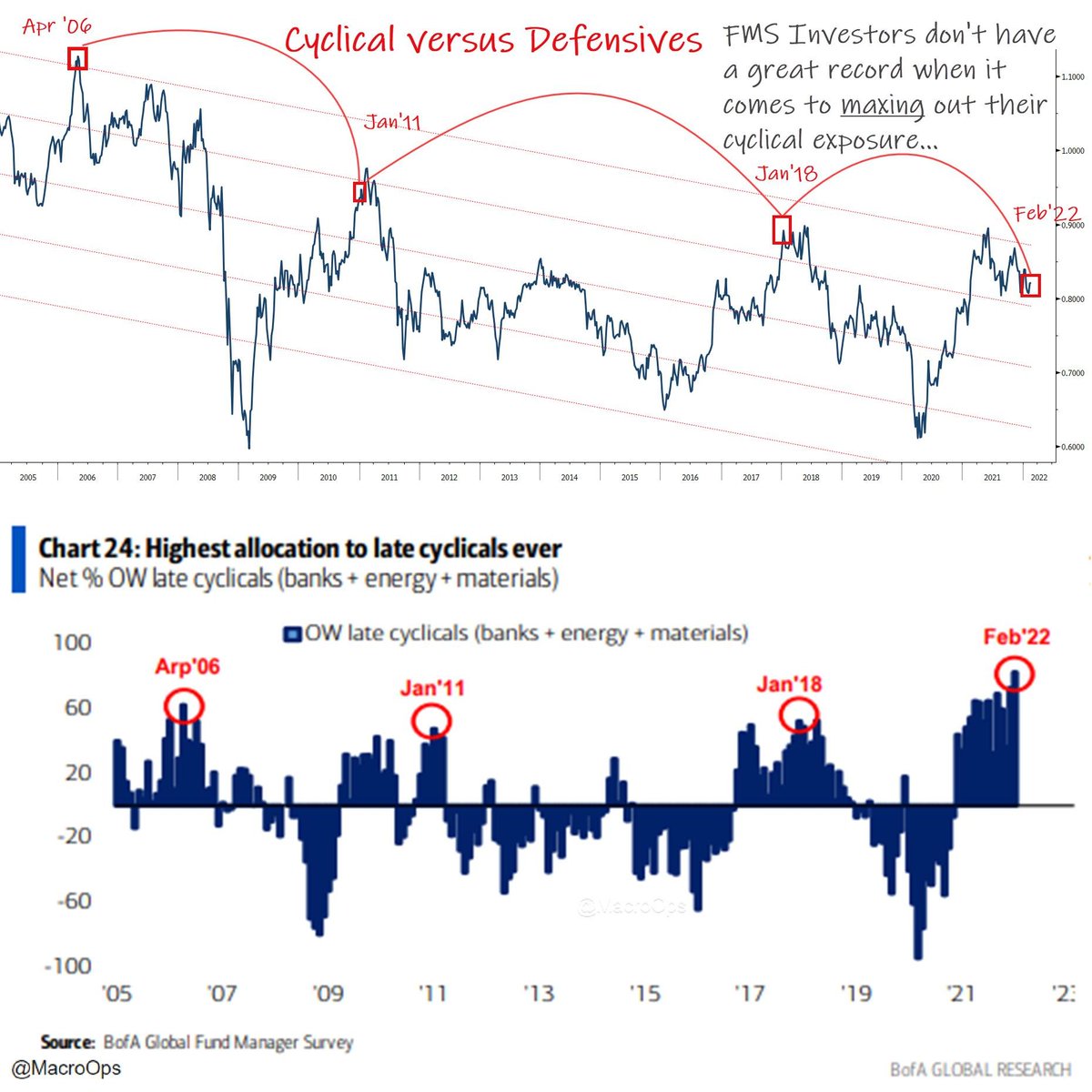
The capital costs of this are just starting to bite, see U.S. Retirement funds, heavy on stocks, brace for losses:

Volatile stock markets are eroding the retirement savings of America’s teachers and firefighters after public pension systems ended last year with equity holdings at a 10-year high.

Public pension funds had a median 61% of their assets in stocks as of Dec. 31, up from 54% 10 years ago, according to Wilshire Trust Universe Comparison Service. Since then, the Russia-Ukraine War and expectations that the Federal Reserve will raise interest rates this month have battered equity prices, reducing those holdings by billions of dollars.

In Canada, the propensity to index-tracking magnifies exposure to dominant late cyclical sectors like financials and fossil fuel companies.  While they typically hold up longer than growth sectors like tech, they follow them down in the end, especially as the yield curve flattens towards zero–as it’s doing now.

Unfortunately, value-indiscriminate buying and passive holding on the way up leads to value-indiscriminate liquidation after bubbles burst.  It’s often only then that people realize the lasting ramifications of their losses.  For these reasons, this PBS segment on early retirees is hard to watch.

Among the reasons for the current labor shortage in the U.S. is the exodus of older workers retiring early during the pandemic. Economics correspondent Paul Solman reports. Here is a direct video link.
Posted in Main Page | Comments Off on Retirement plans for reappraisal as asset prices fall

Diving loonie and treasury spreads warn of recession

Oil prices (WTIC) have doubled in just over three months. Average U.S. gas prices, up 10% in just the past week, hit a 30-year high of $4.17 a gallon ($5.44 in California), and North American LNG prices have spiked to all-time highs.

Oil price shocks become deflationary because they trigger demand destruction and economic contraction, especially when the shock coincides with a leap in the cost of food, shelter, and other staples. Where possible, consumers cut back, avoid and substitute; they also cut spending in other areas. A Bloomberg Intelligence report finds that a one-cent change in gas prices influences annual U.S. consumer spending on fuel by about $1.1 billion (See Bond Market sees a recession in the oil shock). This particular fuel spike is happening as reopening trends have more employees commuting back to work.

For all these reasons (and more), this economic cycle faces a greater recessionary impulse than the historical average. It’s also hitting after consumers spent two years buying an unprecedented amount of durable goods which won’t need replacing for s period of years (aka ‘pent down’ demand), and producers and sellers have rebuilt inventories.

Now imagine the urgency to ‘do something about inflationary pressures’ has North American central banks fantasizing about hiking base interest rates some 500% over the next nine months. They can make the slowdown worse, but they can’t help it. Their policy error has already been made:  coming into this global crisis with base rates at zero.

Stock owners may hold false hope about monetary magicians, but the bond market does not. Globally, corporate bond prices have been tumbling, driving up borrowing costs for highly levered issuers as credit stress spreads–much more of this to come.

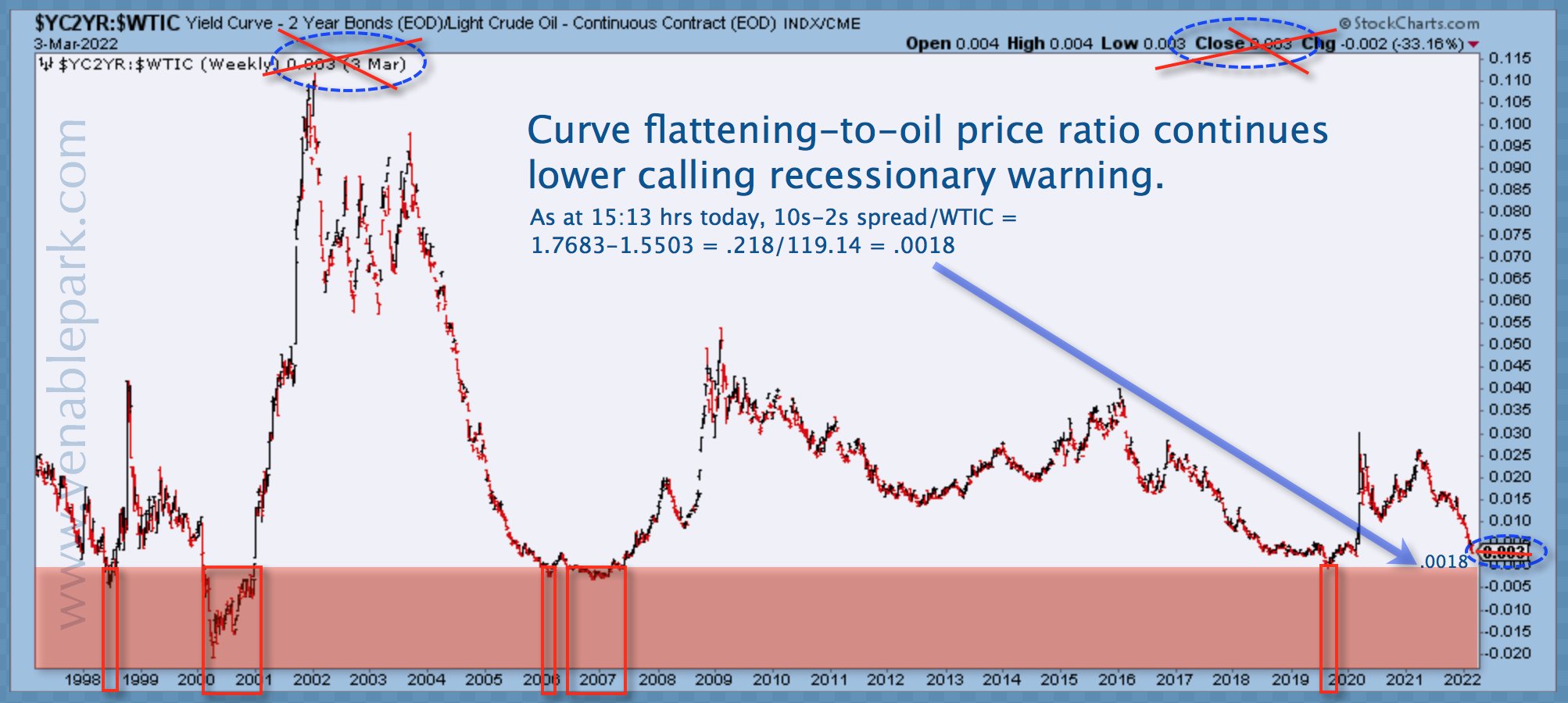
As we expected, North American government bonds are back in favour, attracting capital away from riskier markets. Yesterday, as oil prices leapt, the economically-insightful spread between the two and ten-year U.S. Treasury yield narrowed to .23%, the least since March 2020 when the pandemic was beginning.

As shown below from my partner Cory Venable, when the yield curve has flattened more than the oil price has spiked, the ratio of the two moves to zero and a recession is underway– it’s.0018 now.

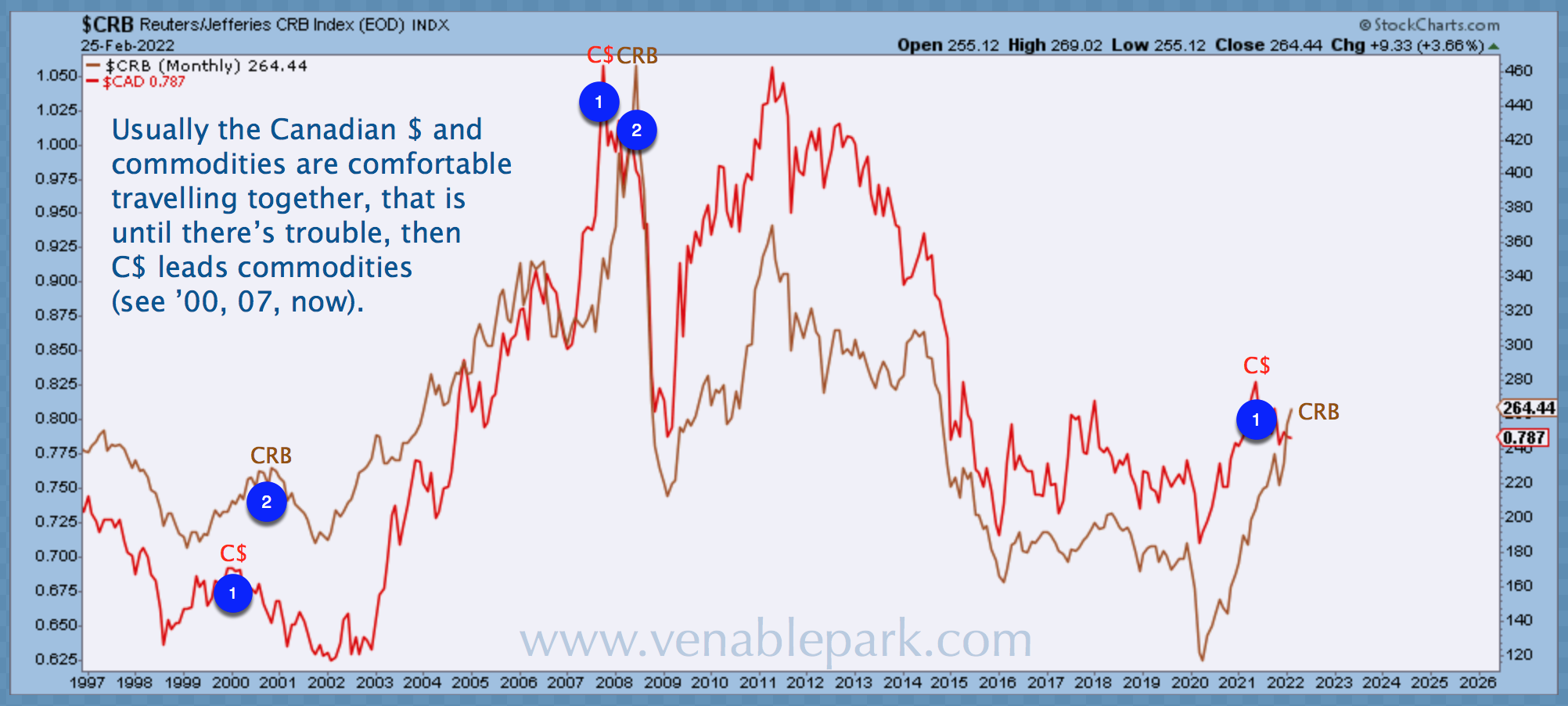
The Canadian Petrodollar has been diving against the greenback over the last year, even as oil prices have soared–another signal for economic pessimism. While the CRB Index  (39% allocated to energy contracts, 41% to agriculture, 7% to precious metals, and 13% to industrial metals) typically moves in concert with commodity currencies like the loonie, once the demand cycle has peaked, the loonie leads the CRB down. As Cory highlights below, it did this heading into the 2000 and 2008 recessions.

As of yesterday, the NASDAQ Index followed the lead of small-cap company indices and notched its first 20% decline since March 2020. As in the 2000 and 2008 cycles, the Canadian stock market’s concentration in fossil fuel (12%) and financial companies (32%) has allowed it (-1.5% since November 2021) to hold up better than U.S. markets so far. But make no mistake, Canadian decoupling from U.S bear markets has never lasted historically. With the Canadian housing market and commodity prices extremely overbought, this time is unlikely to be different.

As mean reversion fulfills its destiny, the hit to balance sheets (households, businesses, and lenders) is set to be more severe than any recession since at least the early ’80s. Those who come into this epic repricing cycle with large cash reserves and little debt hold a strong hand–but they will be few.

Posted in Main Page | Comments Off on Diving loonie and treasury spreads warn of recession

The Problem with Jon Stewart: the stock market

The Problem With Jon Stewart’s latest show looks at deception and rigged trades in the stock market.  Here is a direct video link for Apple TV subscribers.

The segment with SEC chair Gary Gensler is available separately on YouTube at this direct video link.

Since Chair Gensler brings up Madoff, it must be noted that the SEC did not actually catch Bernie Madoff.  They ignored and overlooked his abuses for more than a decade despite being repeatedly alerted by forensic accountant Harry Markopolos as explained here.

Posted in Main Page | Comments Off on The Problem with Jon Stewart: the stock market





