The myth of passive investing

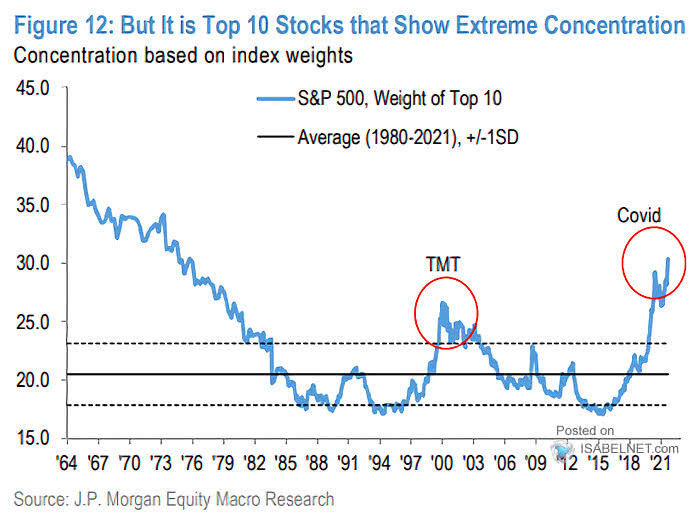
My partner Cory Venable’s big picture snapshot of the S&P 500 Index since 1997 (below) highlights the prior cycle peaks in 2000 and 2007 and the breathtaking parabolic move since 2020.  Remember that this is one of the most widely tracked stock indices by countless mutual funds and exchange-traded funds and is considered a core holding and relatively ‘conservative’ allocation target for ‘buy and hold’ individual portfolios and pensions alike.

Now understand that the most historically informed base case from presently extreme levels of valuation and price-indiscriminate ownership for the S&P 500 is a 65% decline (highlighted with arrows), followed by many years and possibly decades (as with Japan’s Nikkei when its bubble burst in 1989) waiting to recover the recent peak.  Few of the present equity holders will hold on long enough to grow back their losses.

Financial analyst and fund-flow expert Mike Green explains some of the systemic implications for passive allocators and products in the segment below.

Portfolio Manager and financial analyst Mike Green explains The Myth About Passive Investing in this recent discussion with Danielle DiMartino BoothHere is a direct video link.

Posted in Main Page | Comments Off on The myth of passive investing

A world long on risk is short on cash

After a rough couple of weeks, the risk trade is bouncing.  While those in the business of selling us risk (in exchange for our cash ‘trash’) advise that investing requires bravery, the truth is that risk management, discipline, and math-based assessments are the best predictors of longer-term financial outcomes.  Unfortunately, discipline and realism tend to have less mass appeal.

As we look back on 2021, some key trends stand out.  First, as shown below, since 1998, despite ongoing inflation hype, the U.S. prices paid trend indicator (blue line) peaked in June 2021 and turned down–this typically leads ISM Manufacturing prices (below in grey) by 2 to 3 months and suggests inflationary pressures will continue to reverse. Treasury yields are in agreement.  As shown below from my partner Cory Venable, the U.S. 10-year Treasury yield peaked at the start of April and has made lower highs since.  From 1.475% today, the 1% yield area is the next downside test, with capital gains for Treasuries along for the ride.

Commodities are signalling a similar story with the Goldman Sachs Commodity Index (GSCI below) now 11% below its late October peak and back where it was in 2018. On the other end of the commodity teeter-totter, as shown below since 2016, the greenback has also gained against the commodity-centric loonie since last spring, with 1.30 being the next upside test.

Widely overlooked is that eighty-eight percent of global trade, sixty-one percent of foreign bank reserves, and about 40% of the world’s loans are in U.S. dollars.  To make payments, debtors and buyers of goods and commodities must acquire the currency, either through incoming trade flows or by selling other assets and currencies.  Less global trade means fewer dollars circulating into the hands of those needing them.

As the U.S. fiscal and monetary impulse retreats sharply from two years of unprecedented spending, global GDP growth is reverting to a 3% annualized pace in the fourth quarter, from 6% last, and lower than the 4% pace before the pandemic.

A world long on the same levered assets and tons of debt but short on cash and cash flow will increasingly need to liquidate what they can—understanding why and positioning ahead of the pack is essential to risk management.

Posted in Main Page | Comments Off on A world long on risk is short on cash

Third winter of COVID-19: infection curve incredibly steep

Good update in this segment.

Johns Hopkins Bloomberg School of Public Health Professor Chris Beyrer discusses the confluence of a winter surge of coronavirus with the omicron variant, resistance to Covid restrictions, and elevated antibodies from booster shots.  Here is a direct video link.

Posted in Main Page | Comments Off on Third winter of COVID-19: infection curve incredibly steep