
Erosion beneath euphoria

Treasury yields rose initially on news that Fed Chair Powell has the nod for a second term.  Apparently, Powell–who’s endlessly sought to boost animal spirits and his portfolio at every market yip–is now a hawk that will raise rates through a global downturn and tanking risk markets in 2022.  LOL indeed.

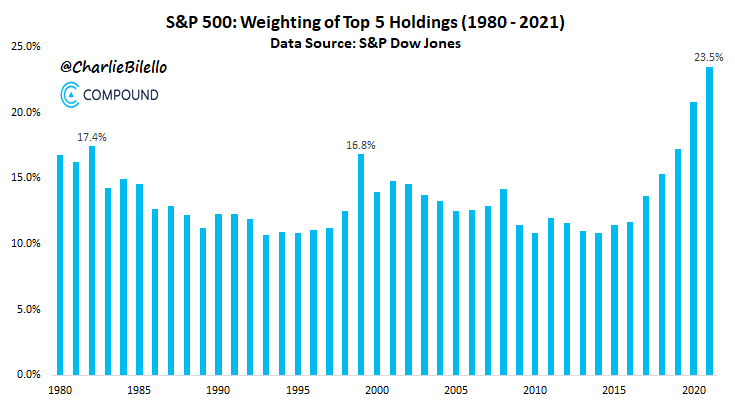
With the five most expensive S&P companies now accounting for 23.5% of its market cap (shown below since 1980, courtesy of Ridgehaven Capital), a world of FOMO surfers are more risk-concentrated and vulnerable to capital implosion than at any time in the past 41 years; even well beyond the 2000 tech top.

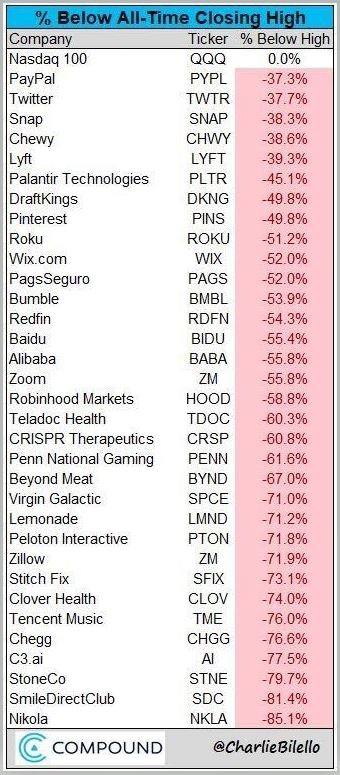
Breadth is brutal beneath the euphoric surface, with many former retail darlings tumbling into well-deserved repricing cycles. The list below highlights 32 standouts, camouflaged by a NASDAQ 100 Index still within 3% of its all-time high.  As in 2000, the magnitude of these drops is par for the math-less buying, which has dominated since 2020.
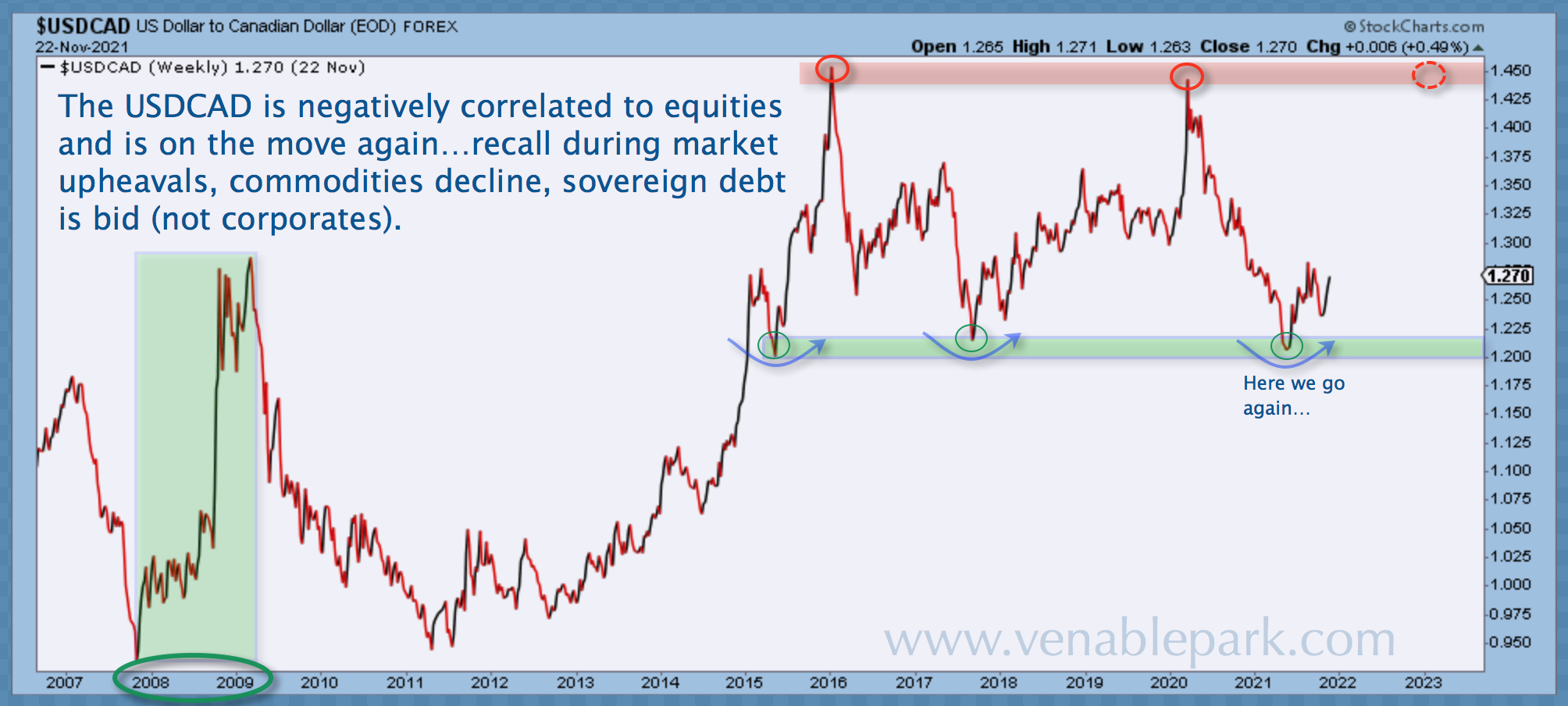
The U.S. dollar has been rising against the basket of global currencies again since June.  As shown below from my partner Cory Venable, since 2007, the greenback’s advance against the commodity-centric-CAD is another warning sign for risk markets.  And, lest we forget, rising greenbacks ramp carrying costs for foreign borrowers who remain heavy in dollar-denominated debt.
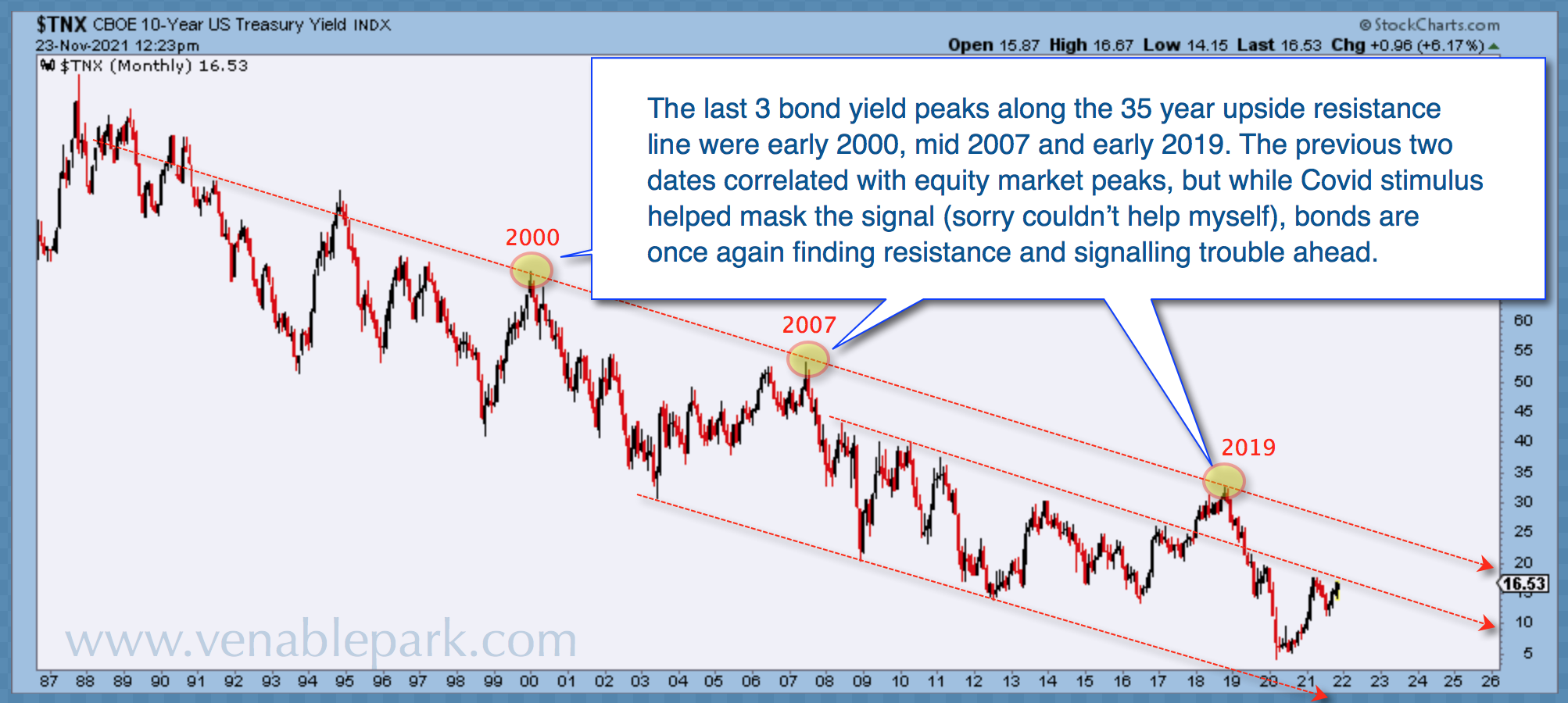
Bond yields have backed up since August, but as shown in Cory’s chart below of U.S. 10-year yields since 1987, the bounce purchased by trillions in monetary and fiscal stimulants looks suspiciously quick.  Like the 2007 and 2000 recessions, yields are likely to move lower for at least a couple more years, while the economy and financial markets finish the downcycle that began in 2019.  Interrupted but not yet completed.
Posted in Main Page | Comments Off on Erosion beneath euphoria

McKinsey: Inflated asset prices leave economy and net worth vulnerable

A McKinsey report published this week examines how productively we are using global ‘wealth,’ and the conclusion is, not very.

While global net worth (asset prices- liabilities) has tripled since 2000, the increase mainly reflects financialized gains in assets, especially real estate, rather than investment in productive activities that expand economic momentum and well-being.

As financial assets and liabilities have grown faster than GDP, two-thirds of global net worth is now based on elevated realty prices and only about 20 percent on productive fixed assets such as machinery, infrastructure and inventories; this is not historically typical or sustainable:

“…in the countries in our sample, net worth in 2020 was nearly 50 percent higher relative to income than the long-run average between 1970 and 1999. Asset price increases above inflation propelled by low-interest rates drove this divergence while saving and investment accounted for only 28 percent of net worth growth. In 2000–20, annual post-inflation valuation gains quadrupled compared with earlier decades…”

The trouble is, higher asset prices are not more economically or socially productive–quite the opposite.  A reversion of prices toward historical norms would wipe out about 33% of global net worth.

The report encourages a shift in policies and focus towards productive and sustainable investments that contribute to the global gross domestic product (GDP) to mitigate the downside.  The video below gives a few of the low lights.

The market value of the global balance sheet tripled in the first two decades of this century. These findings raise important questions for policy makers and business leaders. Foremost among them: is the global economy undergoing a paradigm shift as the world finds new sources of wealth? What might some of those new stores of value be? Or are we at risk of reversion to the historic mean that could result in a decline in net worth? And what will it take to rebalance the global economy? Here is a direct video link.

Posted in Main Page | Comments Off on McKinsey: Inflated asset prices leave economy and net worth vulnerable

Leland: China slowing more than people think

China’s economy is slowing more than people think and the outlook is for weaker growth going forward as the government is unlikely to step in with significant stimulus, according to Leland Miller, chief executive officer of China Beige Book.

“The third quarter was particularly brutal” for China’s economy, Miller said Friday on Bloomberg Television in Singapore. In addition, “we’re going to be looking at much lower growth going forward and it’s going to be because the Party is OK with that.”  Here is a direct video link.

Posted in Main Page | Comments Off on Leland: China slowing more than people think





