Rich Roll Podcast on breaking the toxic-food addiction

It’s not okay or sustainable that two-thirds of our population is overweight and obese and status quo food is driving a pandemic of chronic illness that is far more destructive than COVID-19.  Worse, the health-destroying food is designed to be addictive and social apathy around this fact is helping to perpetuate the plague that ails us.

When you hear the word ‘addiction’, our attention typically turns to mind-altering substances — illicit drugs, alcohol, and prescription medications.Typically overlooked in this conversation? Food.But food addiction isn’t just real, it just might be our biggest problem. In fact, the hyper-industrialized western world is firmly entrenched in an epidemic of dysfunctional eating, fueled by an outsized appetite for an ever-increasing array of highly processed foods that are scientifically designed — with just the right amount of sugar, salt and fat — to hijack our nervous system. Enslave us to compulsive habits that lead to illness. And ultimately render us wards of the pharmaceutical industry.  Meanwhile we’ve normalized this twisted and deleterious relationship. So much so that right now, more than two-thirds of adults in the industrialized world are overweight or obese. Nonetheless, millions of people find it extremely difficult if not downright impossible to change their dietary habits — and simply break the fatal, addictive grip.So how does one effectively transition to a healthy diet sustained over time?  Here is a direct audio link.
Posted in Main Page | Comments Off on Rich Roll Podcast on breaking the toxic-food addiction

How households can cut their use of fossil fuels

Little acknowledged is that natural gas emits methane which has 80 times the warming power of carbon dioxide over the first 20 years after it reaches the atmosphere. So even though CO2 has a longer-lasting effect, reducing methane emissions now has immediate benefits.  At least 25% of today’s warming is driven by methane from human actions. One of the largest methane sources is the oil and gas industry.

For this reason, some U.S cities and municipalities have begun prohibiting natural gas to new builds, including Vancouver, starting in 2030.

Getting it out of our existing homes must now be a focus.  This requires exchanging gas furnaces, fireplaces, stoves and dryers to electric heating/cooling pumps and appliances.

Today, about 65% of Canada’s electricity comes from renewable energy sources. In 2018, some 96% of electricity in Ontario was produced from zer0-emitting sources: 60% from nuclear, 26% from hydroelectricity, 7% from wind, and 2% from solar.   The wind and solar portions are now expanding rapidly.

So despite much propaganda to the contrary, plugging into the electrical grid is healthier than burning fossil fuels, and this goes for electric vehicles too (University of Toronto study). As more renewable power is added to the grid each year, the benefits of the switch increase immediately and exponentially.

According to the New York Times, America has more work to do as it presently uses natural gas to produce about 38% of its electricity, 39% in California, 53% in Texas and almost 90% in Delaware.

Individuals can see more steps on a household level in changes towards a plant-based diet and transportation improvements, here:  How I cut my use of fossil fuels: Tips from the pros.

Posted in Main Page | Comments Off on How households can cut their use of fossil fuels

Commodity inflation to deflationary bust–rinse, repeat

As I discussed last week, in Inflation hype past the boil, the pandemic-inspired leap in consumption helped drive bottlenecks, extra precautionary ordering, and general chaos in international supply chains.

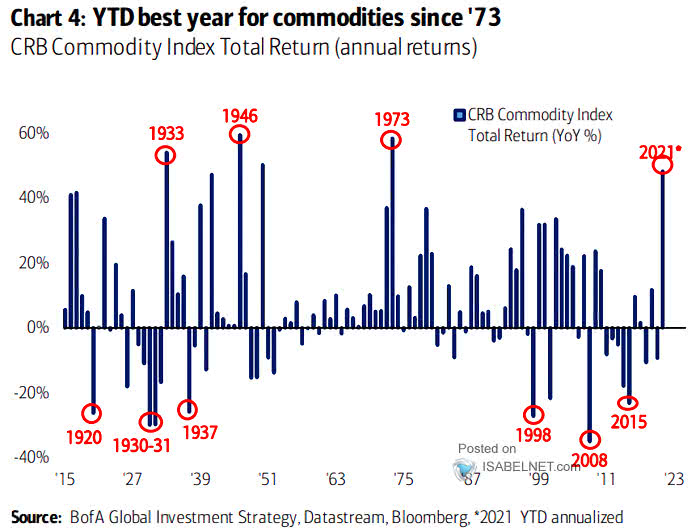
As shown below (courtesy of Isabelle.net.com), the initial squeeze on supply helped to inspire the most dramatic commodity inflation since another infamous market top in 1973 (p.s. from January 1973 to December 1974, the economy then tanked, and global stock markets entered a 694-day 45% plunge).
Today, consensus inflation expectations remain high even though most commodity prices have dropped significantly over the past six months.  As Rosenberg Research points out, only milk, cotton, flour and butter are still rising at this point. At the same time, other economically-sensitive staples have sharply reversed course led by a few standouts such as lumber -64%, iron ore -61%, steel -25%, aluminum -20%, and zinc -15%, so far.

Commodities are infamous for boom-bust cycles because high prices simultaneously encourage supply while curtailing demand.  This time is unlikely to be different.

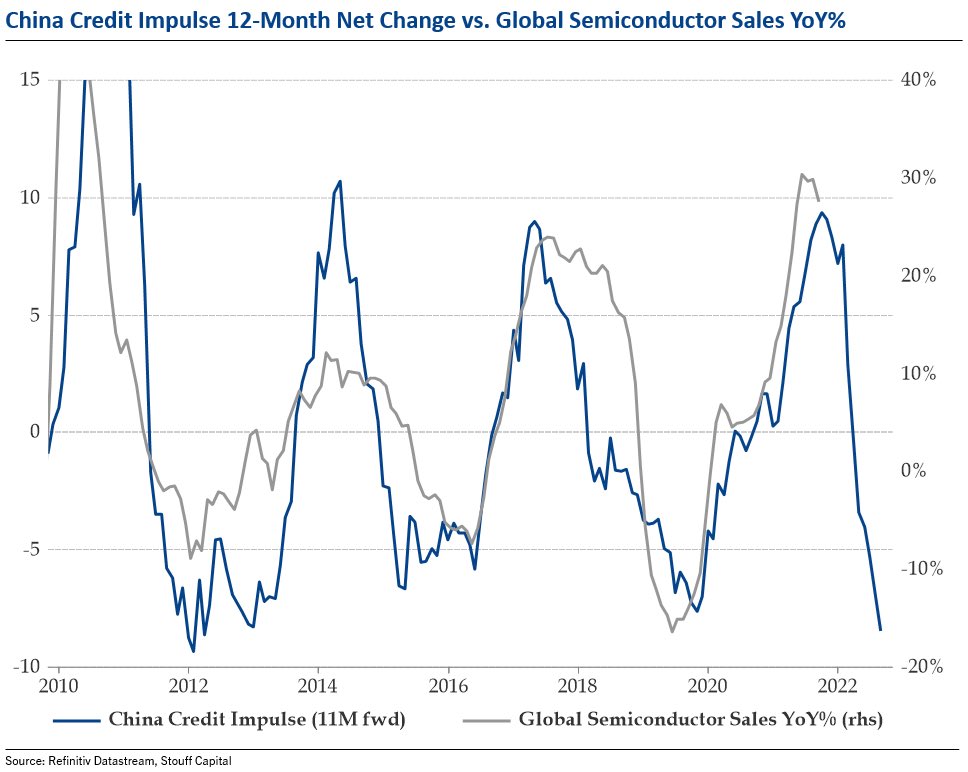
And about that semiconductor shortage…the 12-month change in China’s credit impulse (shown below in blue since 2009 courtesy of Julien Bettel) has led to the year-over-year change in global chip sales (below in grey) with a lag of ll-months.   As usual, production and shipments are ramping while sales and stockpiling appear to have peaked.

Posted in Main Page | Comments Off on Commodity inflation to deflationary bust–rinse, repeat