China gearing down property sector and global commodity demand

CANADA!!! Are we paying attention to where the puck is going??

Leland Miller of China Beige Book International says the research firm has not seen the retail sector become a major growth driver of the Chinese economy. The government is also not making structural changes to empower consumer spending, he adds.  Here is a direct video link.

Posted in Main Page | Comments Off on China gearing down property sector and global commodity demand

Smart wind power and storage

American designer and entrepreneur Joe Doucet has created a wind turbine wall that consists of a grid of square panes spinning simultaneously along 25 axes. The exact size and format aren’t set in stone, so variations of the wall could be used anywhere with a decent span, like on the side of a highway or the fence around a building.  See:  This ingenious wall could harness enough wind power to cover your electric bill:

The average annual electricity consumption for an American home uses a little over 10,000 kilowatt-hours per year. One of these walls would be enough. But where Doucet sees true potential is in larger-scale commercial buildings and even cities. “Instead of the typical retaining walls along roads and freeways, you’d have an array of these,” says Doucet, who says he’s in conversation with several manufacturers to help him bring the product to market. “With the added wind boost from trucks, our highways could take care of all our energy needs.”

Sometime in the near future then, anywhere with enough span for a 25-foot wall could become a potential source of energy. “In urban areas, there’s not a lot of open sunlight for solar to work, says Doucet. “Wind is always there.”  Here is a direct video link.

As the usual mob sets off about the wind not blowing all the time, also watch Renewable Baseload Power from a single desert location. Enough to power 7 million homes.

Posted in Main Page | Comments Off on Smart wind power and storage

Stocks priced for over a decade of negative nominal returns

John Hussman’s October letter includes the chart below, which graphs the actual 12-year nominal annual return for stocks from the rare historic incidents when valuations were as high as presently.  Here’s the bottom line:

At valuations that presently stand at 3.4 times historical norms, the arithmetic here is daunting. Assuming the same 4% growth rate in S&P 500 revenues and nominal GDP that we’ve observed in the past two decades, a return to run-of-the-mill valuation norms would leave the S&P 500 index unchanged even [ln(3.4)/ln(1.04)=] 31 years from now, although the modest dividend yield of the S&P 500 would add something in the area of 2% annually. At a nominal growth rate of 10% annually, a return to historical valuation norms would still leave the S&P 500 index unchanged nearly 13 years from today.

Note:  this would be before any investment fees.
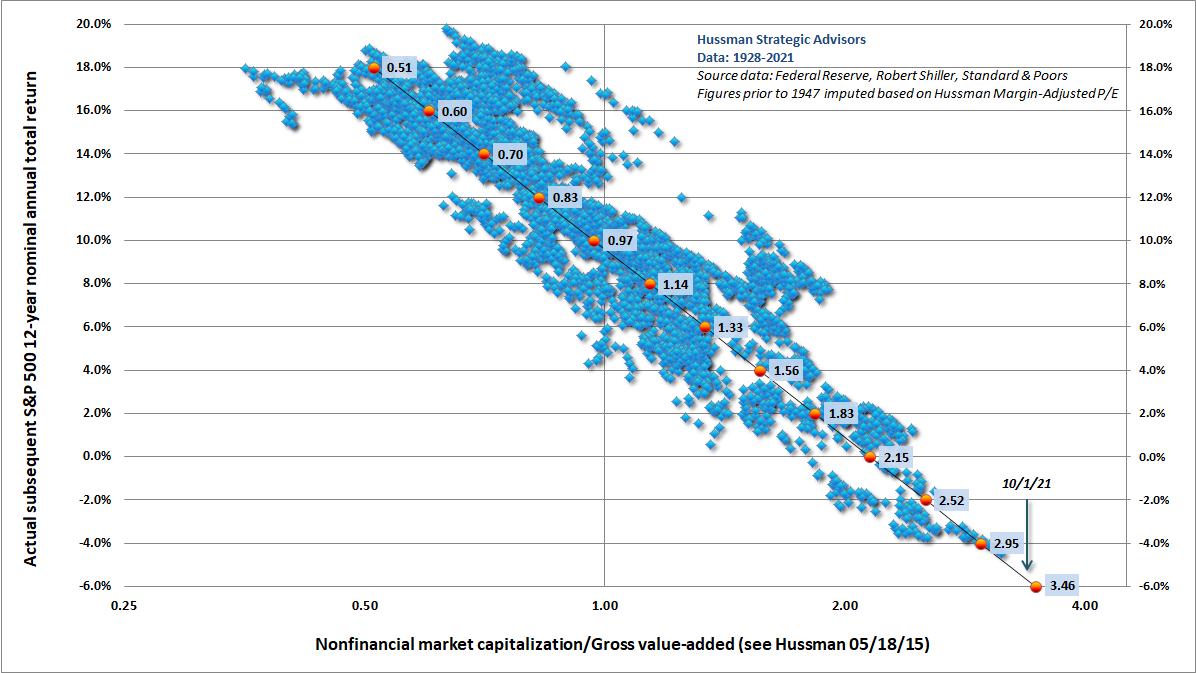

Believe it or not, this is the math:

So 10, 20, or possibly even 30 years from today, investors may look back on years of low or negative total returns and say, well, nobody could have predicted X about the economy, or inflation, or debt, or whatever. What I’m trying to tell you is that it doesn’t matter. The moment you look at where starting valuations are, you already know that, in all probability, the prospects for acceptable stock market returns are screwed. You just don’t quite know what type of screw.


Posted in Uncategorized | Comments Off on Stocks priced for over a decade of negative nominal returns