
Lacy Hunt explains the inflation and yield cycle

The hosts in this segment make the common misnomer of talking about bonds without specifying that they are talking about government bonds or “Treasuries,” but not corporate bonds.  Corporate bonds trade with the equity cycle and do not attract safe-haven inflows during negative financial shocks and bear markets.  Few acknowledge this critical distinction between Treasuries and corporate bonds.  Otherwise, the discussion here is worthwhile.

This month we were joined by Dr. Lacy Hunt, an internationally known and award-winning economist. Dr. Hunt is the Executive Vice President and Chief Economist of Hoisington Investment Management Company. He also is the author of two books and numerous articles published in Barron’s, The Wall Street Journal, The New York Times, and The Financial Analysts Journal among others. Here is a direct video link.

An important point made by Hunt is that the much-anticipated spending bills expected from Congress will be less supportive of inflation and growth than widely suspected because while they mete out spending over the next decade, they start tax increases right away.  Moreover, back to Hunt’s larger point, they pay for spending by increasing debt.   More debt and increased taxation from here (while politically necessary) are both disinflationary–reducing room for future spending and growth.

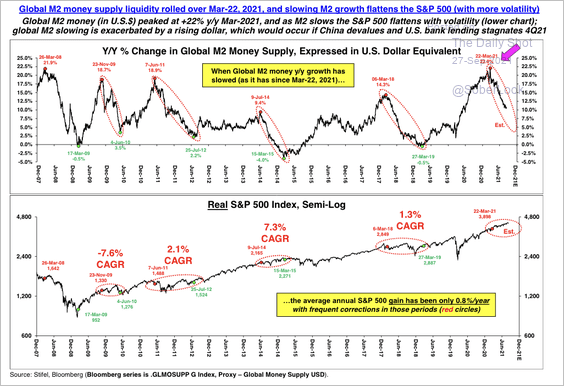
The top panel in the chart below shows the change in global M2 supply since 2007 (discussed by Hunt).  When the money supply is contracting, as it has been most recently since March, stock markets (S&P in lower panel) have lost lift.

Posted in Main Page | Comments Off on Lacy Hunt explains the inflation and yield cycle

Calling BS on carbon capture

F-bomb alert!! The language and content in this clip may offend some listeners.  For those tired of status quo spin and nonsense, however, the calling of bullshit is refreshing.

The Australien Government has made an ad about Carbon Capture and Storage, and it’s surprisingly honest and informative. Here is a direct video link.

Posted in Main Page | Comments Off on Calling BS on carbon capture

“In 2021, the crazy is alive and well in the private and the public markets.”

This weekend brought some excellent market perspective in the Globe read The Death of Profit:  Why investing feels broken and markets no longer make sense.  Here’s a taste:

It’s now not only acceptable for a company to bleed money as it acquires or spends heavily to achieve scale; it’s actually encouraged. Investors are so taken with the prospect of technological revolution that private backers are stretching the limits of reasonable investments and valuations – a mindset that’s also bleeding into public markets. “We’ve completely normalized this concept of no profit,” says Mr. Brown.

This is all extremely devastating for legitimate, responsibly-run competitors who are being undercut into oblivion by weaker businesses with access to indiscriminate capital:

“The amount of capital out there has made it acceptable to lose money for a longer period of time, in the hopes that eventually you tip the market and become a near monopolist, or at least a duopoly,” says Martin Kenney, a professor at the University of California, Davis. Prof. Kenney first wrote a comprehensive paper on the trend in 2018, with co-author John Zysman, called Unicorns, Cheshire cats, and the new dilemmas of entrepreneurial finance. In it, they noted that more and more startups were undercutting incumbents and other rivals on price and service because they were backed by billions of dollars worth of private capital that plugged their annual holes.

…With funding rounds flowing like water, valuations are soaring. It used to be that unicorns, or startups worth US$1-billion or more, were rare and therefore idolized. But since the start of the pandemic, at least 14 Canadian companies have attained that status, including FreshBooks, Clio and Benevity. Toronto-based fintech Wealthsimple recently raised its second round of capital in just seven months, boosting its paper valuation more than three-fold, to $5-billion – even though it has struggled to make money.

And then there are the retail participants who have borrowed record amounts to magnify their exposure to irrational, uneconomical security prices.

Thank you, easy money! Our economic tab for this destructive madness will be expensive indeed.

Posted in Main Page | Comments Off on “In 2021, the crazy is alive and well in the private and the public markets.”




