EVs entering mass adoption because they are better

As with all new technological upheavals, adoption starts slowly until an inflection point is reached and mass adoption moves rapidly through the population (aka S curve).  Electric vehicles are now entering mass adoption because they are better than ICE vehicles.  No one who goes electric wants to go back to dirty, more expensive to operate and maintain gas-guzzling vehicles.

Automakers, consumers, suppliers, gas station managers and governments, who aren’t preparing for this reality will be caught offside.

This year, fourteen of the top fifteen selling cars in Norway are all-electric.  See Norway bans gas cars in 2025.  But trends point to 100% EV sales as early as April.:

Norway is ahead of the game in EV sales, with gasoline’s share of the new car market vanishing more and more every month, faster than almost anyone outside of Electrek‘s Slack channel could have predicted. This has led Norway to have the earliest target for the phaseout of new gas vehicle sales in the world – 2025.

But gas cars might not even last that long. According to an analysis printed by the Norwegian Automobile Federation’s magazine, Motor, the downward trend in sales for gas cars has been so consistent and steep that the last new gas car sale in Norway could happen just seven months from now, in April 2022.

Also, see Air Pollution endangers billions, but a handful of technologies can make air clean again this decade.
Posted in Main Page | Comments Off on EVs entering mass adoption because they are better

China’s ‘controlled’ credit explosion

This report gives a good overview of the global interconnections in our highly levered financial markets and economies. Deflation in the global property sector is needed.  It will be painful but also helpful longer-term in redirecting capital from realty speculation to more productive investment.

Real Vision’s Roger Hirst uses Refinitiv’s best-in-class data to look at issues surrounding China Evergrande, a leveraged conglomerate that includes property development and banking amongst its operations. Expectations of a default have been running high, but its issues……… and the policy response…… go deep into the transition that China is undertaking. This looks more like a controlled explosion, rather than a contagion event, but the repercussions for global investors will be widespread.  Here is a direct video report.

Also See:  Evergrande debt crisis is financial stress test no one wanted.

Posted in Main Page | Comments Off on China’s ‘controlled’ credit explosion

Bubbling assets need more buyers–stat!

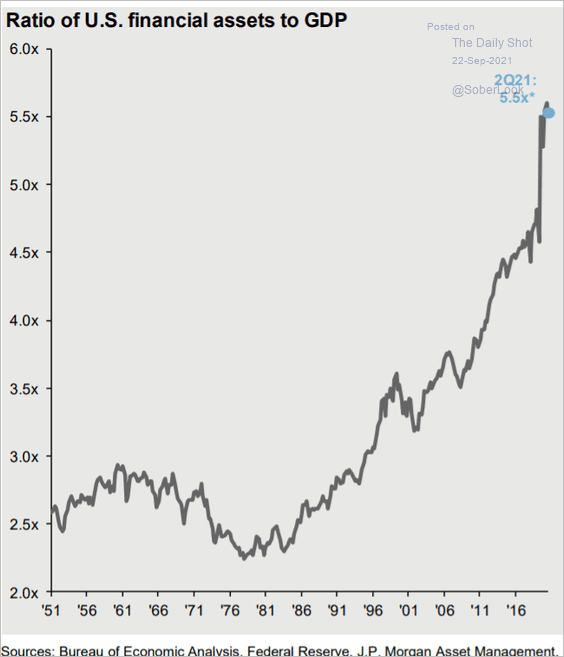
While some wait breathlessly for self-enriching US Fed members to hold forth on their next policy tricks, this chart shows the relative size of US financial assets at 5.5x US gross domestic product today compared with 3.5x at the tech bubble top in 2000, and less than 3x from 1950 through the mid-1990s.

Looks about as healthy and sustainable as Canadian home transfer costs, now making up a whopping 10% of Canadian GDP (as shown earlier this week.)

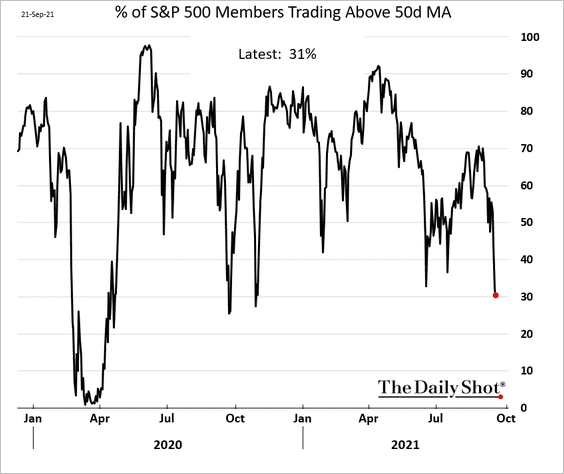
As stocks rebound from some of this week’s losses this morning, under the hood weakness has been broad, with just 31% of S&P 500 members trading above their 50-day moving average as of yesterday’s close (shown lower left).

Meanwhile, the US dollar index (DXY) is so far holding above $93, and long government bonds remain bid in a slowing global economy that is long on debt and increasingly short on cash.

With the consensus expecting a reduction in central bank largesse over the next 6 months, the question is where new inflows will come from to keep asset prices moving higher?  Stagnation is not an option here.  With the retail crowd now fully in and then some (on margin), which weak hands are left to buy?

Posted in Main Page | Comments Off on Bubbling assets need more buyers–stat!