What triggers a crash? Just psychology

John Hussman’s July letter kicks off with a timeless John Galbraith quote:

And so on to the moment of mass disillusion and the crash. This last, it will now be sufficiently evident, never comes gently. It is always accompanied by a desperate and largely unsuccessful effort to get out. The least important questions are the ones most emphasized. What triggered the crash?

This is not very important, for it is in the nature of a speculative boom that almost anything can collapse it. Any serious shock to confidence can cause sales by those speculators who have always hoped to get out before the final collapse, but after all possible gains from rising prices have been reaped. Their pessimism will infect those simpler souls who had thought the market might go up forever but who now will change their minds and sell.

With the greenback and Treasuries surging while lumber futures slice below $500 a thousand board feet this afternoon, some big picture is worth a mull.  Read:  What Triggered The Crash?  Here’s a taste:

A market crash requires nothing more than a shift in investor psychology from careless speculation to even modest risk-aversion. A market crash requires nothing more than an increase in the risk premium demanded by investors, in an environment where risk premiums have become overly depressed.

At some point, enough investors stop basing their expectations for future returns on the mindless extrapolation of past returns, in a market where prices have become detached from fundamentals. At some point, investors discover a basic fact of equilibrium: it is impossible, in aggregate, for investors to “exit” the market. Every single share of stock that has been issued has to be held by some investor, at every moment in time, until it is retired.

Lost in the incoherent blather about “cash on the sidelines,” “money flowing into the market,” and liquidity needing to “find a home,” there is a basic fact of equilibrium: once a security has been issued, it has to be held by someone, exactly in the form it was issued, until it is retired. Every dollar bill. Every share of stock. Every bond certificate. All of them are already home. They can’t magically turn into something else. Not a single dollar comes “into” the stock market that does not simultaneously come “out.” Not a single share is purchased that is not simultaneously sold. Every eager buyer must find a seller. Every eager seller must find a buyer. Either way, the buying always equals the selling. It’s not “money flow” that moves prices around. It’s eagerness.

With valuations at the most extreme level in history, the one thing that the market simply cannot tolerate is the eager attempt of a substantial number of investors to exit. When the walls come down, investors will scavenge the news for “catalysts.” Don’t fall into this trap. Undoubtedly, some “catalyst” will be found, but the mistake will be in believing that the collapse is caused by that piece of “bad” news. The important question to ask is “What drove the bubble?” That’s where the lessons are. The root causes of a crash are always the factors that nurtured and encouraged the “happy” period of carefree and irresponsible speculation that led to the bubble extreme…

Posted in Main Page | Comments Off on What triggers a crash? Just psychology

Pent down demand weighs on global growth and inflation

June’s US consumer price index (including clothes, groceries, restaurant meals, recreational activities and vehicles) increased 5.4% from a year ago, the highest 12-month rate since August 2008.  The so-called core price index, which excludes food and energy, rose 4.5% year over year.  The seasonally adjusted 0.9% rise in June from May was the largest one-month change since June 2008 (a price peak that cycle).

Accelerating prices for new and used cars (driven by a surge in demand and constricted supply during the pandemic) and gains in prices for lodging and transportation services, including car and truck rentals (reopening components), contributed to the vast majority of the core CPI increase.  As shown below, since 2018, core CPI (ex reopening and chip shortage components) has actually been declining since April (blue bars).   Lest anyone forget, vehicles are the largest ticket item in the durable goods category, and durable goods are so-named because they last longer than three years.  By definition, then, record durable goods demand over the last year is unlikely to be repeated for a few years, at least.

As David Rosenberg noted yesterday, the S&P 500 household durable goods stock composite has sagged nearly nine percent from the nearby highs as service spending picks up:

“…this is important since the former represents a US$2.4-trillion chunk of GDP, or four times the size of the latter. And within the “reopening” subsectors, only retailing and restaurants are behaving well, while office real estate investment trusts, airlines, hotels and casinos have rolled over considerably.”

According to the Conference Board, consumer plans to purchase a vehicle in the next six months remain down year-over-year, and the index of consumer sentiment from Morning Consult ended June (down 0.6% from May, which ended down 0.9% from April) 12.1% below Feb. 29, 2020 levels.  As shown on the left, auto auction data suggest that used vehicle prices are now likely to move lower in the months ahead, as pent-down appetite weighs.

Slowing demand is already evident in weakening economic surprise indices for the world’s largest economies since last summer, as shown below.  First-in and out of COVID-19 shutdowns, the weakening in China’s economy and price data year-to-date is noteworthy and prompted a surprise decision from China’s central bank (PBOC) last week to try and expand lending by lowering reserve requirements (RRR) for its banks effective July 15.  The PBOC is now expected to deliver further cuts in the RRR as pressure on the economy persists, and consumer inflation eases (latest Reuters poll).

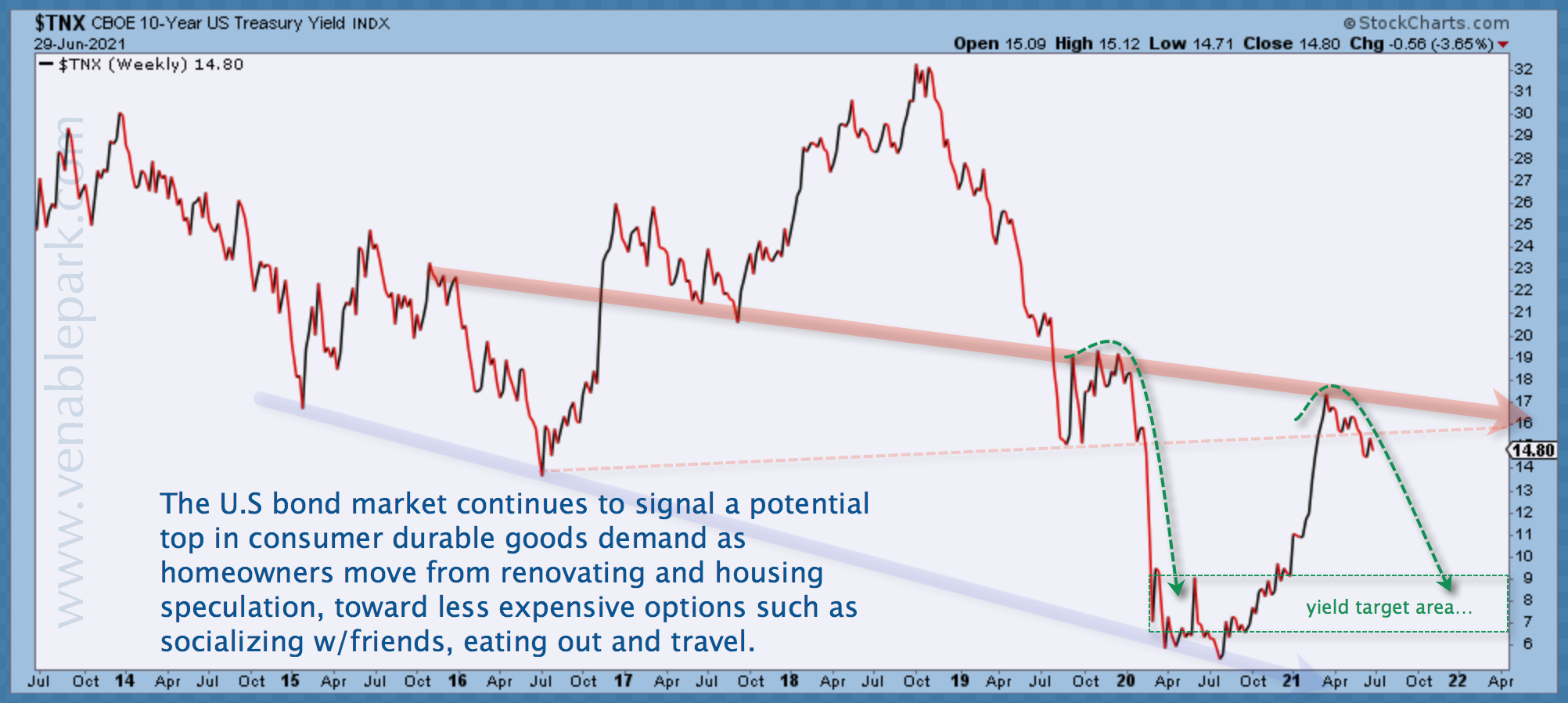
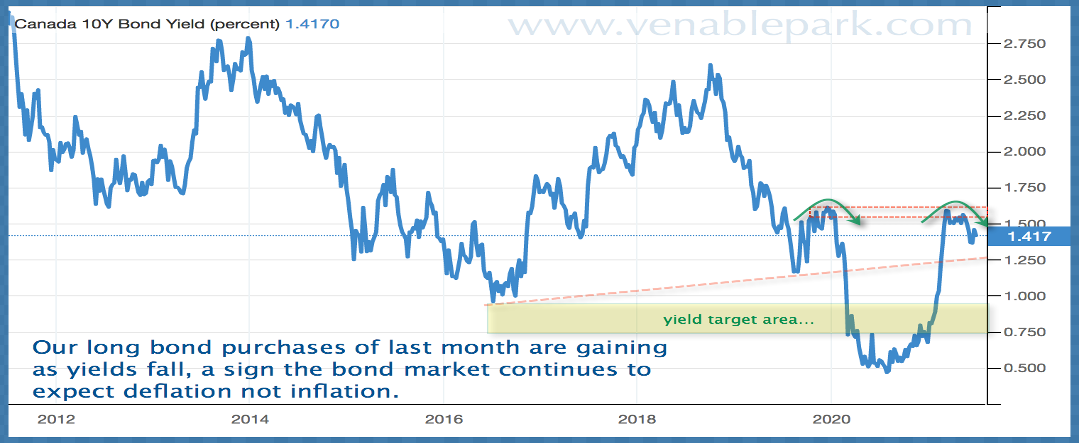
As with North American Treasury yields, the 10-year yield in China has been falling again since March 2021, and at 2.92%, remains well below its 3.22% level before the global recession hit in early 2020 (shown on the left).

At the same time, lumber continues to deflate with futures at $558 per thousand board feet this morning, down 67% since early May, as demand cools and production expands.

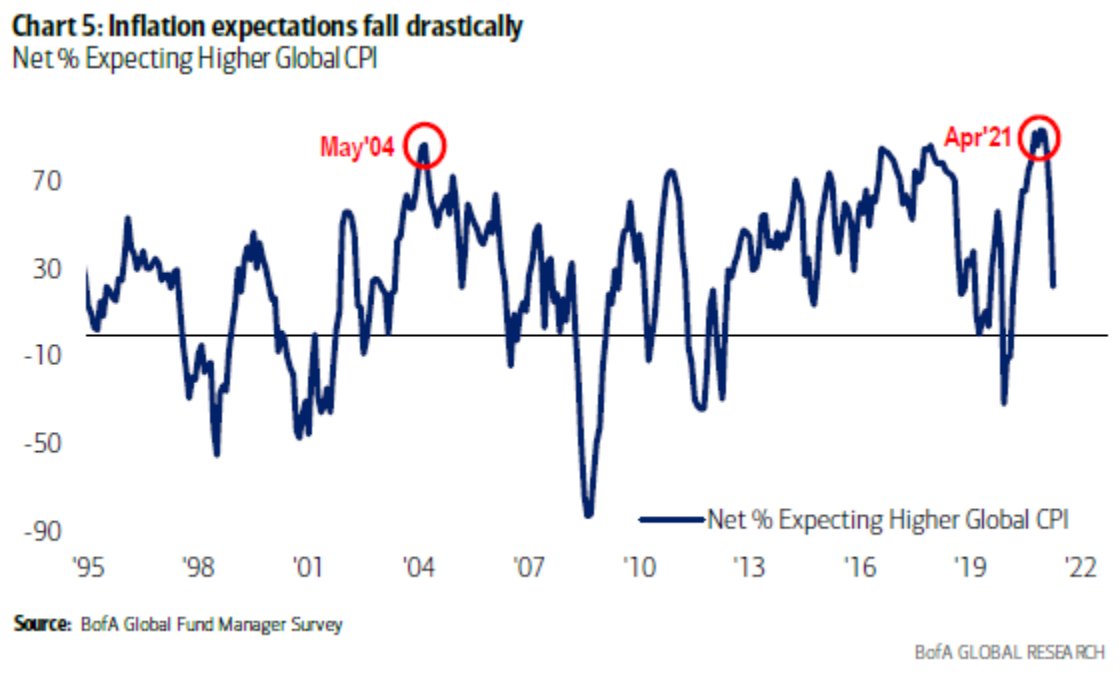
The US dollar has been strengthening against the basket of its major trading partners since May.  A rising dollar is deflationary for America but inflationary for those importing its goods.  This adds to headwinds for developing economies like Russia, Brazil, Turkey and many others who then find they need to raise interest rates to support their currencies and combat a rising cost of goods–slowing the global economy in the process.

Central banks and record levels of debt have not arrested the economic/financial cycle–what magnified the up will also magnify the down.  Understanding this is essential risk management.

Posted in Main Page | Comments Off on Pent down demand weighs on global growth and inflation

Monetary policy impotent during a balance sheet recession

Between 2008 and 2019, excess capacity, slow growth and never-ending central bank liquidity injections suppressed interest rates and encouraged corporations to magnify profits by increasing their debt.  This meant that the corporate sector came into the 2020 recession with record indebtedness.

As central banks flooded financial markets with even more liquidity over the past 16 months, interest rates/yields fell to the lowest level on record and companies borrowed even more.  Nonfinancial companies issued $1.7 trillion of bonds in the U.S. alone last year, nearly $600 billion more than the previous high (Dealogic). By the end of March, non-financial debt reached $11.2 trillion (Federal Reserve), about half the size of the U.S. economy.  See Pandemic Hangover:  $11 Trillion in Corporate Debt.

With global demand/capacity utilization rates still well below 2019 trends and uneconomical pricing for most assets everywhere, compelling capital expenditure opportunities are now scarcer than cash.  As the economy rebounds from the depths of the pandemic shutdown, many business models are in flux and downsizing of commercial/office space is a common theme.  Using cash to reduce debt is the logical move.

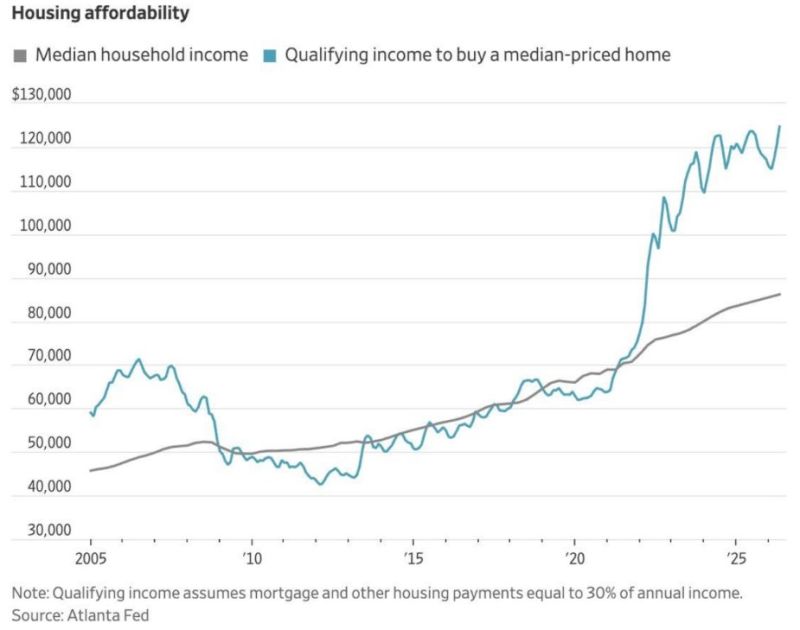
A similar impulse has been evident in US households since the 2008 crisis as home prices slumped with investment yields and an aging population increasingly values financial stability more than discretionary spending.

According to the New York Fed, US households spent just 29%, 26% and 25% of the three pandemic stimuli cheques over the last year, with the balance used to increase savings (which includes paying down debt).  Deleveraging strengthens corporate and household balance sheets but detracts from Gross Domestic Product and increases the need for government spending as an economic stabilizer.

Economist Richard Koo’s 2009 book The Holy Grail of Macro Economics:  Lessons from Japan’s Great Recession explains the 15-year long recession that followed the bursting of Japan’s real estate, debt and stock market bubbles in 1989 and compares it with the US market crash of 1929, the Great Depression and the 2008 Financial Crisis.  The book stimulates much food for thought about our current cycle globally.

Koo uses a century of history to show that when the corporate and household sectors are striving to reduce debt and rebuild balance sheets, monetary prods cease to stimulate spending.  The payback period is both painful and essential:

“…one of the key characteristics of a balance sheet recession…is that monetary policy becomes useless.  People in Japan have already experienced this first-hand:  monetary policy had no effect, even though interest rates remained at our near zero from 1995 to 2005.  The stock market did not rally, and the economy did not recover.   In contrast, the late 1980s asset-price bubble happened when the official discount rate stood at 2.5 percent.  Yet just a few years later, in February 1993, the same policy rate of 2.5 percent had no stimulative impact whatsoever.  Nor, subsequently, did an interest rate of 0 percent.”

Posted in Main Page | Comments Off on Monetary policy impotent during a balance sheet recession