Is that all there is?

The 5% US year over year inflation print (CPI) for May was the highest since August 2008–the last cycle peak.  Then, as now, growth bulls were certain that demand would continue to outstrip supply and that asset prices were only headed higher.

Comparing with a cycle low in May 2020, a lot of the latest increase is a transitory base effect, and the Treasury market sees that.  As we expected, Treasury prices are continuing to rally–compared with the end of May, the US 10-year Treasury yield is today 1.47 from 1.58, and the Canadian 10-year is 1.40 from 1.50.

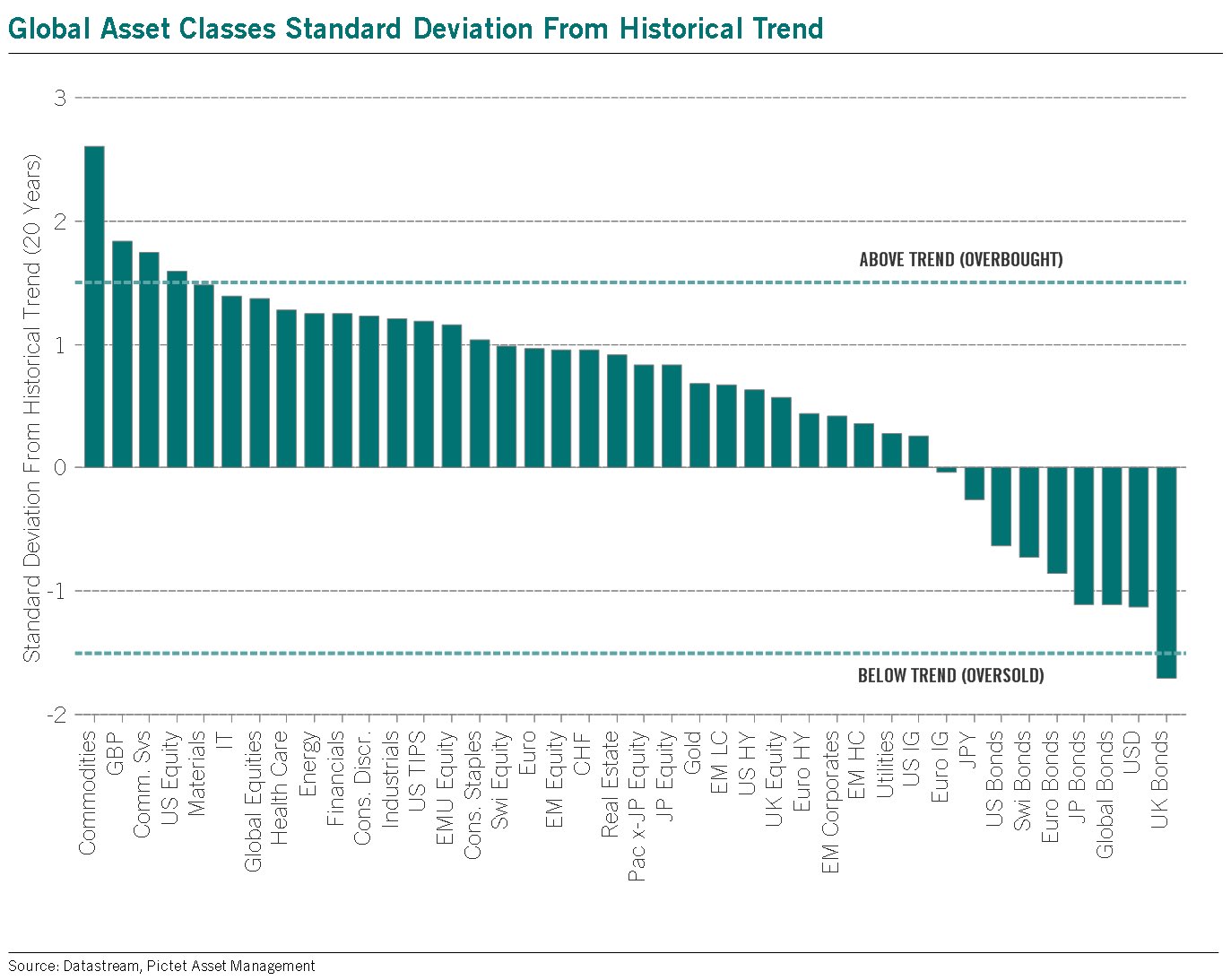
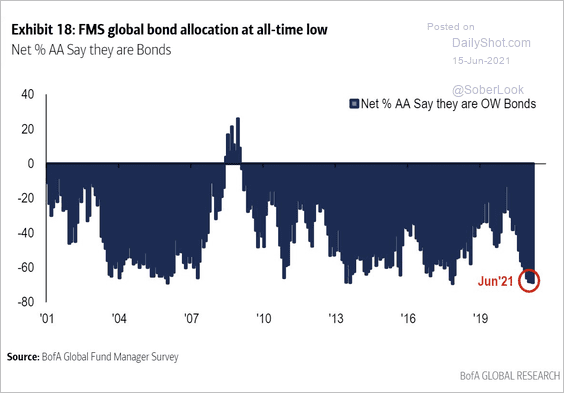
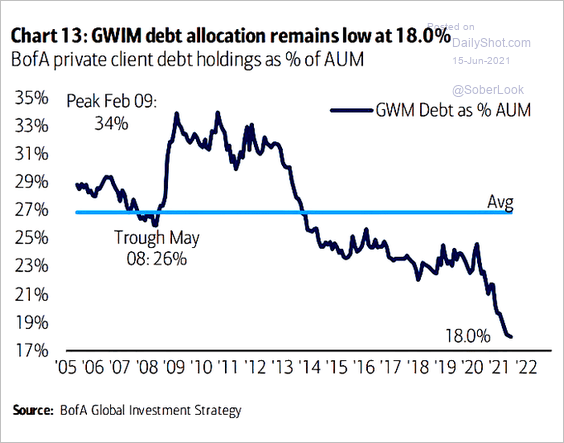
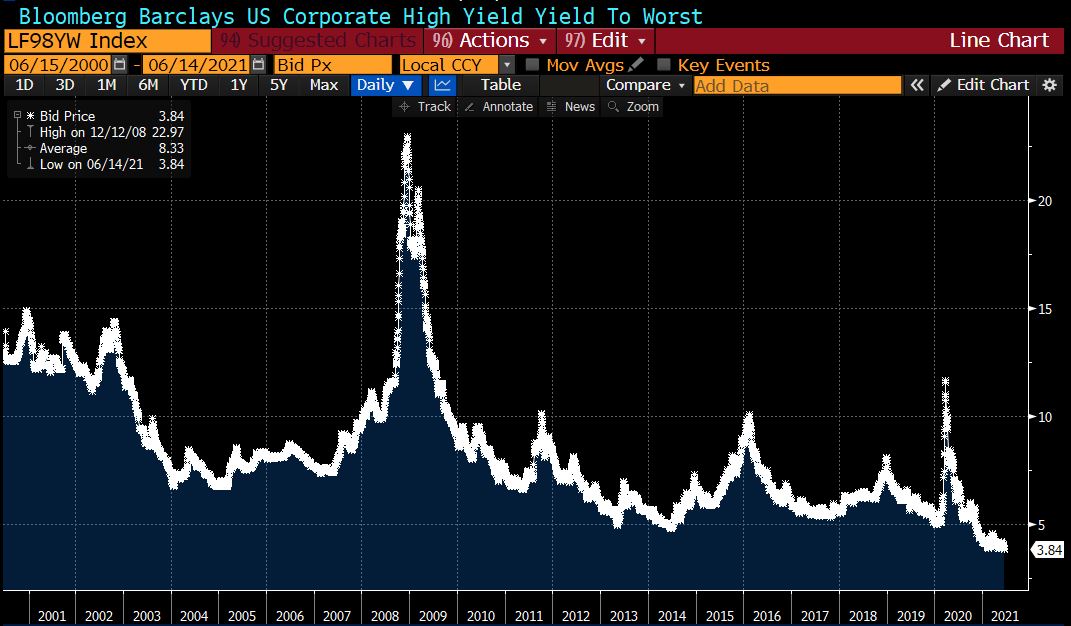
Despite trillions in stimuli thrown at the global demand cycle over the past year, the vast majority of world economies continue to struggle with growth and employment well below 2019 levels.  Bubbling stock and commodity markets notwithstanding, economic recovery will be a process measured in years, not months.  Extreme optimism is evident and likely to prove as hard on capital this cycle as in the 2000-02 and 2009-09 repricing events.

There’s no question that durable goods spending per capita has been incredible in North America.  In the first quarter of 2021, US durable goods spending leapt 41% compared with the fourth quarter of 2020–a 60 year high.  But there are only so many homes, vehicles, furnishings, pools and home gyms that a household can use.  Especially when they’ve heavily indebted themselves in the process.  As the remaining few service sectors of the economy re-open, growth hopes are increasingly focused on small-ticket items:  haircuts, concerts, amusement parks, hotels and restaurants.  And only in the few countries fortunate enough to have mass vaccine programs.  Most of the world does not.

Jeffry P. Snider offers some illuminating insight and charts in Inflation or Deflation, China or U.S. goods.  Here’s a snippet:

There has been this ongoing perception, the very one underneath all the inflationary hysteria, that the frenzy in the US goods economy is representative of conditions first in the rest of the American domestic economy as well as for the entire worldwide system. In truth, as we see time and again in foreign figures – China most of all, a huge marginal chunk of any growth/anti-growth period – the US goods economy isn’t just an outlier it is an extreme one.

The view instead, from China, consistent with that vast majority, is a very lacklustre return from the depths and one that may just have reached its fullest if disappointing speeds already some time ago. This, along with money/liquidity risks epitomized by Feb 24’s Fedwire disruption and its Feb 25 impact on UST liquidity, would more than begin to explain the changing bond viewpoint.

Dealing in probabilities, it would then make perfect sense why global yields which had previously sprung suddenly into reflationary trading almost as suddenly jumped right out of them. Or, more specifically, the balance of probabilities that had been more favorable after last November, risks tilting toward a limited reflationary upside, tilted right back down again and remain steadfastly lower the longer it goes and the more China (and the rest of the world) fails to converge with US goods – despite having been artificially buoyed by that frenzy in US goods.

Posted in Main Page | Comments Off on Is that all there is?

Criminals and climate intensify focus on cryptocurrencies

Each story of criminals using cryptocurrencies to facilitate their activities intensifies the efforts of governments and businesses to stop them.  The US Congress is now considering legislation to ban companies from paying ransoms to reduce the leverage of cybercriminals in exacting payments.  This week, the Chinese Police Arrested 1,100 People for Money Laundering With Cryptocurrencies.

While global crypto mining is currently 75% concentrated in China, this is becoming less tolerable as extreme heat and air conditioning use intensify power shortages and force some factories to shut down GDP-driving production.  See Why China is cracking down on Bitcoin mining and what it could mean for other countries.  In Iran, blackouts and power shortages prompted the government to ban crypto mining on May 26.

As extreme heat and drought intensify globally, these issues are certain to escalate.  At the same time, greenhouse gas emission limits and carbon taxes will drive cities, states, provinces and countries to necessarily clamp down on counterproductive, energy-intensive activites.   When there is only so much emissions budget one can spend, food production, shelter, transportation and essential activities have to take precedence over energy for things like crypto mining.  Those who want to keep mining will need to find emission-free, renewable power sources or move to places that offer them.

This week, El Salvador’s president instructed the nation’s state-owned geothermal electric company to market facilities for cheap, renewable power to bitcoin miners.

Posted in Main Page | Comments Off on Criminals and climate intensify focus on cryptocurrencies

Mark Z. Jacobson on the clean energy transition

Mark Z. Jacobson needs the patience of Job.

Not only does he lead by example, living in a zero-emission house and drive a zero-emission car that consume zero energy to run (actually, he gets money back from the grid). He is a civil and environmental engineer who has held a doctorate in Atmospheric Sciences for nearly 30 years. He’s been at the forefront of climate science since the early 90s and helped spearhead the Solutions Project out of Stanford University in 2013 which invested the work to create and publish blueprints on how every country, state, province and major city worldwide can transition to 100% renewable energy by 2050. Their website is here.

Jacobson has also written over 165 peer-reviewed papers as well as three textbooks, the most recent being the very enlightening 100% Clean, Renewable Energy and Storage for Everything, which I highly recommend as a valuable resource for daily fact-checking in the area of energy and storage.  In 2019, he was selected by Apolitical as one of the world’s 100 most influential people in climate policy.

In a world full of nay-saying non-experts, science-deniers and status quo sponsors, Mark continues to study and explain what we are doing wrong and how to fix it.   His latest interview with Resilience.org is worthwhile as the interviewer presents many of today’s commonly heard contrary talking points.  See Mark Jacobson on the clean energy transition.  For those who don’t wish to read the whole thing, here are a few key excerpts:

AA [interviewer]: Yes, sure, but if you keep growing the economy and you need more and more energy, even from 100% renewables, you’re going to have to do a lot more mining (to get all the materials for turbines and so on) to keep pace with that and is that really going to make the emissions go down? All that neodymium and lithium and aluminium?

Mark Jacobson:  First of all, when you transition to electrifying the energy sector, you have a 57% reduction of demand just by electrifying. And if you reduce that much you’re not going to grow energy demand worldwide that much. People are also going to be using energy efficient technologies…

MJ: First of all, rare earths are not rare, they’re everywhere. They’re not rare elements, but they are dispersed and not found in many concentrated deposits that are economically exploitable. And for something like lithium, every time they look they find more. It’s a question of looking…

AA: You’ve articulated a technical vision very well for how we can respond to the climate crisis. We already have the technology we need. Here’s the puzzle. So many people around me, STEM students, other Professors, keep harping on about how technologies that don’t yet exist are going to save us. Why?

MJ: I think there are just enough people pushing those ideas. Especially in a University like my own, I can see where those ideas come from.  They come from the energy resources engineering department which used to be called petroleum engineering. They come from a few economists who, for a lack of a better word, like fossil fuels. They might have been climate deniers, and now they believe, but they resist rapid change, they like the status quo. There was a Princeton study, it did a largely renewables scenario, but it was funded by ExxonMobil and British Petroleum (BP). MIT has large funding from fossil fuel interests and Stanford does too. At our School of Earth Sciences at Stanford, every faculty member gets two paid-for students. That comes from royalties from the oil and gas industry, since the 1950s…

Posted in Main Page | Comments Off on Mark Z. Jacobson on the clean energy transition