China steps up zero tolerance for commodity ‘speculators and hoarders’

As I explained here, because commodities and commodity futures are widely stockpiled and traded by speculators, users and producers alike, prices can wildly disconnect from supply and demand factors, misleading inflation expectations and intensifying social unrest.

Over the past year of record financial stimulants and job loss, food prices have risen for 11 consecutive months, according to the Food and Agriculture Organization of the United Nations.  This is making it harder for families to afford basic staples. Corn prices are 67% higher than a year ago, while sugar is up nearly 60%, and prices for cooking oil have doubled.  See Food prices soar, compounding woes of the world’s poor.  This matters a lot in developing countries where food costs can account for more than 30% of household spending (compared with 10% in America, down from 17% in 1960).

Most commodity traders are headquartered outside of North America, where bets on staples like oil, copper and corn transact far beyond the reach of national regulators.

Capital has also been piling into industrial metals on bets that world demand will rebound strongly from the pandemic, even though it has remained strong throughout.  But as higher input costs feed into higher prices for finished goods, affordability falls, and demand tends to shrink along with a shift to cheaper substitutes.

All of this concerns export-dependent manufacturers like China a great deal.  Its economy accounts for about half of the world’s commodity demand, and its GDP sputtered to just .6% growth in Q1 2021.  This has prompted Beijing to announce new steps to clamp down on commodity speculation, and trading see China targets speculators and hoarders to stop commodity boom.  With many prices at cycle highs, an inevitable downside looms.

China stepped up its fight against soaring commodities prices, summoning top executives to a meeting that threatened severe punishment for violations ranging from excessive speculation to spreading fake news.

The government will show “zero tolerance” for monopoly behavior and hoarding, the National Development and Reform Commission said after leaders of top metals producers were called to a meeting in Beijing with multiple government departments on Sunday.

Here is a direct video link.
Posted in Main Page | Comments Off on China steps up zero tolerance for commodity ‘speculators and hoarders’

Ford gets serious with electric F-150 and home back up power

Not only will these trucks be much cheaper to run than ICE versions, no one will need a loud, expensive, gas-powered backup home generator either.  Smart-tech is going mainstream, at last.

The F-150 has been the best-selling vehicle in Canada for 11 years in a row, and Ford’s first all-electric pickup truck is to be available for purchase starting in 2023.

Ford lists 2,000 pounds of payload capacity with the standard-range battery, while the extended-range battery offers a 10,000-pound tow rating when equipped with the tow package. The Lightning will also come with either 420 or 563 horsepower depending on battery size. With the extended-range battery, its 0-60 mph acceleration time is in the mid-4-second range. As for the electric part of the F-150 Lightning, it is best to think of it as one big battery you can drive. Ford is introducing a feature called Intelligent Backup Power that, when configured properly, can provide 9.6 kilowatts’ worth of power to your home. Over the next 18 months, we expect to see new electric trucks from GM, Rivian and Tesla. The electric Ford F-150 Lightning is positioning itself as the most real-world practical of these EV trucks. It has all the features you would expect from an electric vehicle yet maintains its pickup truck roots. This is the reveal of the all-new Ford F-150 Lightning electric pickup. Here is a direct video link.

Posted in Main Page | Comments Off on Ford gets serious with electric F-150 and home back up power

Inflation expectations peak?

As I detailed last week in Inflation-cycle déjà vu, commodity prices lead inflation expectations, and inflation readings are a lagging economic indicator.   Because commodities and commodity futures are widely stockpiled and traded by speculators, users and producers alike, prices can wildly disconnect from supply and demand factors and, hence, mislead inflation expectations.

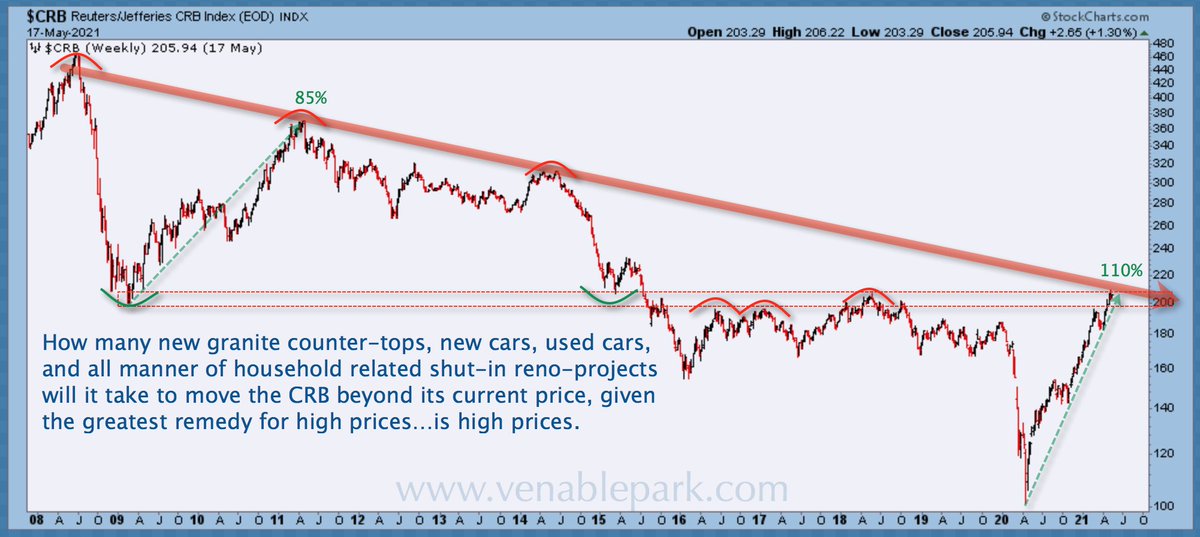
As shown below in my partner Cory Venable’s updated chart of the commodity index since 2007 (CRB- a basket of 19 commodities-39% energy contracts, 41% agriculture, 7% precious metals and 13% industrial metals), the 110% rebound in commodity prices over the last year has been greater than the 85% rebound out of the great recession into 2011.


With 80%+ of the economy already open, and consumers having spent record amounts throughout the shutdown on commodity-intensive goods like housing, vehicles and other goods, there are reasons to suspect that the reflation “trade” and inflation expectations are now wildly overdone.

While China has consumed some 50% of all global commodities produced over the last two decades, domestic consumption is just 43% of China’s GDP growth. So, western demand for Chinese exports remains the swing vote on global commodity demand.

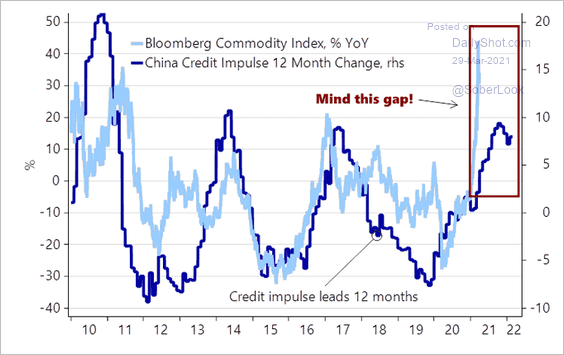
After an 8.7% annualized GDP growth rate between 2008 and 2013, China’s growth target over the next 5 years has dropped to 5.3%.  As shown below since 2009 (courtesy of the DailyShot.com), China’s credit impulse in dark blue–a measure of changes in new public and private credit as a percentage of GDP, typically marks turning points in economic activity–appeared to have peaked in March, as commodity prices (light blue) went parabolic.  This suggested commodity prices and inflation expectations had overshot.

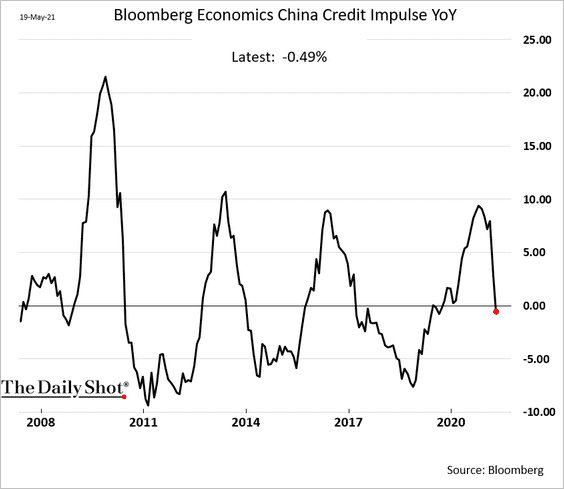
As shown on the left, updated through April, China’s credit impulse contracted further over the last month.

Before the COVID-induced spending splurge of the past year dragged forward even more future consumption, aging populations in most countries were already set to want fewer goods over the next decade+, and technological advances are helping us do more with less.

The other major reason we suspect inflationary pressures will recede is that what’s inflated most in the past decade is asset prices. And, as shown throughout history (and today), highly-levered asset inflation, and the over-zealous expectations thereon, are always transitory.

Posted in Main Page | Comments Off on Inflation expectations peak?