India’s pandemic nightmare matters

The scale of human suffering in the COVID nightmare unfolding in India and other developing countries is hard for us to grasp in North America.  But it has far-reaching implications.

Eighty-six percent of global humans live in emerging and developing economy countries that accounted for two-thirds of global GDP growth before the pandemic.  Sixty-six percent of the revenue and 75% of global profits for publicly traded S&P 100 companies came from emerging market economies in 2019.

Moreover, India–the world’s sixth-largest economy and second most populous nation (1.3 bn people, behind China’s 1.4bn)–has been dubbed the “pharmacy to the world” and is being counted on to send millions of vaccines to us.  See:  India’s COVID crisis threatens the world’s Pandemic recovery:

The country’s exports and donations were a critical part of Covax, the World Health Organization’s global program to provide inoculations to low-income countries. When they all but dried up, it left many countries scrambling to find alternatives.

Given India’s growing strategic importance, the crisis risks not only the fledgling recovery in Asia’s third-largest economy, but attempts to tamp down Covid-19 and recuperate globally. Some scientists have linked India’s fresh wave to a more virulent strain, with the out-of-control outbreak providing a petri dish for further mutations to evolve that could challenge the vaccines now being distributed from Europe to the U.S.

Here is a direct video link.

Posted in Main Page | Comments Off on India’s pandemic nightmare matters

Lessons to learn from Michael Lee-Chin and mean reversion

Michael Lee-Chin started his money management career as a financial advisor with Investors Group in Hamilton Ontario in 1979. In 1987, he bought Kitchener-based Advantage Investment Council which he renamed AIC and developed it into a mutual fund company that focused on buying the shares of other investment management companies and banks. The timing was perfect. Assets under management billowed with the rapidly rising stock market into 1999.

I owned some AIC funds in the late 1990s. Everyone loved the gains in AIC. That is until tech stocks doubled in 1999 and AIC funds looked like underperformers. When the 2000-03 bear market hit, tech shares mean-reverted with an 80% average price decline and financial service companies and bank shares ‘outperformed’ with a 48% loss. AIC, like others, lost millions in assets under management as prices plunged and customers liquidated their holdings. The company managed to hold on and rebuild through the 2003-07 market recovery.

Lee-Chin set up the Berkshire group of companies, which included an investment planning arm, a securities dealership and an insurance operation. By 2007 (another cycle top), Berkshire had amassed more than C$12 billion under management when Manulife bought Berkshire from Portland Holdings in exchange for shares, making Portland one of the largest shareholders of Manulife.

In 2009, Lee-Chin became a billionaire by selling the fee-generating customer assets in AIC Limited to Manulife.  The following year, Manulife rebranded the heritage AIC funds and eliminated the AIC name from the mutual fund line-up.

Mutual funds, like most retail investment portfolios, are generally designed to be fully allocated at all times regardless of risk-reward prospects for their unitholders or owners.  Being more tactical and careful in terms of timing exposure requires both independent managers willing to take the career risk of ‘missing out’ and underperforming during speculative eras, as well as clients/unitholders who are also self-disciplined enough to resist emotional impulses (greed near tops and then fear of buying once valuations are low again) through full market cycles.

With all of this background, it was interesting to hear Lee-Chin, now 70, discussing markets on BNN yesterday (clip below).  One thing for sure, Lee-Chin was not sitting with 50% cash in their funds under management in 2000 or 2007.

Billionaire investor and philanthropist Michael Lee-Chin is sitting on a veritable mountain of dry powder on expectations sky-high equity market valuations will take a tumble and present significant buying opportunities.

In a television interview Thursday, Lee-Chin, the founder and chairman of privately-held investment firm Portland Holdings, said he’s allocated a massive portion of his fund to cash in anticipation that markets will fall precipitously.

“In the fund I manage today, we have over 50 percent cash, and we’ve been holding that 50 percent cash notwithstanding the fear of missing out,” he said. “We have no fear of missing out. We are confident that this too will eventually regress to the mean.”  Here is a direct video link.

Posted in Main Page | Comments Off on Lessons to learn from Michael Lee-Chin and mean reversion

Coming off the boil?

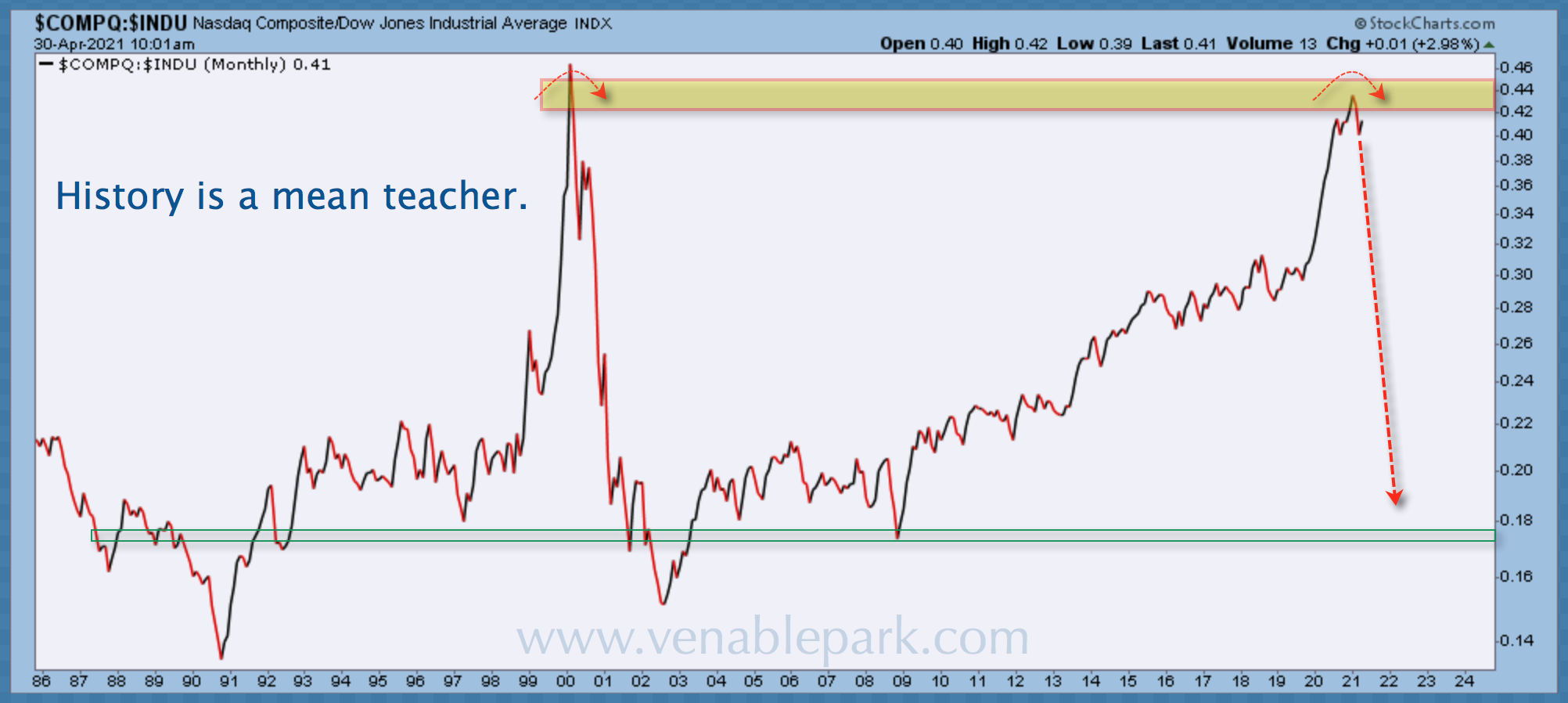
A handful of the world’s most expensive tech companies helped pushed US stock indices to record high valuations this spring.  However, as shown here since 1986 (courtesy of my partner Cory Venable), the tech-heavy NASDAQ index has lost lift relative to the older-economy Dow Jones Industrial Average since April 21, and a similar leadership reversal marked the secular market top in the spring of 2000.

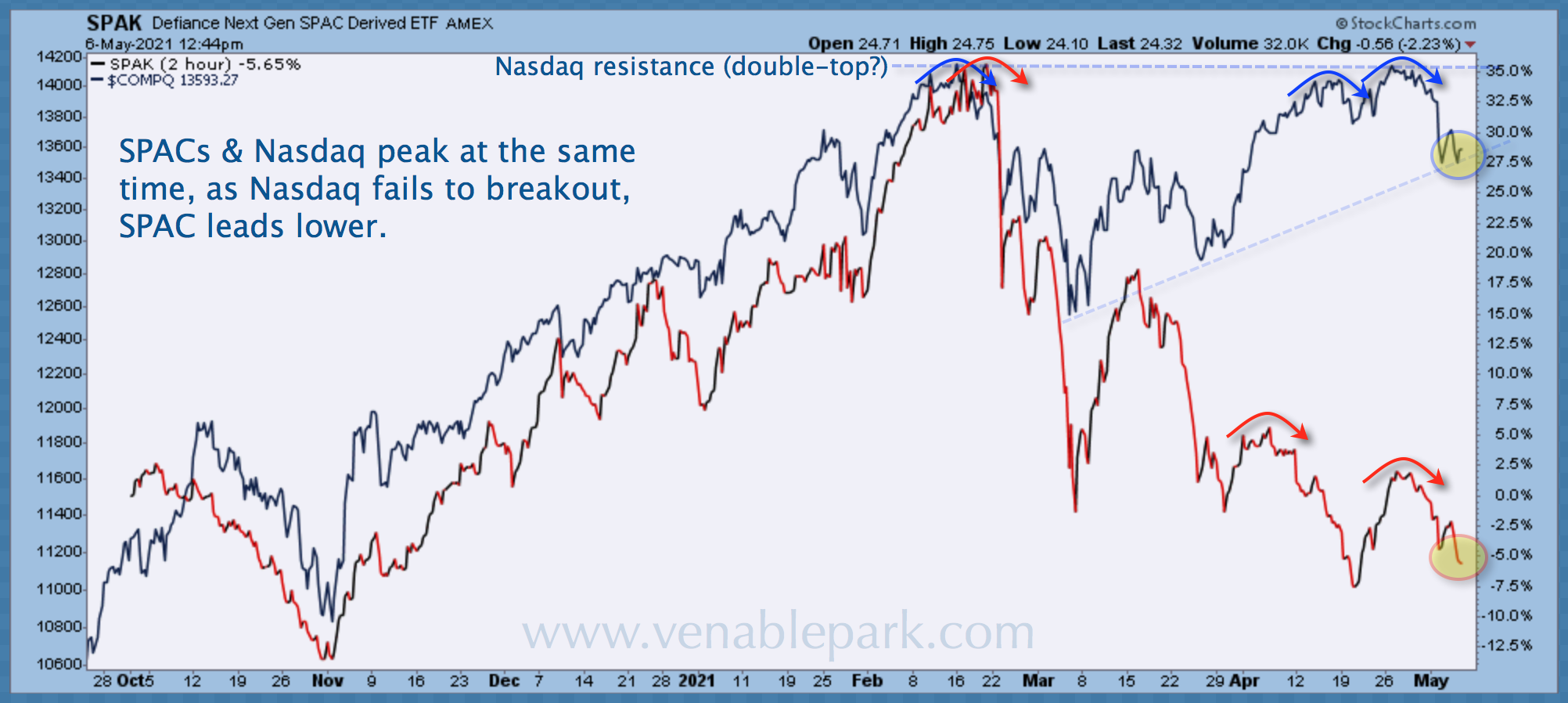
Other recent risk-market leaders are also showing weakness. Bitcoin’s so far down just 10% from its April 15th high.  But as shown below in red, the 7 month-old-SPAC ETF is abruptly -40% from mid-February.  Here, we can see that the NASDAQ index (in blue) rolled over with SPACs to the end of March, double-topped to April 21, and faltered again since.

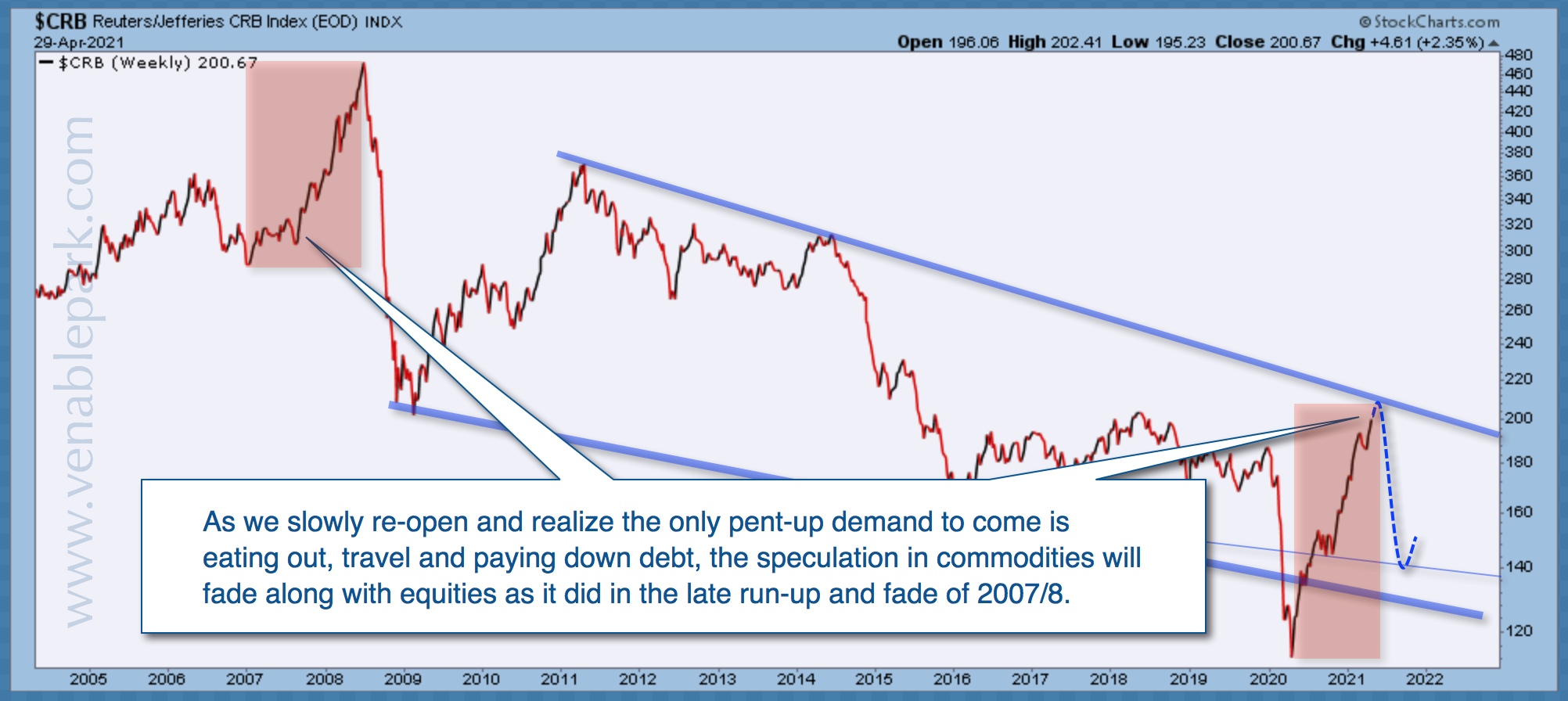
To be sure, inflation mania has revived some aggressive commodity speculation over the past year, but with the CRB Index (below since 2004) already having doubled amid government-subsidized consumption, a good deal of future demand has surely been spent.

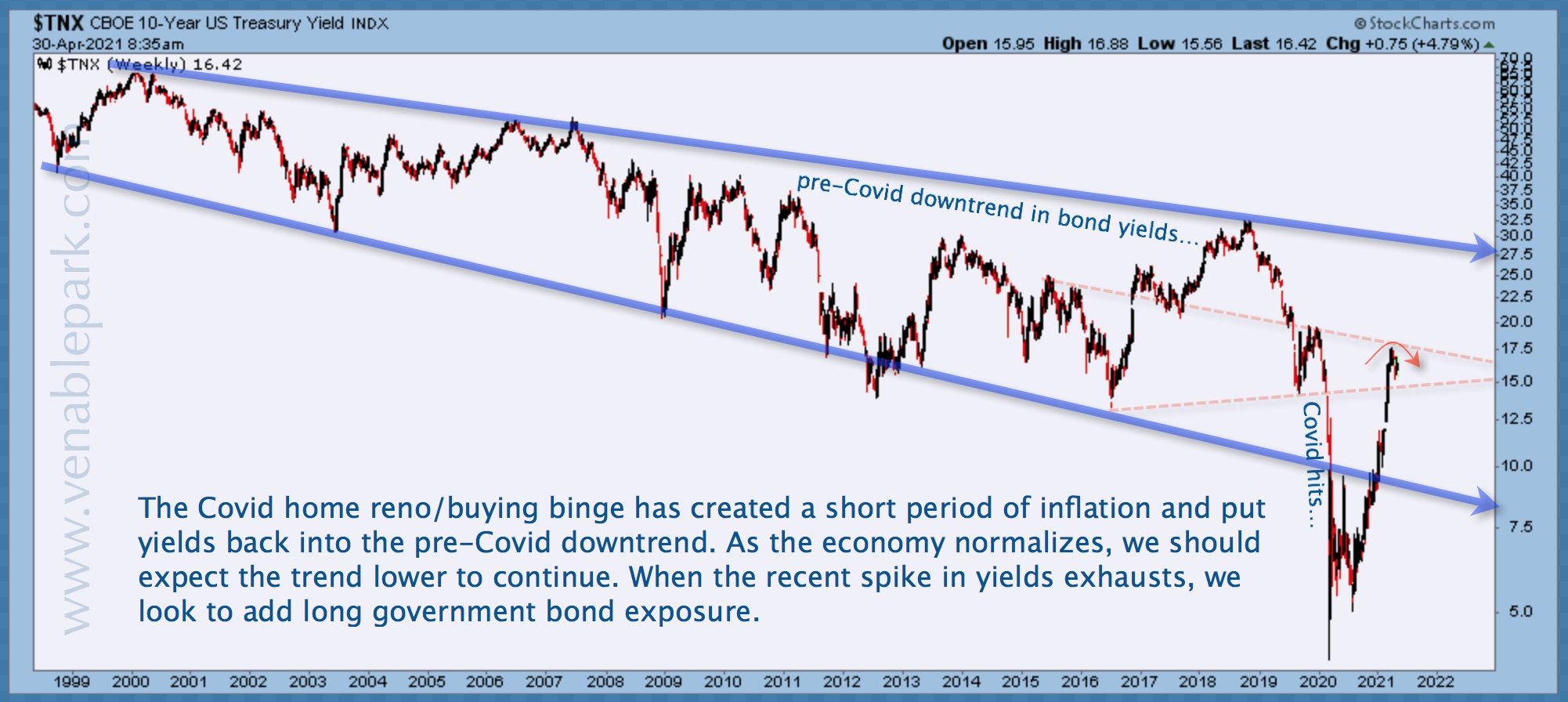
Treasury yields are, so far, not buying the hype.  As shown below since 1998,  after bouncing to 1.776 percent on March 30, 2021, the US ten-year yield closed on April 30th at 1.64. It’s 1.559 this afternoon.

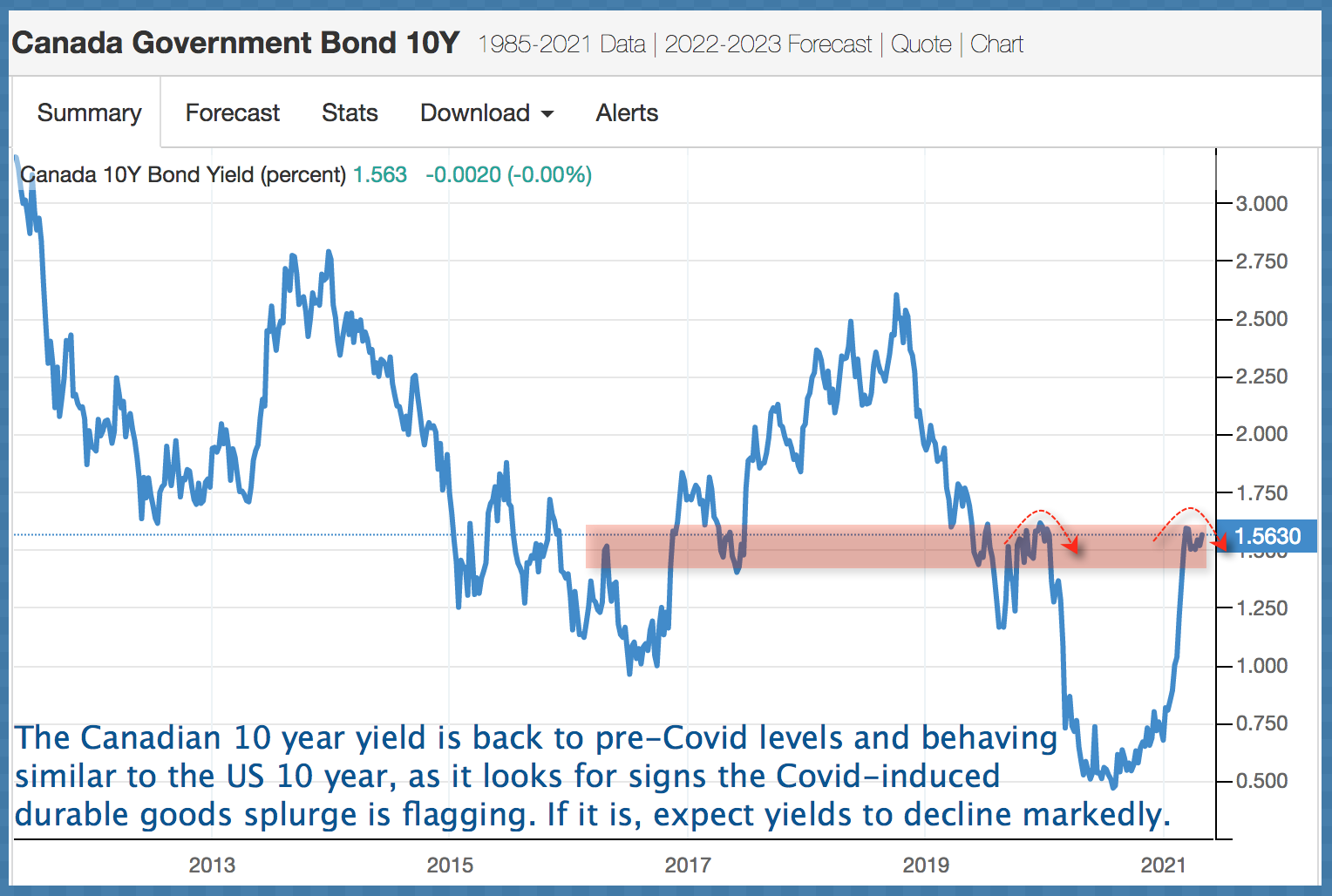
Canadian Treasury yields are sporting a similar trend having peaked at 1.68% on March 18, 2021, and closing April (below) at 1.56%; today, they’re back at 1.50.

The risk-rally has had one hell of a run, but if ‘reopening’ mania is finally coming off the boil, we should have another good opportunity to add some Treasuries.  A little more time will tell.

Posted in Main Page | Comments Off on Coming off the boil?