Danielle on CBC Weekend Business Panel

Here is a direct video link.

Posted in Main Page | Comments Off on Danielle on CBC Weekend Business Panel

Extraordinary markets promise extraordinary opportunity for the prepared

In a product-creating financial world paid to sell us growth and inflation narratives, sober risk-reward assessments are not well tolerated.  In the past 24 years, I’ve had to be bearish more often than bullish, but it’s not my fault, in fairness.  I’m a naturally optimistic person.  It’s just that my entire career as a financial analyst has happened to coincide with the most egregious asset bubbles and regulatory forbearance in human history.  I’ve witnessed repeatedly the real-life carnage that reckless financial management eventually inflicts on individuals and, call me hopeless, it’s not something I want to ignore.

Most so-called financial advisors only have training in product sales.  That may be nice.  Perhaps ignorance is bliss for some, at least until the blowups, losses and lawsuits happen.  But I’m trained to measure risk-reward prospects.  Done diligently that should work as a detriment to careless risk-taking.  And it does.  But most financial analysts also work for investment sales firms where they are paid primarily to meet sales targets, not sweat the downside.

Today, I am worried for many people who are blindly holding financial hand grenades, and I work continually to illuminate proactive steps for self-preservation and how we can prepare for the inevitable opportunities coming out of all this mess.

A recent lookback from economist David Rosenberg, just a few years my senior, reminded me of similar experiences in my own career.  And at the most extremely over-valued financial conditions ever recorded, I can’t help but agree with David here, see:  I haven’t been this excited about going against the herd in years:

I was being interviewed on CNBC last week when I was told that my views were diametrically opposed to the consensus and how the markets are positioned. To which I exclaimed that it’s been many years since I was this excited about going against the herd. I had just enough airtime to work in Bob Farrell’s Rule No. 9: “When all the experts and forecasts agree, something else is going to happen.”

Of course, this was all about the debate over runaway growth, inflation and the call on the United States Federal Reserve and the Treasury market. I didn’t take the bait on the stock market, as the bubble just gets bigger and bigger, with the cyclically adjusted price-to-earnings (CAPE) ratio now pressing against 37x, only surpassed historically by the late 1990s’ tech frenzy.

Yes, I am not positioned the way the dominant “Roaring Twenties” crowd is, that much is for sure. But I have been here before. When I turned bearish on tech at the height of the dotcom bubble back in 2000, my partners at the time thought I was nuts…

Posted in Main Page | Comments Off on Extraordinary markets promise extraordinary opportunity for the prepared

Central banks trying every trick to boost inflation

I have explained many times that central banks worry that falling inflation (disinflation) and outright deflation reduce the incentive for spending and capital flow into financial markets.

The theory goes that if consumers and businesses believe that prices will be flat or lower in the future, they have less incentive to spend today. Moreover, if savers are not threatened by the fear of inflation eroding their purchasing power, they have less incentive to buy the risky securities that financial firms and public corporations continually seek to sell them.

Even though inflation has averaged less than the official 2% target since 2007, recently, U.S. Fed head Powell threatened that he is willing to tolerate inflation above 3% if that’s what it takes to keep prices moving up.

Apparently, that includes buying up inflation-linked treasuries (TIPS).  As shown below, the US Fed has gobbled up just over 24% of the outstanding TIPS market in 2021.  The principal of a TIPS increases with inflation and decreases with deflation, as measured by the Consumer Price Index. In buying these bonds, the central bank intentionally boosts their price and inflation expectations along for the ride. 

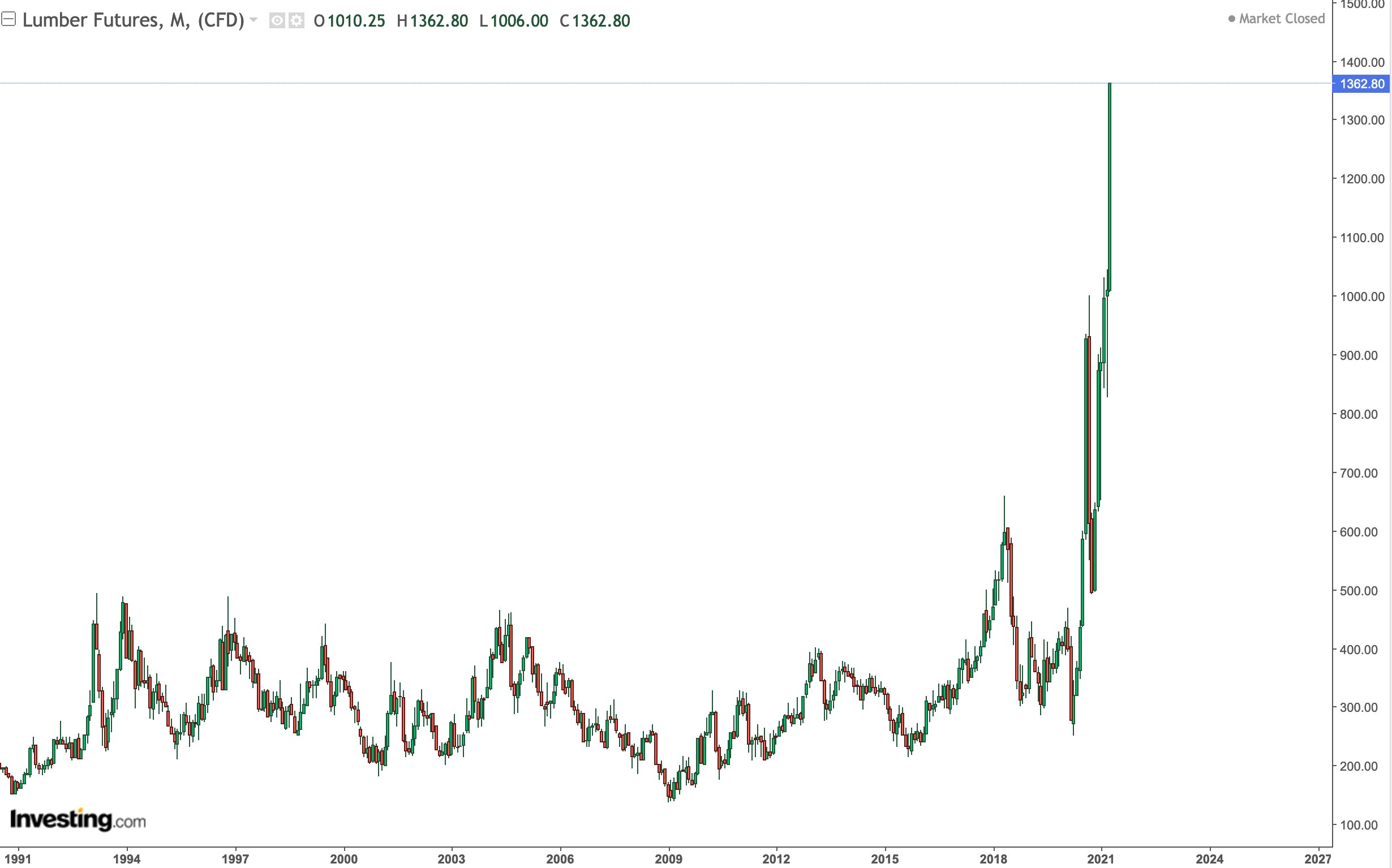
Taking the bait, commodities and corporate securities have spiked higher with inflation expectations, as individuals and trend-following funds have ratcheted up risky holdings in the hopes of outrunning capital shortfalls.

This is a familiar pattern.  Each time central banks have redoubled efforts to suppress interest rates and boost risk-appetite in financial markets, funds have flowed out of lower-risk bonds and cash and into commodities, stocks, junk debt, and other risky assets.  For a while.

Then, in a self-fulfilling circle, the incoming capital spikes commodity prices and inflation expectations and lowers bond prices, which increases bond yields/interest rates, which leads to reduced borrowing capacity and spending, disappointing growth. Then funds reverse back out of commodities and corporate assets and into perceived safe havens like government bonds and the U.S. dollar once more.

We never know the precise moment of inflection in real-time but realizing that central banks are Oz-like and knowing what inputs to measure and map is a huge help in anticipating where capital is due to flow next.

Posted in Main Page | Comments Off on Central banks trying every trick to boost inflation