Tough to get a word in edge-wise with David, but this segment is rich in economic insight.
It’s easy to feel confused these days. With the stock market at all-time highs, some analysts predict this bull market has a lot longer to run as the business-friendly policies of the new Administration start adding tailwinds to the economy. Others see economic growth as imbalanced, at best, and worry that overall the trend for 2026 is downwards, risking recession and a material market correction. So, which is it? For guidance, we turn to highly-respected economist & award-winning researcher David Rosenberg, founder & president of Rosenberg Research. David concludes the market is in a major price bubble not unlike the DotCom era, and advises investors to build/maintain liquidity within (at least) part of their portfolio in order to weather the bubble’s bursting as well as to have dry powder to deploy at attractive valuations when it does. Here is a direct video link.
Posted inMain Page|Comments Off on TM: Every Bubble Bursts
Investment sales Hoorang can be hard to resist, but self-preservation requires that we do. Never more than amid today’s everything bubble, where mania has ballooned the pricing of many assets all at once, from stocks to high-yield credit, private equity, credit funds, real estate, crypto, and precious metals.
I have long said that people should hold bullion if it makes them sleep better, but to keep the amount as a set ratio of other assets and remember that it’s a bet against the value of everything else we own. I offered all of my thoughts on the topic in this 2011 article: A Word to the Gold Bugs. And the points remain relevant today.
Humans have been vulnerable to outbreaks of precious metals fever throughout history, and we should never forget that those selling us the story are taking our (worthless?) cash in exchange.
Many, critical of central banks and their myopic foresight, have been simultaneously touting the idea that central banks adding to their gold reserves is a reason for individuals to do the same. Blindly follow the blind? Those aware of history will know that a similar notion helped fuel the gold rush of 1979-80, before prices collapsed.
In the latest iteration, belief in dollar debasement has helped propel bullion and related share prices in a self-fulfilling loop, where higher prices increase the perceived allocation, even though volume allocations have changed little.
Believers rarely let facts get in the way or see any reason to cash out wins. Still, Real Investment Advice principal Michael Lebowitz offers sober analysis for those who are open to it in Dollar Debasement: Reality or Dangerous Narrative? Here’s Michael:
Another popular but misleading argument is that foreign central banks’ reserves in gold are increasing rapidly. That is true. However, as we share, central banks have barely added physical gold to their gold reserves. Instead, gold, as a percentage of reserves, has grown significantly because its price increases the value of the gold compared to other reserves.
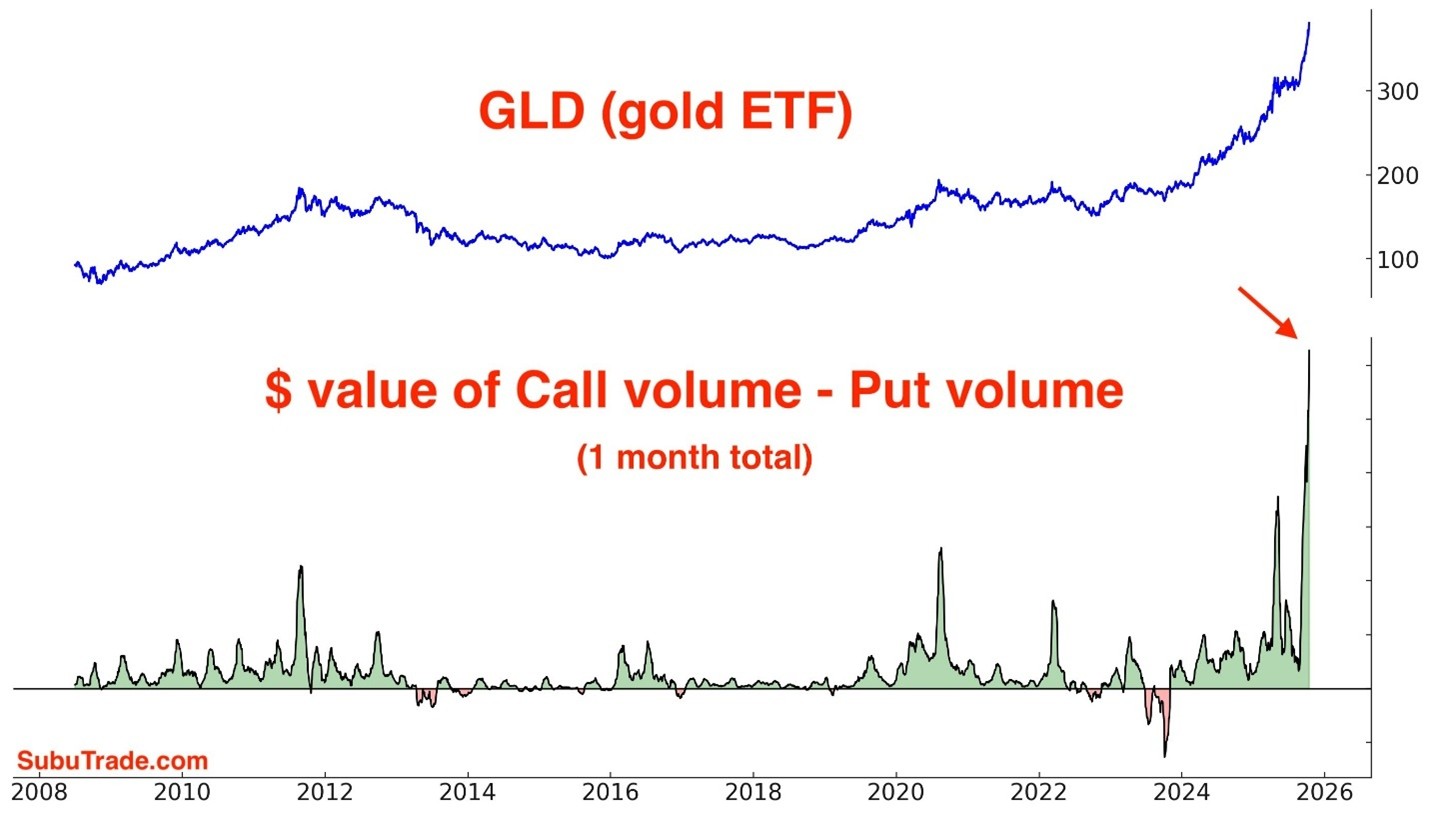
Epic speculative fever is further evidenced in record levered bets in the space:
The chart below is courtesy of @SubuTrade. It shows that the volume of gold calls exceeds that of puts by the widest margin in the past 15 years. Call buyers are speculative traders who tend to follow narratives rather than fundamentals. The record call buying reflects the highly speculative enthusiasm in the gold market.
We are always at risk of losing our collective heads before coming to our senses one at a time. It’s wise to keep in mind the timeless quote attributed to Mark Twain:
“It ain’t what you don’t know that gets you into trouble.
It’s what you know for sure that just ain’t so.”
Posted inMain Page|Comments Off on Another word to the gold bugs
The financial system is sending out a major distress signal. While stocks hover near all-time highs, former Federal Reserve insider Danielle DiMartino Booth warns that a systemic liquidity crisis is already here, and it will force the Fed to abandon its inflation fight. In this interview, the CEO of QI Research tells Kitco News’ Jeremy Szafron that the violent 5% sell-off in gold is a “repeat of March 2020″—a forced liquidation event signaling that the “dash for cash” has begun. She breaks down why “prime borrower” delinquencies are the new canary in the coal mine and explains how banks are using “extend and pretend” tactics to hide a brewing credit event she says will unleash “more cockroaches” into the public markets. Is the Federal Reserve trapped? Booth lays out the final indicator that will prove the system has broken and the Fed has lost control. Here is a direct video link,
Posted inMain Page|Comments Off on DDB on dash for cash catalysts
“An explosive critique about the investment industry: provocative and well worth reading.”
Financial Post
“Juggling Dynamite, #1 pick for best new books about money and markets.”
Money Sense
“Park manages to not only explain finances well for the average person, she also manages to entertain and educate while cutting through the clutter of information she knows every investor faces.”
Toronto Sun