‘YOLO’ gamblers increase downside for all participants

Bloomberg Intelligence estimates that ordinary retail investors have accounted for some 23% of all US equity trading in 2021, more than twice the level of 2019.  As charted below by the FT, this makes the ‘retail’ activity in equity markets today (navy blue line) about as big as all hedge funds (green) and mutual funds (pink) combined and trails only high-frequency traders (in red) in hyperactivity.  In other words, some 70% of those buying and selling in stock markets today are day and nano-second-traders, not long-term owners or investors.  See Rise of the retail army:  the amateur traders transforming markets.

A Deutsche Bank survey found that nearly half of US retail participants were completely new to markets.  Most were under age 34 and more willing than experienced investors to borrow money and use options to magnify their wagers.

This is not just about penny stocks.  Thanks to brokers selling fractional shares and levered ‘free’ trades, in some weeks, the retail mob has accounted for as much as half of all trading in Apple, Amazon and other large-cap giants that make up the heaviest weights in the market indices.  Canadian stock indices have seen a similar explosion in retail trading over the past year.  The cumulative trading volume on the Toronto Stock Exchange, the Canadian Securities Exchange and TSX Venture Exchange soared more than 250% year over year in February.

High leverage means, by definition, that these participants have a high probability of catastrophic implosions.  Apparently, they see no better prospects for themselves.  Their rallying motto is ‘you only live once’ (YOLO).  Suicide bombers have nothing on these folks.  The trouble is that it’s not just those with little to lose that are in harm’s way.

Low-interest rates and trend-following have enticed life-savings alongside the YOLO’s.  This is like sober people trying to drive safely amid death-wish speedsters travelling 200 miles an hour on black ice.  Mass pileups and collateral damage are inevitable.

Some recent surveys report that participants plan to up their ante by adding up to 50% of any forthcoming stimulus cheques to stocks (DB chart on the left).

Many say that they intend to add even more money in the event of a market drop.  This is unlikely.  Forty-three percent have less than 12 months of market experience. Most have never lived through a multi-month bear market or even know they are a recurring part of market cycles.  They’ve not faced margin calls that demand they add more cash or sell securities day after day to up collateral as asset prices fall.  They’re keen to gamble because they’re broke.  They’ll be even more broke at the end of this adventure.

Those with money they don’t wish to lose must practice self-defence to be stable and opportunistic as the bear market runs its course. In the meantime, there’s zero safety in holding equities at record highs alongside a desperate and reckless levered crowd.

Posted in Main Page | Comments Off on ‘YOLO’ gamblers increase downside for all participants

Thoughts from the Frontline: Everything is broken

John Mauldin’s latest Thoughts from the Frontline adeptly summarizes the financial markets and prospective losses facing those holding equity and corporate bond portfolios and funds today.  There is a way through this mess, but few people are proactively positioned to survive and thrive.  See Everything is Broken, here’s a snippet:

Millions of Baby Boomers are approaching what they thought would be a comfortable retirement age and instead finding they’re nowhere near ready. Worse, many believe themselves ready when in fact they aren’t. They will realize it only when markets show them what reality looks like.

The many reasons for this mostly trace back to the above-mentioned broken bond market. Retirement investing used to be easy. Save money, park it in interest-bearing instruments, and live off the income, with Social Security and maybe a job pension to help. Not complicated and it worked well for decades.

But about the time the oldest Boomers began reaching their mid-60s, this thing called “interest” mostly disappeared as committees and politicians decided to favor borrowers by keeping rates ultra-low. And just like that, retirement broke. The old method stopped working.

This left retirees and pre-retirees little choice but to “stretch for yield” in riskier assets. Indeed, that was the plan. The Federal Reserve under Bernanke, Yellen, and now Powell explicitly wants investors to take more risk. It’s the other side of their desire to encourage borrowing. This is also called “financial repression.”

So now we have retirees with far too much in stocks, junk bonds, or other risk-heavy assets. And not just individuals; the same is true for large pension funds. Their trustees are truly trapped: contractually obligated to pay certain benefits and unable to do so without robbing future beneficiaries.

…What happens when you force investors into an asset class they don’t especially want or understand? Well, price comes from supply and demand. Artificially generated demand leads to artificially higher prices, and that is what we see in the stock market today. A survey in the year 2000 shows that investors expected future returns from the stock market would be 15% per year. I think current investors have similar expectations. They think stocks only go up, because the Fed will intervene if they don’t.

I reviewed stock valuations in more detail a few weeks ago (see here) and everything I said then still applies. Anyone who owns passive index funds will endure a major drawdown at some point. I can’t say exactly when but it’s going to hurt. And who holds those funds? Investors who don’t really want to be in stocks in the first place and/or don’t understand the risks, or institutions that have little choice. Both categories are being forced by circumstances to make decisions they wouldn’t make in an otherwise “normal” market.

At the same time, managers of many listed companies aren’t making the greatest decisions, either. Many are responding to short-term incentives that encourage them to load up on debt, boost their share prices via buybacks, and profit by suppressing competition instead of innovating.

This is a stock market in which, much like bonds, prices bear little resemblance to fundamental reality. But more broadly, the equity markets are broken. I am all for making them accessible to everyone. Unfortunately, the regulatory and educational structure hasn’t kept up. So what we’ve really done is empower people to do risky things without preparing them for the consequences. It’s not going to end well.

Posted in Main Page | Comments Off on Thoughts from the Frontline: Everything is broken

James Grant on Bitcoin and other bubbles

This segment is a worthwhile overview of the history of interest rates, the Federal Reserve, asset bubbles and their deleterious effects on the economy and savers.

One caveat:  I disagree entirely with Jim’s dismissal of Tesla vehicles (as distinct from its bubblicious share price).  Having driven one for three years now, with zero fuel and maintenance costs, it’s quite clear that the technology has earned its world-leading status.

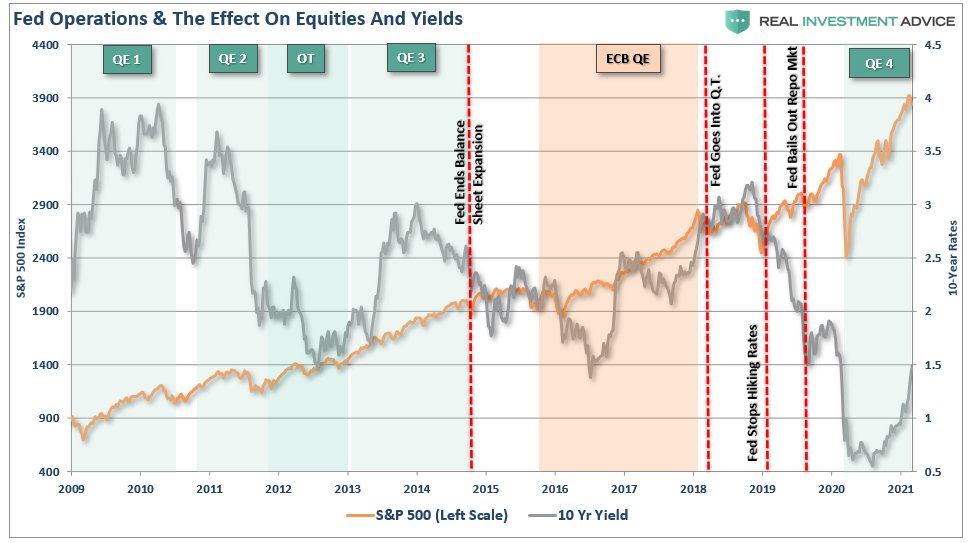
The balance sheet of the Federal Reserve continues to surge at an unprecedented rate, up 83% y/y to a historic level, $7.59 trillion at the latest count.

According to our WEALTHTRACK podcast guest, financial historian, and long-time market observer James Grant, interest rates, the “central pricing mechanism for financial markets” have been pushed to artificially low levels by the Fed’s policies which have created numerous market bubbles. He cites Bitcoin as one of the most extreme examples. Here is a direct video link.

“The more intense the craze the higher the order of intellect that succumbs to it…this is a bubble like all others…when the time comes, when greed turns to gravity, you’re not goin’ to get out.”

Posted in Main Page | Comments Off on James Grant on Bitcoin and other bubbles