Another manic March

Twenty-one years ago this month…March 2000, what a time to be in stocks, I remember like it was yesterday.  The world had gotten through Y2K without any issues, technology was changing everything (again), the much-loved NASDAQ had doubled in just the prior 12 months, Greenspan’s Fed was deemed all-powerful, and market optimism felt boundless.  There was nowhere to go but down.  Tech stocks peaked that month.

The CRB commodity index also doubled in less than a year but did not peak until 8 months later in November.  Commodities, banks and Nortel (before it collapsed in fraud) held Canada’s TSX up until July, then gravity overcame it too.


There are many parallels between 2000 and our present cycle.  One big added negative this time:  home prices then were not caught up in the market exuberance in 2000.  Property prices had been pretty flat for a decade after their ’88-’90 decline and homeowners were nowhere near as indebted.  No such luck today.

At this point, the next few months will be breathtaking no matter what happens next.

Posted in Main Page | Comments Off on Another manic March

Tax avoidance has reached tipping point

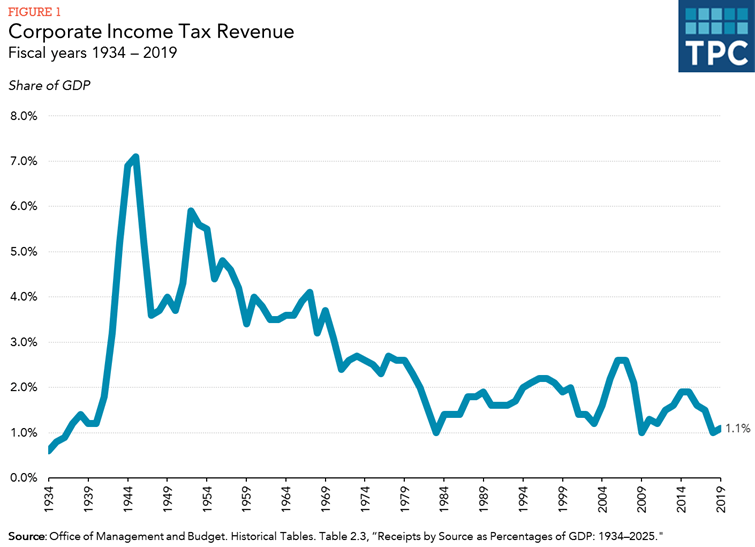
The argument that raising taxes on the ultra-wealthy will not eliminate government deficits is a red herring.  The primary purpose of tax policy is not to eliminate deficits but to incentivize socially constructive behaviour and dissuade the socially destructive.  Tax collection from the wealthiest individuals and corporations has fallen since WW2 worldwide, while government subsidies, bailouts and support programs favouring the wealthiest constituents have soared.  This chart of US corporate income tax revenue as a portion of GDP since 1934 reflects a trend that has played out across all OECD countries.

In Canada, the general corporate tax rate has fallen from 50% in 1982 to 26% in 2020, while the top marginal personal tax rate has fallen from 80% in 1972 to 60% until 1981, to 33% today.

Tax policy has been a major factor increasing wealth disparity, falling productivity, and destructive asset bubbles for at least the past thirty years, and the pandemic has accelerated the problems.  If history repeats, the policy pendulum will now swing back in the opposite direction for years to come.   This month, the British government got the ball rolling with the announcement of its first corporate tax rate increase since 1974–to 25 percent from 19 percent starting in April 2023– after successive Conservative governments lowered it from 28 percent over the past decade. The government also plans to freeze several personal tax allowances for four years starting in 2022 ( I suspect the freeze will end up being longer than 4 years).

The beneficiaries of the ‘American Rescue Plan’ from the Biden administration are compared below (on the right) with the Trump administration’s tax cuts (on the left)–both ballooned the national deficit and national debt, but different values are evident in each.

Many of the world’s wealthiest individuals and corporations have increasingly used low or no tax zones, trusts and off-shore shelters to help stockpile wealth outside of the tax system and real economy even as they benefit from government-funded infrastructure and services.

The segment below is a worthwhile recap of some recent high-profile examples.

At the WEF in Davos the world’s wealthiest people meet annually to discuss philanthropic solutions for saving the world. But few want to talk about the issue of tax avoidance through philanthropy.  Here is a direct video link.

Posted in Main Page | Comments Off on Tax avoidance has reached tipping point

‘YOLO’ gamblers increase downside for all participants

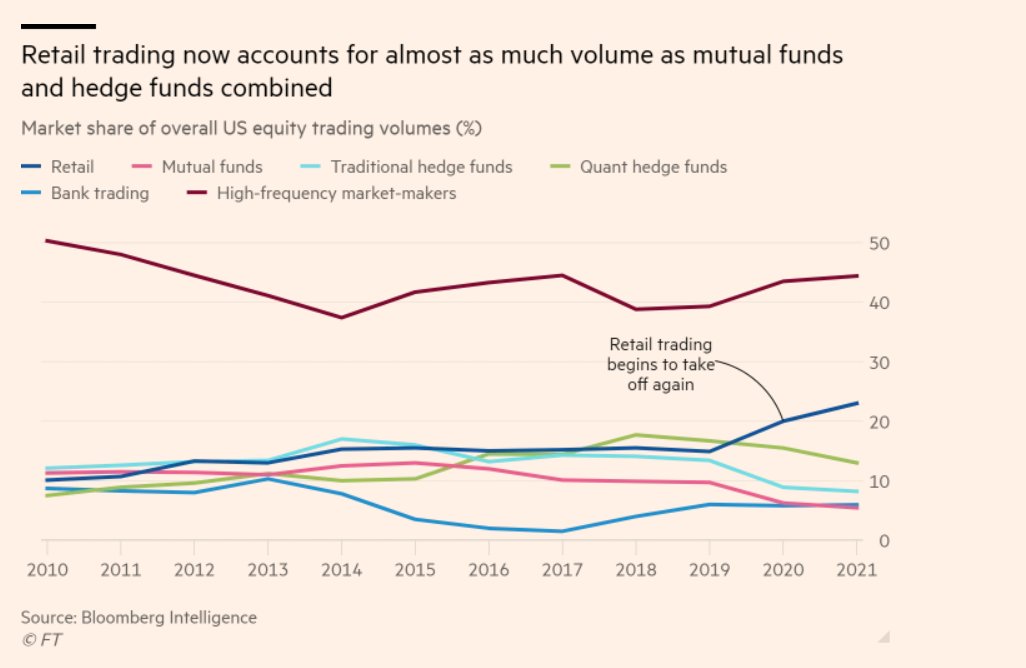
Bloomberg Intelligence estimates that ordinary retail investors have accounted for some 23% of all US equity trading in 2021, more than twice the level of 2019.  As charted below by the FT, this makes the ‘retail’ activity in equity markets today (navy blue line) about as big as all hedge funds (green) and mutual funds (pink) combined and trails only high-frequency traders (in red) in hyperactivity.  In other words, some 70% of those buying and selling in stock markets today are day and nano-second-traders, not long-term owners or investors.  See Rise of the retail army:  the amateur traders transforming markets.
A Deutsche Bank survey found that nearly half of US retail participants were completely new to markets.  Most were under age 34 and more willing than experienced investors to borrow money and use options to magnify their wagers.

This is not just about penny stocks.  Thanks to brokers selling fractional shares and levered ‘free’ trades, in some weeks, the retail mob has accounted for as much as half of all trading in Apple, Amazon and other large-cap giants that make up the heaviest weights in the market indices.  Canadian stock indices have seen a similar explosion in retail trading over the past year.  The cumulative trading volume on the Toronto Stock Exchange, the Canadian Securities Exchange and TSX Venture Exchange soared more than 250% year over year in February.

High leverage means, by definition, that these participants have a high probability of catastrophic implosions.  Apparently, they see no better prospects for themselves.  Their rallying motto is ‘you only live once’ (YOLO).  Suicide bombers have nothing on these folks.  The trouble is that it’s not just those with little to lose that are in harm’s way.

Low-interest rates and trend-following have enticed life-savings alongside the YOLO’s.  This is like sober people trying to drive safely amid death-wish speedsters travelling 200 miles an hour on black ice.  Mass pileups and collateral damage are inevitable.
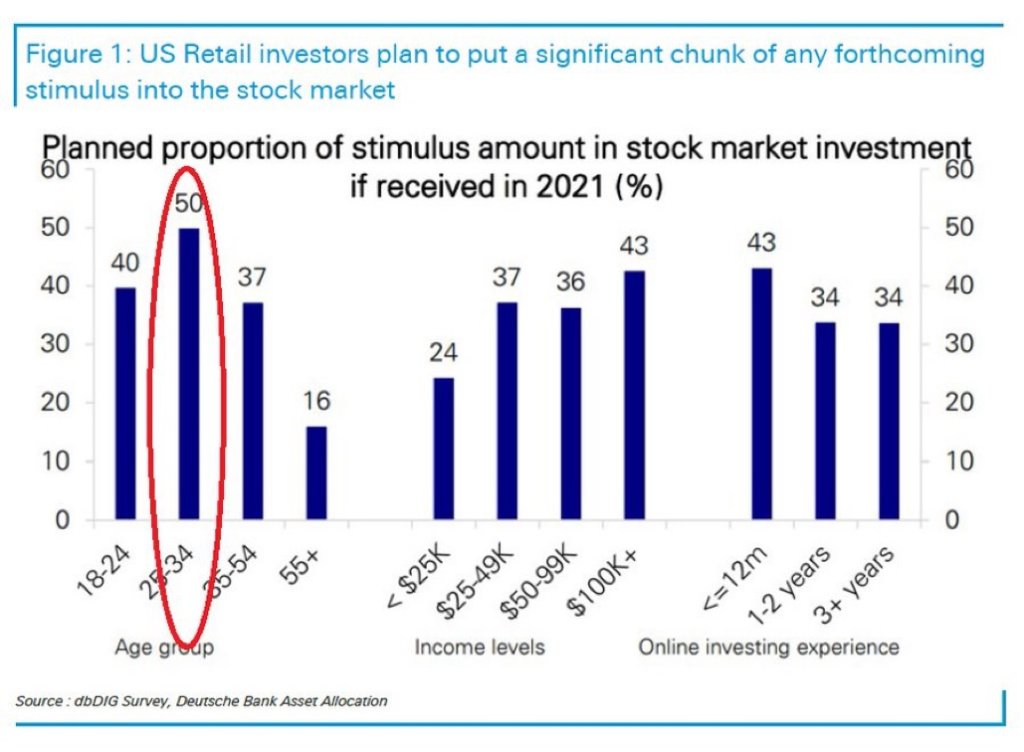
Some recent surveys report that participants plan to up their ante by adding up to 50% of any forthcoming stimulus cheques to stocks (DB chart on the left).

Many say that they intend to add even more money in the event of a market drop.  This is unlikely.  Forty-three percent have less than 12 months of market experience. Most have never lived through a multi-month bear market or even know they are a recurring part of market cycles.  They’ve not faced margin calls that demand they add more cash or sell securities day after day to up collateral as asset prices fall.  They’re keen to gamble because they’re broke.  They’ll be even more broke at the end of this adventure.

Those with money they don’t wish to lose must practice self-defence to be stable and opportunistic as the bear market runs its course. In the meantime, there’s zero safety in holding equities at record highs alongside a desperate and reckless levered crowd.

Posted in Main Page | Comments Off on ‘YOLO’ gamblers increase downside for all participants