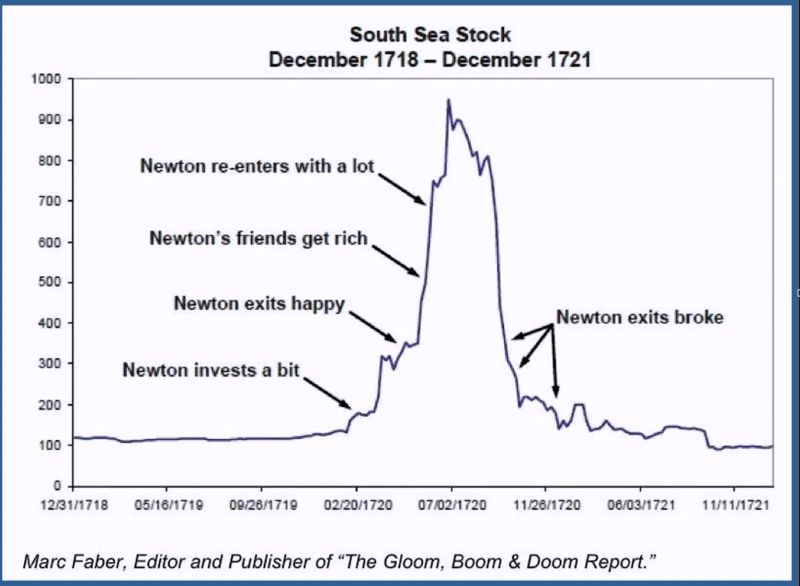
When does this financial bubble burst? Who can say; that it will, is without a doubt. At the moment, virtually no one thinks that the burst is imminent. On the other hand, this is typical of bubble tops. GMO’s Q3 quarterly letter here summarizes 2020 well.
Perhaps it was the lockdown that left people with plenty of time on their hands and no sports to bet on, but this year has seen more crazy activity in the stock market than anything we have seen since 2000 (chart on left shows share prices to sales 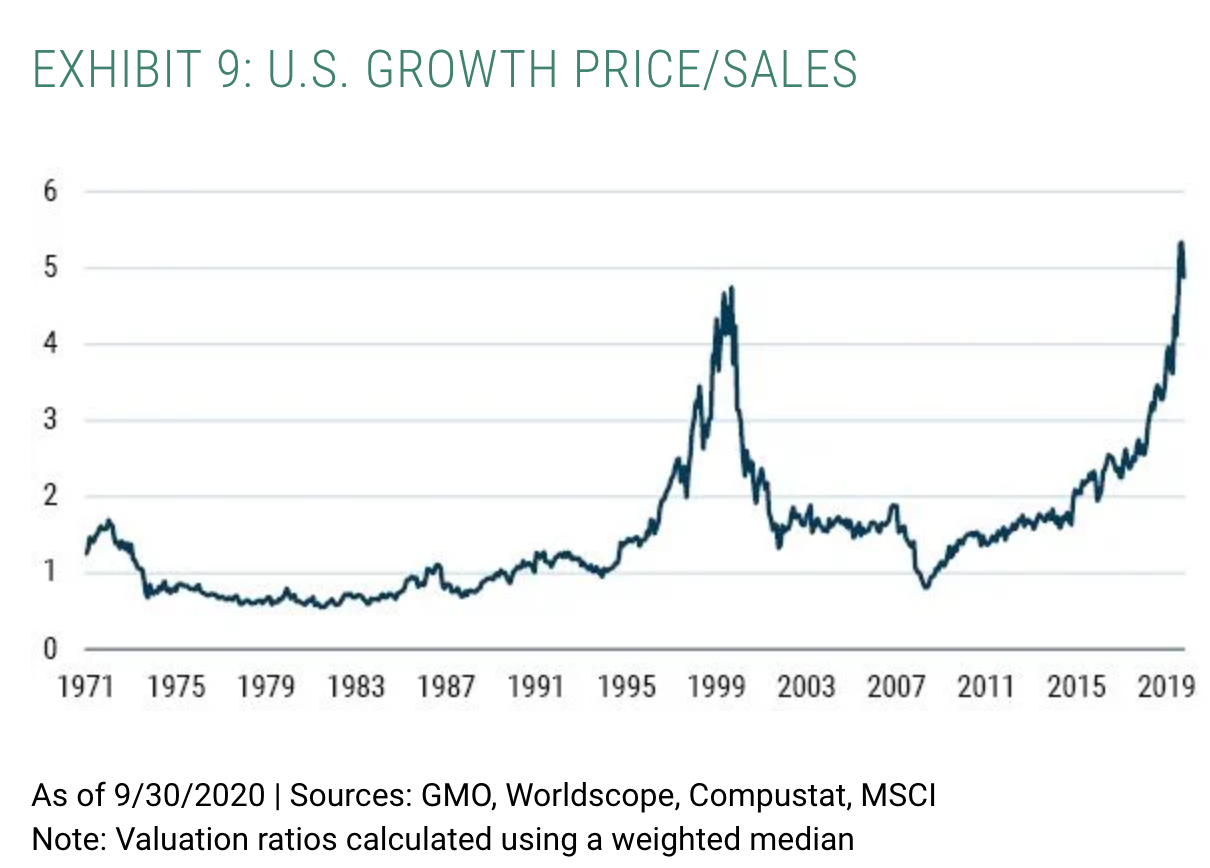 of US growth companies sinec 1970.)
Whether it was Hertz stock rising 10-fold in the spring as a high beta recovery play despite the fact that the company was bankrupt and shareholders wouldn’t have benefitted from a recovery even if it happened, or Kodak stock rising 30-fold after announcing it was going to start making chemicals to enable the production of Covid-19 treatments, very odd and speculative things have been going on.
As a more traditionally Growth-y example, Tesla has risen some 800% since the fall of 2019 on the back of 17% growth in vehicles sold. It now has a greater market cap than the sum of all the other U.S. automakers, all the European automakers, and all the Korean automakers, with Honda, Mazda, and Nissan thrown in for good measure. That collection of companies sold approximately 100 times as many cars as Tesla did in 2019. But Tesla isn’t the craziest thing that happened this year, and that is true even if we restrict ourselves to looking only at electric vehicle companies named after Nikola Tesla.
This spring a would-be Tesla called Nikola went public via a reverse merger with a SPAC9 at a valuation of $3 billion. In the 2020 EV frenzy, it rose 10-fold to a market cap of about $30 billion. This company is a rare bird in the stock market, a pre-revenue manufacturing company. In fact, Nikola is not only pre-revenue, having never sold any vehicles it has produced, it has also never produced a vehicle. Further, it has not even built the factory in which it aspires to build the trucks that it has yet to sell. This summer, a report came out detailing allegations that almost all of the claims of Nikola’s Elon Musk wannabe founder over the few years of its existence were lies. That founder, Trevor Milton, was forced to resign and the company has yet to meaningfully refute any of the claims made in the report. The stock duly fell, but even after information came out showing that pretty much everything the company has claimed to accomplish in its history was a lie, it still has a market cap more than three times its value at its public debut less than a year ago – a valuation that was presumably predicated on the company’s claims actually being true.
With a combination of some the highest valuations ever seen and clear corresponding manic investor behavior, it seems clear to us that Growth stocks are indeed in a bubble.