Riocan reminds income-seekers of the risks inherent in equities

People are learning the hard way, again, that income and return of principal from equities and equity-based funds are not contractually prescribed, as with a bond, but rather at the discretion of management and market pricing.

In challenging financial conditions, management often cuts payouts to shore up capital.  This is the right thing to do in terms of the company’s solvency, but it hurts those holding the equities.  Not only do the income payouts drop, but the share prices typically plunge in response, delivering a double whammy for the majority who cannot afford to lose money.

Real estate funds are in the midst of a liquidity shock that is unlikely to end quickly.  The overconfidence and asset inflation in condo and commercial space over the last decade, particularly in Canada, has been one for the boom-bust history books.  There is much inventory to work down, repurpose and demolish as bricks and mortar demand is reduced by virtual commerce and work outside downtown centers for many.  Property prices and rents have more downside before more stable investment metrics have been restored.

Riocan is the latest widely held real estate investment trust (REIT) to slash its payout by 33% this week, in addition, the shares have lost 37% of their value since January, and are now -23% over the past 5 years.  Those who thought they were getting paid more in Riocan than in bonds over this period have now lost all of the apparent advantage and more.

Riocan is the second-largest holding in Canada’s Real Estate Investment Trust Index (XRE) which is currently down about 22% since January.  Riocan will not be the last company in the space to cut payouts.  Opportunities are coming for those who wait to buy.

It was irresponsible of Riocan CEO Sonshine to confidently assure shareholders in May that cuts were not in the cards.  This BNN clip tells the tale and reminds us of why doing our own asset allocation assessments is critical rather than relying on assurances from the sales force.

RioCan Real Estate Investment Trust is slashing its payout to investors by 33 per cent as COVID-19 wreaks havoc on the real estate industry. The move comes after RioCan’s CEO pledged to preserve the distribution earlier this year.  Here is a direct video link.
Posted in Main Page | Comments Off on Riocan reminds income-seekers of the risks inherent in equities

Democrats stuck between “Blackrock and a Hard Place”

I’m not endorsing all of the ideas and comments in this interview, and I am not enamoured of Janet Yellen or cryptocurrency, but the discussion is thoughtful and worth a mull.

Democrats are caught in structural hypocrisy as they juggle the interests of Wall. St, workers, the right-wing and the progressive wing of the party. Rana Foroohar and Mark Blyth join Paul Jay on theAnalysis.news podcast.  Here is a direct video link.

Rana Foroohar is a business columnist and associate editor at The Financial Times. She’s also CNN’s global economic analyst. Her books include the highly recommended Makers and Takers: The Rise of Finance and the Fall of the American Business and Don’t Be Evil: How Big Tech Betrayed Its Founding Principles. Mark Blyth is a political economist at Brown University. He researches the cause of stability and change in the economy. And, as he says, why people continue to believe stupid economic ideas despite buckets of evidence to the contrary.

Posted in Main Page | Comments Off on Democrats stuck between “Blackrock and a Hard Place”

Long time running

The US Dollar Index (DXY) is bobbing at a 52-week low in the $91 range this week, and stocks and commodities are similarly trading trends looking for direction.

As I have explained previously, the risk rally needs further dollar weakness, and with the US Fed promising more QE and more fiscal stimulus soon, that could happen.  On the other hand, more monetary and fiscal interventions are the base case now, so they should also be priced in.  The fiscal package size is the only question mark, and the larger it is, the less central banks will do, and vice versa.  Zero-sum game?

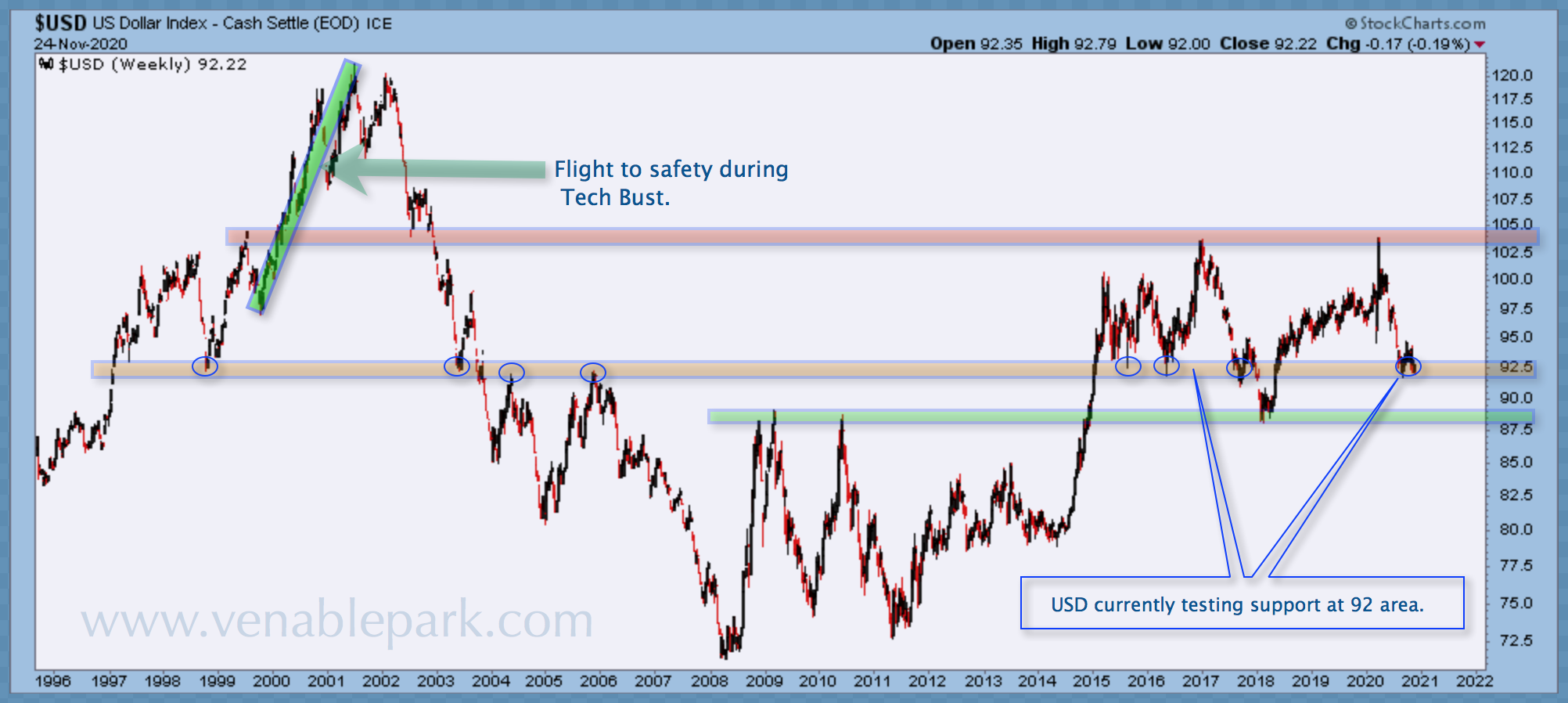
As shown in my partner Cory Venable’s chart below, if $92 now proves resistance, the next test for the greenback index could be the $87 area that served as support in early 2018 just as risk markets entered their nineteenth nervous breakdown.


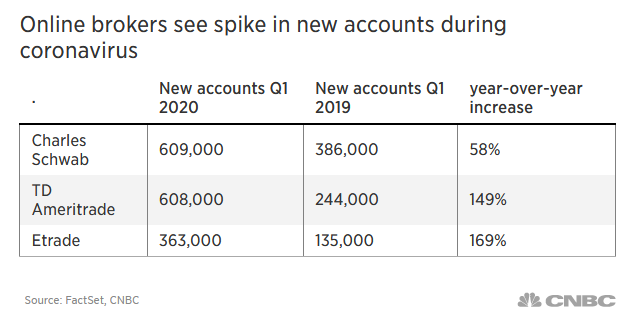
One increasing headwind for equity bulls today is the fact that the ‘dumb money‘ –as the street calls them–is finally up to their oxters in stocks and derivatives.  More than a decade after the little people were wiped out in 2008-09, they’ve finally been enticed back in.  The leap in online trading accounts in 2020 is just one of many indicators reflecting retail zeal today (table on left, hat tip:  Michael Lebowitz).  The online trading companies are jumping for joy as they sell the flow to larger predators.

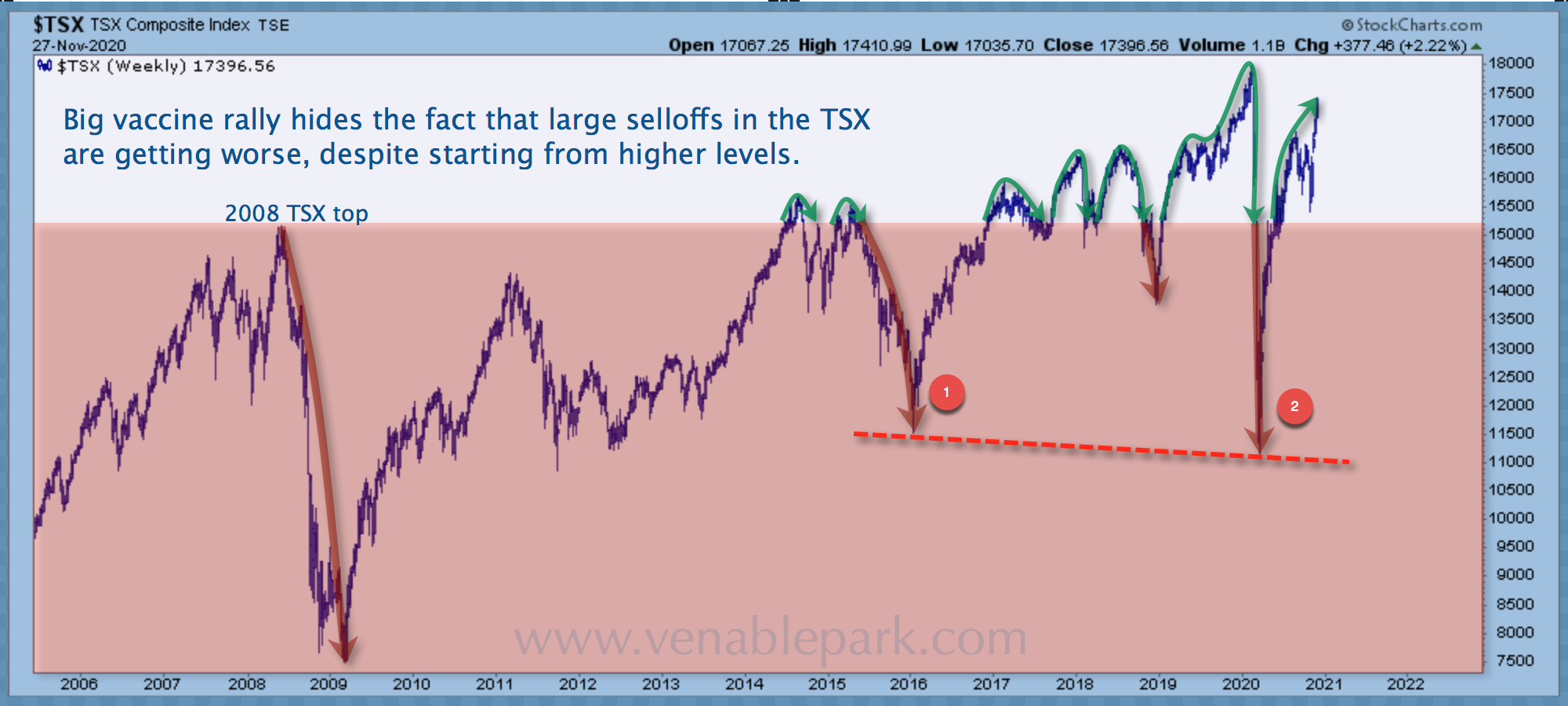
As shown in Cory Venable’s chart below of Canada’s TSX since 2005, from the last exuberant cycle top in 2008, Canadian stockholders spent 7 years waiting to grow back capital just in time for the TSX ‘Tower of Terror‘ to serve them vertical drops in 2016, 2018 and again this spring.  By April 2020, the TSX index was -26% from its 2008 top.  Nothin’ for money, and your heart attacks for free, Dire Straits might say.  With the rebound since March, the TSX closed November up 15% over the last 12 years.  Government bonds and guaranteed deposits have kicked its can with zero principal risk—a rarely-noted secret in the equity-product-selling financial biz.

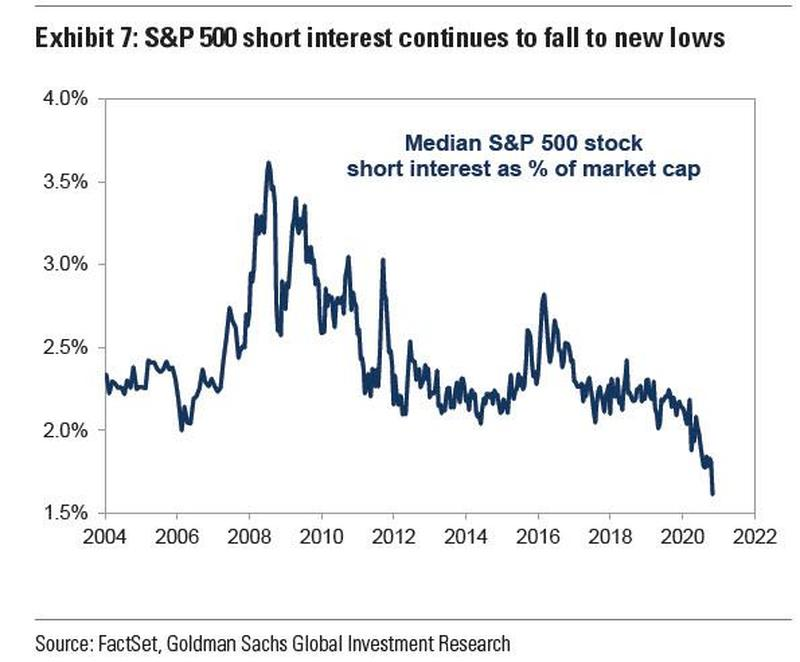
Short interest as a percentage of the S&P 500 market cap, meanwhile,–bets that equity prices will fall–is nearly extinct, as shown on the left. When the consensus agrees, something else tends to happen.

One thing for sure, whatever the motivation here, investing isn’t it.

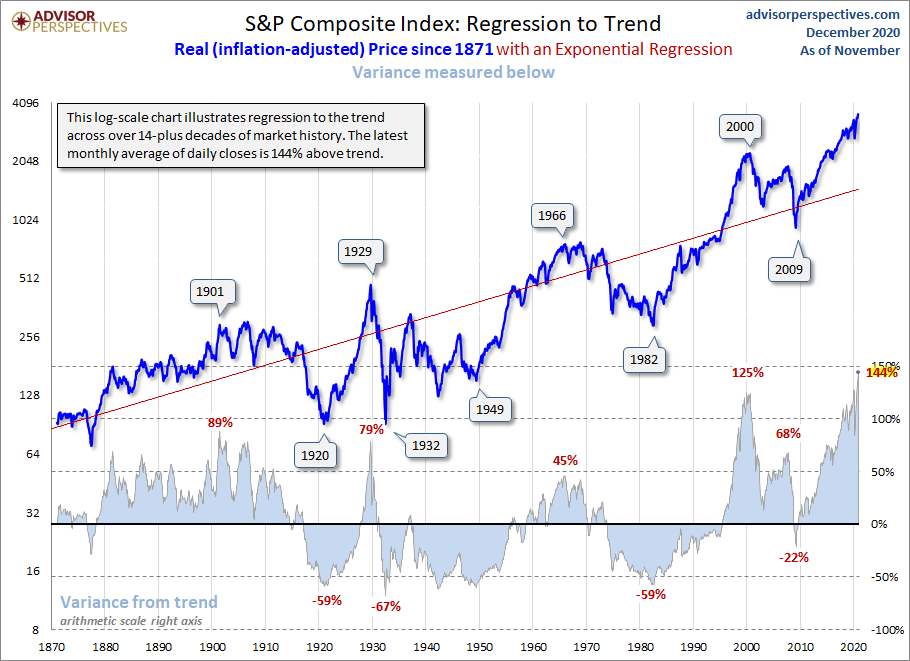
As shown below in this chart from advisorperspectives.com of the S&P 500 price regression since 1871,

US stocks closed November 144% above their 14 decade-inflation-adjusted monthly average of daily closes.  As a few other sober folks and we have mentioned, the only thing that has been certain in the stock market over the long run is mean-reversion: periods of overperformance are followed by underperformance periods and vice versa.  From February to March this year, the one-month correction was a tiny start in the big picture of downside work yet to come.  Following less extreme valuation periods, other bear markets lasted 9 to 24 months and lopped 50 to 80% off the strongest companies.  The weak ones went bankrupt.

To quote another of my favourite bands: “It’s been a long time running.
It’s been a long time coming.  It’s well worth the wait.”

If you don’t have an investment plan or strategy that ignores the madness of crowds and protects your life savings from multi-month drawdowns while maintaining liquidity to buy when asset prices do become investment quality, there’s literally no time like the present to awaken from your slumber.

Posted in Main Page | Comments Off on Long time running