Corporate tax receipts must rise from here

Large corps have long-lobbied for preferential tax treatment and government subsidies because they are ‘job creators.’  In reality, automation and off-shoring have been reducing their employment rolls steadily.  As globalization has allowed multi-nationals to position head offices in the lowest tax zones, countries, states, and provinces have raced each other to the death for the most corporate-friendly offerings.

In one 2018 EU study, it was found that global tech companies were paying average tax rates of less than 10%, compared with 23% for more traditional firms.  Meanwhile, two-thirds of North American jobs are at small and medium-size businesses with fewer than 100 employees.

In North America, the general corporate tax rate was halved over the last 40 years from 50% in 1982 to 26% in 2020, with similar trends evident in all OECD countries except Chile.  Government deficits and debts have ballooned in the process, and none of this is sustainable.

All corporations benefit from taxpayer-funded infrastructure and social benefits that support the workforce and customers where they do business.  They can afford to contribute fairly, and they must.

New proposals have global corporations taxed according to where their customers and employees live and not where they have proclaimed their head office.  This is more equitable.  See Global companies are caught between new taxes and a trade war.

The podcast below also discusses the advent of a new digital tax for the 21st century.

The world is trying to figure out a tax system fit for the 21st century. But the debate over a digital tax has caused political clashes between Europe and the United States.

Posted in Main Page | Comments Off on Corporate tax receipts must rise from here

Sri-Kumar: Selloff just beginning, tech not impervious

Komal Sri-Kumar, president and founder of Sri-Kumar Global Strategies, says the Covid-19 pandemic, the lack of another federal stimulus package and the U.S. presidential election are creating a trifecta of negative forces for markets. Here is a direct video link.

Posted in Main Page | Comments Off on Sri-Kumar: Selloff just beginning, tech not impervious

Loonie, oil and Canadian financials, all in this together

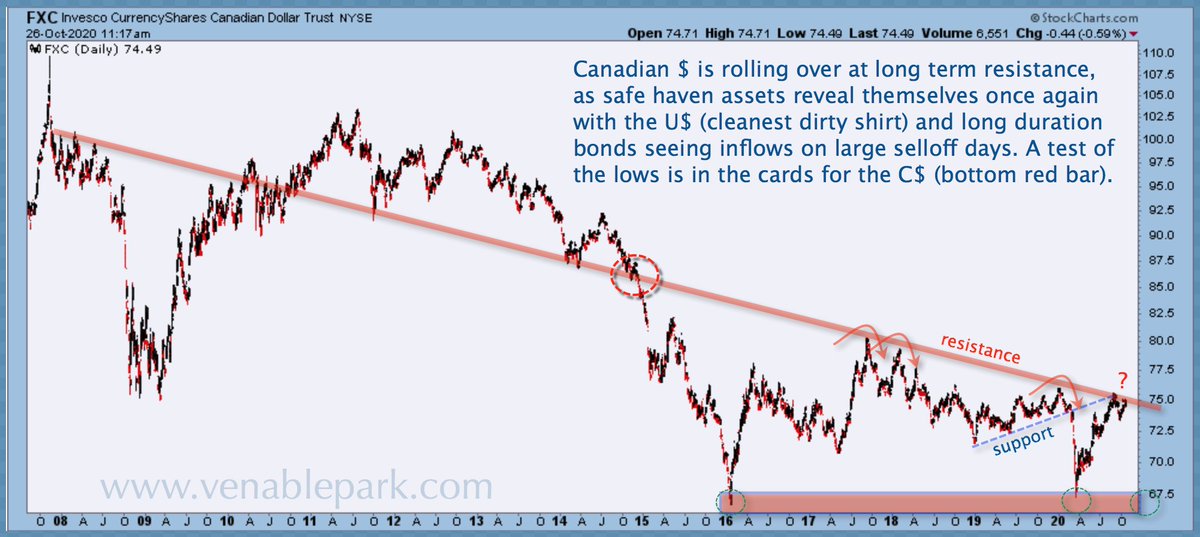
After bouncing 10% between March 20 and September 1, the Canadian dollar continues its allegiance with risk assets, dropping 1% against the US dollar today and rolling over at the 74.50 resistance range, highlighted in my partner Cory Venable’s chart below since 2007.  A restest of the March low in the .67 area (pink band below) is likely as recession and an equity bear market continue into 2021.

With global demand faltering afresh, the Bank of Canada is stuck near zero (.25% on overnight rate) and already buying 4 billion in government bonds weekly (which they dialled back from $5 bn).  There is no more monetary cavalry to rescue zombie borrowers and highly levered asset holders.

Oil (WTI -6% today), back under $38 a barrel knows it, with another retest in the $18 to $25 range likely ahead (as we noted in our September month-end client letter).

With just five TSX companies in the green today, even index-leader Shopify (-5.8% on the day) can’t catch a bid.  The heavy-weight oil and gas sector (now 11.8% of the TSX index) is -55% in 2020, and the widely held Canadian banks are wallowing:  -22% since February 20.  As shown in Cory’s chart below of the financial index (XFN), a nasty head and shoulders formation beckons Canadian financials (31.6% of the TSX) to give up ill-gotten gains as the fruit of their reckless lending years now rots.


More sustainable business models are needed and, fortunately, they exist.

Lower asset prices are essential in restoring attractive investment opportunities.  Waiting for them to materialize can be hard, but not nearly as hard as holding them while they drop.

Posted in Main Page | Comments Off on Loonie, oil and Canadian financials, all in this together