‘SPAC’ and gambling in today’s greater recession

Never before have so many companies with no revenue pursued a public market listing at such high valuations.  The froth is particularly evident in sectors like online gambling and nascent start-up companies.  See:  EV start-ups are Wall Street’s hot new thing.  No revenue? No problem:

Companies at such a nascent stage are inherently risky and are typically funded by venture-capital investors as they build out assembly lines and sales operations. Instead, these startups are going public at a far earlier stage than is standard by merging with blank-check companies, before they have proven that they can manufacture their product or that they have a viable business model. Blank-check companies are publicly traded shell companies that merge with private companies, enabling the private firms to sidestep an initial public offering.

Even EV companies with world-changing, first-in-class products like Tesla offer gambling-grade investment prospects when priced at crazy multiples of sales and profits.  Earning 50 cents a share over the past four quarters, at $422, Tesla shares are trading more than 840 times trailing earnings.  See:  Tesla stock price still makes no sense.

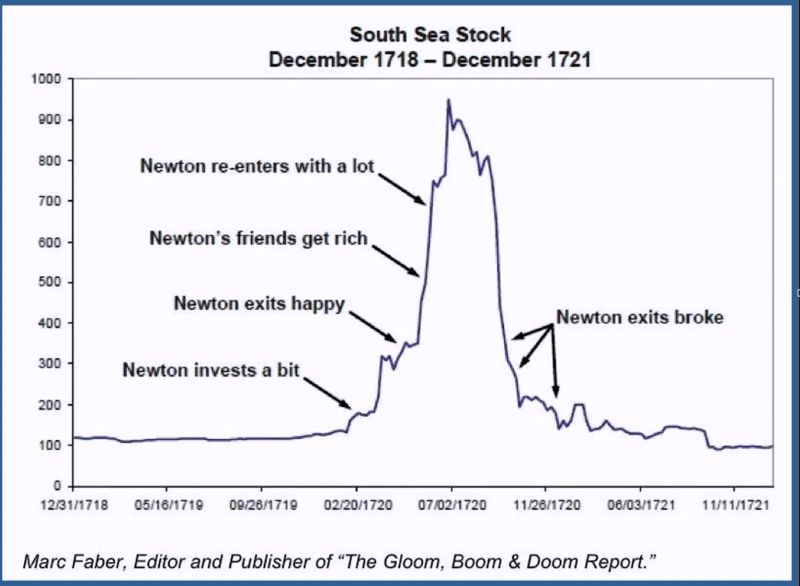
Tesla shares and other ‘FAANG’-like favourites will be remembered (by those with financial memory, at least) as hallmarks of the 2017-2020 mania that was,  just as many other tech and pharma names were after 2000, and commodity and financial shares after 2008. The companies may well survive and thrive, but their present stockholders are unlikely to do as well.

Today’s speculative mania is evident in the appetite for special purpose acquisition companies (SPAC)–“blank check” shell corporations designed to take companies public without going through the traditional IPO process with investor protections. SPACs lure retail investors to invest in private equity-type transactions, particularly leveraged buyouts, and the financial sector reaps fortunes packaging and selling the products to the gullible and reckless.

Short-seller Jim Chanos, President & Founder of Kynikos Associates, discussed SPAC, Tesla, rampant financial fraud and more with Hedgeye CEO Keith McCullough in a “Hedgeye Investing Summit” interview last week.  Here is a direct video link.

Posted in Main Page | Comments Off on ‘SPAC’ and gambling in today’s greater recession

Lending and buying frenzy has bubble hallmarks

Living one hour north of Toronto, the COVID-19 home-buying frenzy is readily apparent.  Prices have appreciated more than 20% year over year, and “Coming Soon” signs turn into “Sold” within days.  Many properties don’t even make it to an MLS listing.

A realty lawyer friend told me yesterday that she is having the busiest transaction year of her 20-year practice.  I asked if she saw many all-cash deals, and she laughed, “no, all highly financed.”

As government bond yields have plunged with the economy year to date, mortgage rates (which are priced off the 30-year bond yield in the US and the 5-year in Canada) have fallen with them.  Central banks have been buying up mortgages to prop up prices (further suppress rates) and keep the game going.

Meanwhile, some 11 percent of mortgage borrowers from large Canadian banks — representing around $175 billion of mortgage debt — are not making payments. Up to 20% of mortgages under deferral are considered a higher risk of default. See Don’t be alarmed, but as much as 20% of Canadian mortgages are at a ‘higher risk of defaulting’:

We are most concerned about borrowers on a deferral program who are unemployed (and were receiving the Canada Emergency Response Benefit, or CERB) and borrowers on a deferral program who are employed but are earning less than what they earned pre-COVID,” wrote RBC analyst Darko Mihelic and senior associate Sanly Li in a report earlier this week.

“We are also concerned about borrowers not on a deferral program but are facing some form of financial hardship. If 20 per cent of mortgages under deferral eventually become delinquent in Canada, this equates to a mortgage delinquency rate of 2.3 per cent which is almost 4 times higher than the peak Canadian mortgage delinquency rate over the past 30 years…”

Simultaneously, appraisers are running ragged with increased pressure to rubber-stamp prices so that ‘deals’ and refinancings can close.  This is all classic debt and price bubble indicia.

Similar patterns are playing out south of the border where the U.S. Mortgage Bankers Association’s refinancing index soared in March to its highest level since 2012 and remains more than 40% above its year-ago level despite some 13 million Americans being out of work and relying on weekly jobless benefits from the government.

As Danielle DiMartino-Booth explains in Mortgage-Refinancing Boom is too automated, all this activity is further aided by automated appraisal waivers, which replace human appraisers with a computer-generated model that draws values from the latest comparables where the mortgage is being refinanced.

As in the 2005-06 US housing bubble, automated lending assessments in a highly levered and quickly rising price environment are ripe for disaster.  Danielle discussed these issues in the podcast below, with many cross-over points to conditions in Canada today.

Phil welcomes Danielle DiMartino Booth to the show! Danielle breaks down the economic dangers of “Appraisal Waivers” at FHA and the GSE. Here is a direct video link.

Posted in Main Page | Comments Off on Lending and buying frenzy has bubble hallmarks

Revolving door between finance and government is part of our downfall

America has become the gold standard for abuse of trust but the model is evident all over the world.

It’s one of the biggest conflicts of interest and we act like it doesn’t exist. Why do we allow people to go from Wall Street, to Washington, back to Wall Street again? Here is a direct video link.

Posted in Main Page | Comments Off on Revolving door between finance and government is part of our downfall